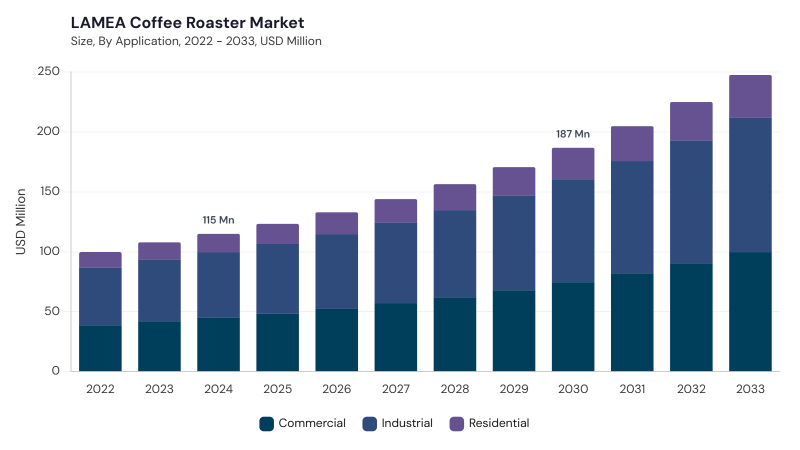
The LAMEA Coffee Roaster Market is expected to reach USD 170.6 million by 2029, growing at a CAGR of 9.3% during (2026 - 2033).
The LAMEA Coffee Roaster Market evolved from small-scale manual roasting practices into a more structured ecosystem combining artisanal craftsmanship with mechanized and digitally controlled production. Basic gas and electric roasters progressively gave way to computer-controlled equipment, advanced temperature profiling, automated airflow management, and scalable processing systems. Expanding urban coffee culture, specialty consumption, and local processing activities further encouraged modernization across Latin America, the Middle East, and Africa. Current development increasingly emphasizes smart roasting, energy efficiency, traceability, localized flavor profiles, flexible batch processing, and technologies capable of balancing regional authenticity with higher production consistency.
Specialty coffee, local value-added processing, sustainability, and digital integration are shaping current market development. Roasters are increasingly adopting IoT-enabled monitoring, programmable roast curves, automated temperature controls, energy-efficient burners, predictive maintenance, and low-emission technologies to improve consistency and reduce operating costs. Growing interest in single-origin coffee, artisanal roasting, traceable sourcing, localized processing, and small-format roasting units is also widening equipment demand. At the same time, high capital requirements, limited technical infrastructure, skilled workforce shortages, regulatory complexity, energy costs, and uneven access to service networks continue to influence modernization and scalability across LAMEA.
Based on Application, the market is segmented into Industrial, Commercial, and Residential. The Industrial market dominated the LAMEA Coffee Roaster Market by Application in 2025, and would continue to be a dominant market till 2033; thereby, achieving a market value of USD 78.9 million by 2029, growing at a CAGR of 8.7 % during the forecast period. The Commercial market is expected to witness a CAGR of 9.7% during (2026 - 2033). Additionally, The Residential market is expected to witness highest CAGR of 10.2% during (2026 - 2033).
Industrial applications require high-capacity systems with automated temperature regulation, batch monitoring, energy management, emissions control, and consistent processing across varied bean origins. Commercial applications serve cafés, hotels, specialty roasteries, and independent coffee businesses requiring flexible batch sizes, programmable roasting curves, and differentiated flavor development. Residential applications remain smaller but are gradually expanding as home enthusiasts seek compact, easy-to-use roasters offering greater control over freshness, roast intensity, and bean experimentation, supported by growing specialty coffee education and e-commerce accessibility.
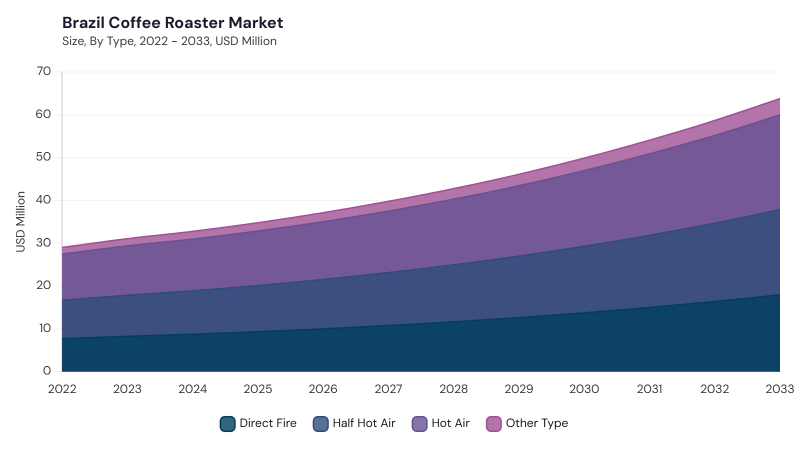
Based on Type, the market is segmented into Hot Air, Half Hot Air, Direct Fire, and Other Type. Hot Air roasters use convection-based heating to provide even thermal distribution, reduce scorching risk, and support detailed flavor development across specialty and medium-scale applications. Half Hot Air systems combine convection and conduction, offering a balance between throughput, flexibility, and roast control for growing commercial operators.
Direct Fire roasters remain relevant among artisanal and traditional businesses seeking robust flavor characteristics and comparatively simpler operating structures. Other Type includes fluidized-bed, microwave-assisted, hybrid, electric, and other emerging roasting technologies focused on energy efficiency, compact design, sustainability, and advanced process control.
Free Valuable Insights: Coffee Roaster Market Size Worth USD 2619.5 Million billion by 2033
Based on Country, the market is segmented into Brazil, Argentina, UAE, Saudi Arabia, South Africa, Nigeria, and Rest of LAMEA. The Brazil market dominated the LAMEA Coffee Roaster Market by Country in 2025, and would continue to be a dominant market till 2033; thereby, achieving a market value of USD 46.1 million by 2029, growing at a CAGR of 8 % during the forecast period. The Argentina market is expected to witness a CAGR of 9.9% during (2026 - 2033). Additionally, The UAE market is expected to witness a CAGR of 8.2% during (2026 - 2033).
Across LAMEA, coffee roasting development is being shaped by specialty consumption, localization, sustainability, digitalization, and stronger domestic processing ecosystems. Brazil emphasizes value-added roasting, single-origin products, IoT-enabled equipment, energy efficiency, and traceable sourcing, while Argentina focuses on specialty coffee, micro-roasting, digital roast curves, sustainability, and personalized profiles. The UAE is advancing premium roasting, integrated café-roastery models, circular practices, automation, and digital customer engagement, whereas Saudi Arabia emphasizes specialty coffee, localized processing, Arabic coffee heritage, IoT-enabled roasting, and national coffee-sector development. South Africa focuses on electric roasting, ethical sourcing, specialty coffee, traceability, and environmentally responsible operations, while Nigeria emphasizes domestic roasting capacity, premium blends, digital sales, supply chain transparency, and energy-efficient equipment. Rest of LAMEA continues to develop smart roasting, small-scale systems, sustainable technologies, localized flavor profiles, and digitally connected equipment suited to varied infrastructure and consumer preferences.

By Application
By Type
By Country
Set to reach $170.6 Million by 2029, growing at 9.3% CAGR during 2026-2033.
Brazil leads with $46.1 million by 2029, growing at 8% CAGR during the forecast period.
The Residential segment is expected to witness the highest CAGR of 10.2% during 2026-2033.
The Industrial segment will reach $78.9 million by 2029, growing at 8.7% CAGR during the forecast period.
The UAE market is expected to witness a CAGR of 8.2% during 2026-2033.
The Argentina market is expected to witness a CAGR of 9.9% during 2026-2033.
Our team of dedicated experts can provide you with attractive expansion opportunities for your business.




 Unique Offerings
