The sample copy of this report is available for access.
The North America Carrier Screening Market is expected to reach USD 1.4 billion by 2032, growing at a CAGR of 11.8% during (2026 – 2033).
The North America Carrier Screening Market developed alongside advances in genetic science, prenatal care, and molecular diagnostics. Early carrier screening was focused on selected hereditary conditions and high-risk populations, using limited panels for disorders such as cystic fibrosis and Tay-Sachs disease. Over time, polymerase chain reaction, microarray platforms, and next-generation sequencing expanded the ability to detect a broader range of inherited conditions with improved accuracy. The shift from ethnicity-based testing toward expanded and more universal screening models changed clinical adoption patterns.
The North America Carrier Screening Market is being shaped by rising awareness of inherited diseases, wider use of expanded panels, growing reproductive health planning, direct-to-consumer genetic testing, and stronger clinical integration of genomics. Healthcare providers are using carrier screening to support prenatal care, fertility planning, population-risk assessment, and early identification of hereditary disease risks. Demand is supported by declining sequencing costs, improved bioinformatics, expanding genetic counseling models, and the normalization of genomic testing in preventive healthcare. Vendors are focusing on broader gene panels, faster turnaround times, AI-supported variant interpretation, digital patient engagement, and secure data management.
Based on Type, the market is segmented into Expanded and Targeted Disease. The Expanded market dominated the North America Carrier Screening Market by Type in 2025, and would continue to be a dominant market till 2033; thereby, achieving a market value of USD 914.4 million by 2032, growing at a CAGR of 11.5 % during the forecast period. The Targeted Disease market is expected to witness a CAGR of 12.4% during (2026 - 2033).
Expanded leads due to rising preference for comprehensive testing that evaluates many inherited disorders through a single screening panel. It supports broader reproductive risk assessment by moving beyond ancestry-specific testing and enabling more inclusive carrier detection across diverse populations. Targeted Disease remains important where specific conditions, family history, population risk, or cost-sensitive clinical decisions guide testing choices. This segment continues to be used for well-established disorders such as cystic fibrosis, Tay-Sachs disease, sickle cell disease, and other conditions with known carrier patterns, strong clinical familiarity, and clear counseling pathways.
Based on Technology, the market is segmented into DNA Sequencing, Polymerase Chain Reaction, Microarrays, and Other Technology. The DNA Sequencing market dominated the North America Carrier Screening Market by Technology in 2025, and would continue to be a dominant market till 2033; thereby, achieving a market value of USD 646.6 million by 2032, growing at a CAGR of 11.2 % during the forecast period. The Polymerase Chain Reaction market is expected to witness a CAGR of 12.1% during (2026 - 2033). The Other Technology market is expected to witness a CAGR of 12.4% during (2026 - 2033).
DNA Sequencing leads due to its broad mutation detection capability, high sensitivity, and strong integration into next-generation carrier screening workflows. It enables laboratories to assess multiple genes and variants in a single process, improving clinical utility for expanded panels and diverse population screening. Polymerase Chain Reaction remains widely used for rapid and reliable targeted mutation analysis where known variants are being evaluated. Microarrays support multiplex screening of several known variants in high-throughput settings, while Other Technology includes emerging molecular diagnostic methods, digital PCR, specialized genotyping tools, and platforms being explored for faster, more accessible carrier testing.
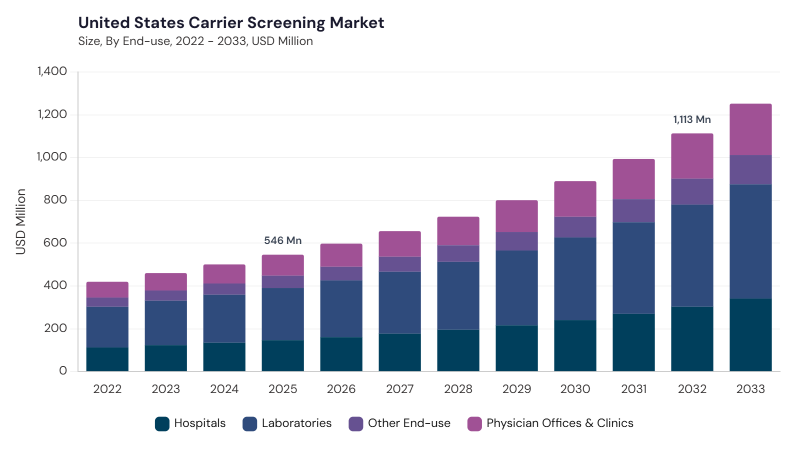
Based on End-use, the market is segmented into Laboratories, Hospitals, Physician Offices & Clinics, and Other End-use. The Laboratories market dominated the North America Carrier Screening Market by End-use in 2025, and would continue to be a dominant market till 2033; thereby, achieving a market value of USD 609.5 million by 2032, growing at a CAGR of 11.2 % during the forecast period. The Hospitals market is expected to witness a CAGR of 12% during (2026 - 2033). Additionally, The Physician Offices & Clinics market is expected to witness highest CAGR of 12.7% during (2026 - 2033).
Laboratories lead due to advanced molecular diagnostic infrastructure, high testing volumes, specialized sequencing platforms, bioinformatics capabilities, and strong quality control processes. These facilities support broad panel testing, sample processing, variant interpretation, and result reporting for hospitals, clinics, fertility centers, and physician referrals. Hospitals contribute through integration of carrier screening into prenatal care, reproductive medicine, maternal-fetal health, and clinical genetics programs. Physician Offices & Clinics support early patient education, sample collection, preconception screening, and referral pathways, while Other End-use includes fertility centers, academic institutions, research programs, and specialized healthcare facilities.
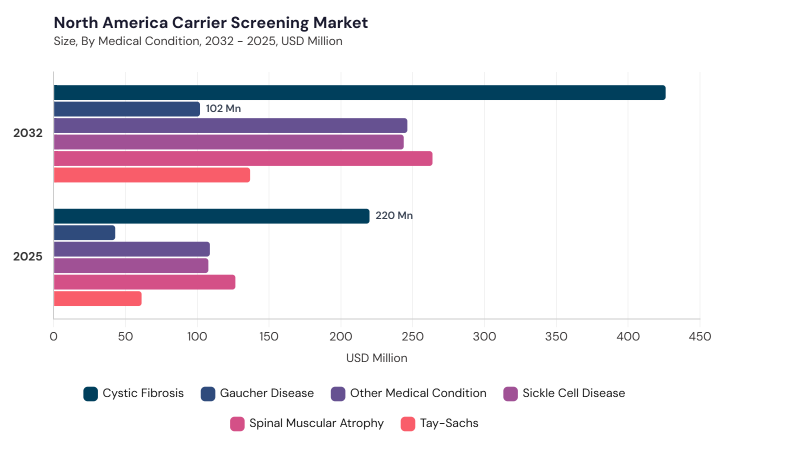
Based on Medical Condition, the market is segmented into Cystic Fibrosis, Spinal Muscular Atrophy, Sickle Cell Disease, Tay-Sachs, Gaucher Disease, and Other Medical Condition. Cystic Fibrosis leads due to established screening guidelines, strong clinician awareness, routine inclusion in reproductive testing, and its long-standing role in carrier screening programs. Spinal Muscular Atrophy is gaining importance as clinical awareness, genetic medicine advancements, and early detection priorities support broader screening.
Sickle Cell Disease maintains demand through targeted screening among higher-risk populations and public health awareness around inherited blood disorders. Tay-Sachs and Gaucher Disease remain important in population-specific and expanded panels, while Other Medical Condition gains support from broad screening panels covering rare metabolic, neuromuscular, and inherited disorders.
Free Valuable Insights: The Global Carrier Screening Market will hit USD 3.9 Billion billion by 2033, at a CAGR of 12.3%
Based on Country, the market is segmented into US, Canada, Mexico, and Rest of North America. The US market dominated the North America Carrier Screening Market by Country in 2025, and would continue to be a dominant market till 2033; thereby, achieving a market value of USD 1.1 billion by 2032, growing at a CAGR of 11.1 % during the forecast period. The Canada market is expected to witness a CAGR of 14.7% during (2026 - 2033). Additionally, The Mexico market is expected to witness a CAGR of 13.7% during (2026 - 2033).
The US leads due to strong adoption of expanded carrier screening, advanced sequencing infrastructure, digital health integration, direct-to-consumer testing availability, and broad clinical use in prenatal and fertility care. Canada supports market growth through pan-ethnic screening demand, genomic testing adoption, ethical data governance, and increased use of digital counseling tools. Mexico is advancing through broader access to carrier screening panels, telemedicine-enabled genetic counseling, public health interest, and improved clinical awareness around reproductive risk assessment. Rest of North America benefits from expanded panels, quality-focused laboratory services, direct-to-consumer models, regulatory standardization, and growing integration of carrier screening into reproductive healthcare pathways.

By Type
By Technology
By End-use
By Medical Condition
By Country
Set to reach $1.4 Billion by 2032, growing at 11.8% CAGR during 2026-2033.
The US leads with $1.1 billion by 2032, growing at 11.1% CAGR during the forecast period.
Rising demand for expanded screening, reaching $914.4 million by 2032 at 11.5% CAGR during the forecast period.
DNA Sequencing will achieve $646.6 million by 2032, growing at 11.2% CAGR during the forecast period.
The Canada market is expected to witness a CAGR of 14.7% during 2026-2033.
Physician Offices & Clinics are expected to witness the highest CAGR of 12.7% during 2026-2033.
Our team of dedicated experts can provide you with attractive expansion opportunities for your business.




 Unique Offerings