The sample copy of this report is available for access.
The Asia Pacific Carrier Screening Market is expected to reach USD 683.3 million by 2030, growing at a CAGR of 13% during (2026 – 2033).
The Asia Pacific Carrier Screening Market developed from early genetic testing programs that focused on single-disorder screening among high-risk groups. Initial testing relied on conventional molecular methods and was mainly available through specialized healthcare centers. Over time, advances in molecular genetics, next-generation sequencing, microarrays, and bioinformatics expanded screening from limited tests to broader multi-condition panels. This shift became important because Asia Pacific has highly diverse ethnic groups, mutation patterns, and inherited disease profiles. Today, the market reflects a growing preventive genetics ecosystem shaped by expanded panels, public health initiatives, genetic counseling, localized mutation databases, and improving access to reproductive healthcare.
The Asia Pacific Carrier Screening Market is being shaped by rising awareness of inherited disorders, expanding healthcare infrastructure, and wider adoption of advanced genomic technologies. Healthcare providers are using carrier screening for prenatal care, preconception planning, fertility treatment, maternal health programs, and population-specific risk assessment. Demand is supported by government initiatives, declining sequencing costs, digital health platforms, and growing acceptance of preventive genetic testing. Vendors are focusing on region-specific gene panels, AI-supported variant interpretation, tele-genetic counseling, decentralized sample collection, and faster reporting systems.
Based on Type, the market is segmented into Expanded and Targeted Disease. The Expanded market dominated the Asia Pacific Carrier Screening Market by Type in 2025, and would continue to be a dominant market till 2033; thereby, achieving a market value of USD 445.4 million by 2030, growing at a CAGR of 12.6 % during the forecast period. The Targeted Disease market is expected to witness a CAGR of 13.6% during (2026 - 2033).
Expanded leads due to rising use of comprehensive screening panels that assess multiple inherited conditions through a single test. It is gaining preference in urban hospitals, fertility centers, and advanced diagnostic laboratories where broader reproductive risk assessment is becoming more common. Targeted Disease remains important for screening disorders that are highly prevalent in specific populations or communities. This segment continues to support cost-effective testing for conditions such as thalassemia, cystic fibrosis, sickle cell disease, Tay-Sachs disease, and other inherited disorders where focused screening is clinically practical.
Based on Technology, the market is segmented into DNA Sequencing, Polymerase Chain Reaction, Microarrays, and Other Technology. The DNA Sequencing market dominated the Asia Pacific Carrier Screening Market by Technology in 2025, and would continue to be a dominant market till 2033; thereby, achieving a market value of USD 316.4 million by 2030, growing at a CAGR of 12.4 % during the forecast period. The Polymerase Chain Reaction market is expected to witness a CAGR of 13.2% during (2026 - 2033). The Other Technology market is expected to witness a CAGR of 13.7% during (2026 - 2033).
DNA Sequencing leads due to its ability to detect a wide range of genetic variants with high accuracy and strong suitability for expanded screening panels. Its adoption is supported by growing NGS infrastructure, genomic research investment, and increasing laboratory capacity across major Asia Pacific economies. Polymerase Chain Reaction remains important because it is affordable, rapid, familiar to clinical laboratories, and useful for detecting known mutations. Microarrays support medium-scale variant analysis and population-based testing, while Other Technology includes digital PCR, MLPA, FISH, biosensor-based assays, and other emerging diagnostic methods used in specialized testing settings.
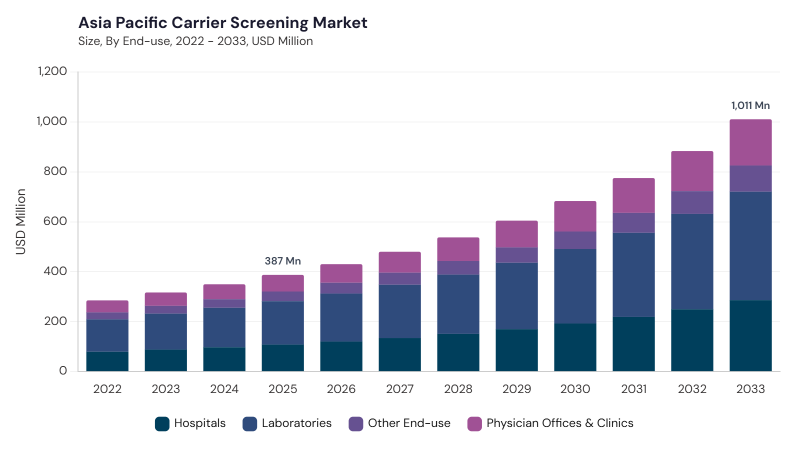
Based on End-use, the market is segmented into Laboratories, Hospitals, Physician Offices & Clinics, and Other End-use. The Laboratories market dominated the Asia Pacific Carrier Screening Market by End-use in 2025, and would continue to be a dominant market till 2033; thereby, achieving a market value of USD 298.5 million by 2030, growing at a CAGR of 12.3 % during the forecast period. The Hospitals market is expected to witness a CAGR of 13.2% during (2026 - 2033). Additionally, The Physician Offices & Clinics market is expected to witness highest CAGR of 13.9% during (2026 - 2033).
Laboratories lead due to expanding diagnostic networks, high-throughput testing capacity, advanced sequencing systems, quality control processes, and bioinformatics capabilities. These facilities support carrier screening for hospitals, fertility centers, clinics, public health programs, and direct testing channels. Hospitals contribute through integration of carrier screening into prenatal care, fertility services, obstetrics, and maternal health programs. Physician Offices & Clinics support early-risk assessment, patient education, sample collection, and preconception counseling, while Other End-use includes fertility centers, diagnostic centers, research institutions, and government screening programs.
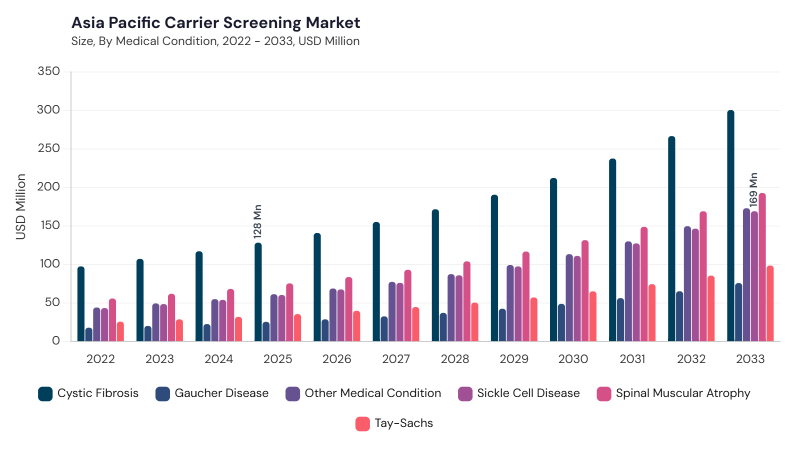
Based on Medical Condition, the market is segmented into Cystic Fibrosis, Spinal Muscular Atrophy, Sickle Cell Disease, Tay-Sachs, Gaucher Disease, and Other Medical Condition. Cystic Fibrosis leads due to rising awareness of inherited disorders and increasing inclusion of CF-related variants within broader carrier screening panels. Spinal Muscular Atrophy is gaining importance as early detection priorities, genetic medicine advancements, and public health initiatives support wider carrier testing.
Sickle Cell Disease maintains demand through targeted screening in affected populations and hereditary blood disorder programs. Tay-Sachs and Gaucher Disease remain relevant in selective screening and expanded panels, while Other Medical Condition gains support from thalassemia variants, fragile X syndrome, metabolic disorders, rare diseases, and population-specific inherited conditions.
Free Valuable Insights: Carrier Screening Market is Predicted to reach USD 3.9 Billion billion by 2033, at a CAGR of 12.3%
Based on Country, the market is segmented into China, Japan, India, South Korea, Singapore, Malaysia, and Rest of Asia Pacific. The China market dominated the Asia Pacific Carrier Screening Market by Country in 2025, and would continue to be a dominant market till 2033; thereby, achieving a market value of USD 184.3 million by 2030, growing at a CAGR of 10.9 % during the forecast period. The Japan market is expected to witness a CAGR of 12.2% during (2026 - 2033). Additionally, The India market is expected to witness a CAGR of 13.7% during (2026 - 2033).
China leads due to strong genomic testing capacity, expanding prenatal care programs, advanced laboratory networks, population-specific databases, and growing integration of carrier screening into reproductive health services. Japan supports market growth through preventive healthcare adoption, NGS-based panels, genetic counseling, and localized testing for population-specific variants. India is advancing through rising awareness, high inherited disease burden, expanding diagnostics infrastructure, and affordable genetic testing models. South Korea, Singapore, and Malaysia add momentum through precision medicine programs, government health initiatives, digital counseling, and genomic data integration, while Rest of Asia Pacific benefits from public health screening, fertility services, localized panels, and broader genetic testing access.

By Type
By Technology
By End-use
By Medical Condition
By Country
Set to reach $683.3 Million by 2030, growing at 13% CAGR during 2026-2033.
China leads with $184.3 million by 2030, growing at a 10.9% CAGR during the forecast period.
Rising demand for expanded carrier screening, projected to hit $445.4 million by 2030.
DNA Sequencing will reach $316.4 million by 2030, growing at a 12.4% CAGR during the forecast period.
The India market is expected to witness a CAGR of 13.7% during 2026-2033.
The Laboratories segment will reach $298.5 million by 2030, growing at a 12.3% CAGR during the forecast period.
Our team of dedicated experts can provide you with attractive expansion opportunities for your business.




 Unique Offerings