The sample copy of this report is available for access.
The LAMEA Carrier Screening Market is expected to reach USD 158.3 million by 2029, growing at a CAGR of 14.7% during (2026 – 2033).
The LAMEA Carrier Screening Market developed from the rising need to identify hereditary disease risks across Latin America, the Middle East, and Africa. Early carrier screening relied mainly on single-gene tests and basic molecular approaches for common inherited disorders within specific ethnic or high-risk groups. Over time, advances in molecular biology, sequencing platforms, and bioinformatics enabled broader multi-gene testing with improved accuracy and clinical relevance. The adoption of next-generation sequencing helped shift screening from narrow disease-specific testing toward expanded reproductive risk assessment.
The LAMEA Carrier Screening Market is being shaped by the rising burden of inherited disorders, expanding genomic medicine, healthcare modernization, and growing awareness among prospective parents. Healthcare providers are using carrier screening to support reproductive planning, prenatal care, premarital testing, fertility services, and targeted public health programs. Demand is supported by government initiatives, laboratory infrastructure investment, digital health platforms, and increasing use of AI-assisted variant interpretation. Vendors are focusing on comprehensive panels, region-specific genetic coverage, faster turnaround time, tele-genetics, secure data handling, and cost-efficient testing models.
Based on Type, the market is segmented into Expanded and Targeted Disease. The Expanded market dominated the LAMEA Carrier Screening Market by Type in 2025, and would continue to be a dominant market till 2033; thereby, achieving a market value of USD 104.6 million by 2029, growing at a CAGR of 14.3 % during the forecast period. The Targeted Disease market is expected to witness a CAGR of 15.4% during (2026 - 2033).
Expanded leads due to increasing use of comprehensive panels that assess multiple inherited disorders through a single test. It is gaining preference as healthcare systems and diagnostic providers move toward broader reproductive risk assessment across genetically diverse populations. Targeted Disease remains important for high-risk groups, family-history-based evaluation, and region-specific hereditary disease screening. This segment continues to support focused testing for conditions such as sickle cell disease, thalassemia, cystic fibrosis, Tay-Sachs disease, and other disorders where targeted screening offers clinical relevance, affordability, and practical use in routine care.
Based on Technology, the market is segmented into DNA Sequencing, Polymerase Chain Reaction, Microarrays, and Other Technology. The DNA Sequencing market dominated the LAMEA Carrier Screening Market by Technology in 2025, and would continue to be a dominant market till 2033; thereby, achieving a market value of USD 74.5 million by 2029, growing at a CAGR of 14.1 % during the forecast period. The Polymerase Chain Reaction market is expected to witness a CAGR of 14.9% during (2026 - 2033). The Other Technology market is expected to witness a CAGR of 15.5% during (2026 - 2033).
DNA Sequencing leads due to its ability to detect common, rare, and population-specific genetic variants with strong accuracy across broad screening panels. Its adoption is supported by increasing use of next-generation sequencing in reference laboratories, specialized diagnostic centers, and reproductive healthcare programs. Polymerase Chain Reaction remains important because it is accessible, rapid, cost-efficient, and widely used for identifying known mutations in clinical settings. Microarrays support high-throughput variant analysis, while Other Technology includes digital PCR, isothermal amplification, biosensor-based assays, and emerging molecular diagnostic tools used in specialized and decentralized testing applications.
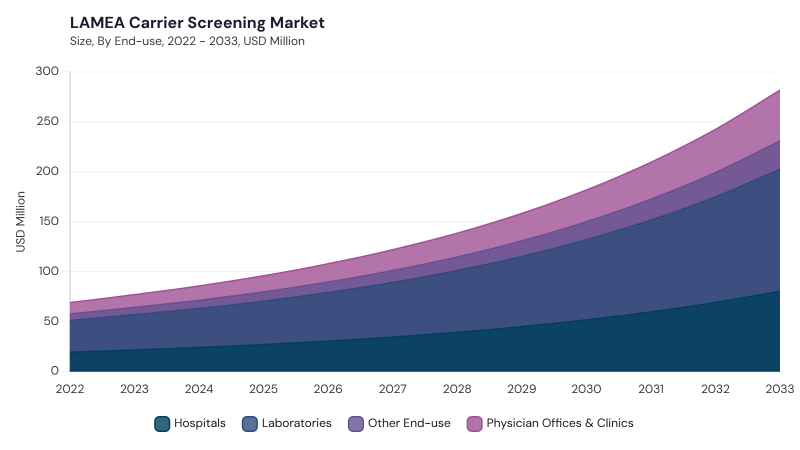
Based on End-use, the market is segmented into Laboratories, Hospitals, Physician Offices & Clinics, and Other End-use. The Laboratories market dominated the LAMEA Carrier Screening Market by End-use in 2025, and would continue to be a dominant market till 2033; thereby, achieving a market value of USD 70.3 million by 2029, growing at a CAGR of 14 % during the forecast period. The Hospitals market is expected to witness a CAGR of 14.9% during (2026 - 2033). Additionally, The Physician Offices & Clinics market is expected to witness highest CAGR of 15.7% during (2026 - 2033).
Laboratories lead due to expanding diagnostic capabilities, centralized genetic testing services, sequencing infrastructure, sample processing capacity, and bioinformatics expertise. These facilities support broad carrier screening panels for hospitals, clinics, fertility centers, research programs, and public health initiatives. Hospitals contribute through integration of carrier screening into prenatal care, maternal-fetal health, fertility treatment, and specialty genetics services. Physician Offices & Clinics support patient education, risk assessment, referrals, and sample collection, while Other End-use includes fertility centers, genetic counseling centers, academic institutions, mobile testing units, and specialized genomic research facilities.
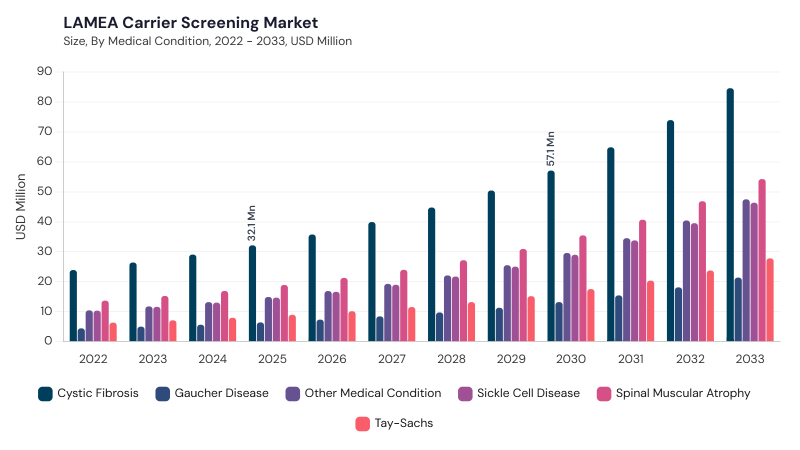
Based on Medical Condition, the market is segmented into Cystic Fibrosis, Spinal Muscular Atrophy, Sickle Cell Disease, Tay-Sachs, Gaucher Disease, and Other Medical Condition. Cystic Fibrosis leads due to increasing use of standardized genetic screening protocols and growing awareness of inherited diseases within reproductive healthcare. Spinal Muscular Atrophy is gaining importance as molecular diagnostics improve and prenatal screening access expands across selected healthcare systems.
Sickle Cell Disease maintains strong relevance due to its higher burden in several LAMEA populations and continued use of targeted screening initiatives. Tay-Sachs and Gaucher Disease remain important in selective screening and expanded panels, while Other Medical Condition gains support from hemophilia, thalassemia, fragile X syndrome, metabolic disorders, and rare hereditary diseases.
Free Valuable Insights: Carrier Screening Market Size Worth USD 3.9 Billion billion by 2033
Based on Country, the market is segmented into Brazil, Argentina, UAE, Saudi Arabia, South Africa, Nigeria, and Rest of LAMEA. The Brazil market dominated the LAMEA Carrier Screening Market by Country in 2025, and would continue to be a dominant market till 2033; thereby, achieving a market value of USD 39.0 million by 2029, growing at a CAGR of 13.2 % during the forecast period. The Argentina market is expected to witness a CAGR of 16.1% during (2026 - 2033). Additionally, The UAE market is expected to witness a CAGR of 13.7% during (2026 - 2033).
Brazil leads due to increasing adoption of expanded panels, AI-supported genetic interpretation, public-private collaboration, and rising integration of genetic screening into preventive healthcare. Argentina supports market growth through NGS adoption, population-specific screening, public health partnerships, and improved carrier detection across diverse genetic backgrounds. The UAE contributes through premarital screening programs, regulatory support, expanded panels, digital health integration, and strong investment in genetic testing infrastructure. Saudi Arabia, South Africa, and Nigeria add momentum through premarital screening, sickle cell disease prevention, localized panels, tele-genetics, and laboratory capacity development, while Rest of LAMEA benefits from decentralized testing, public health programs, and broader access to reproductive genetic services.

By Type
By Technology
By End-use
By Medical Condition
By Country
Set to reach $158.3 Million by 2029, growing at 14.7% CAGR during (2026 – 2033).
Brazil leads with $39.0 million by 2029, growing at a CAGR of 13.2% during the forecast period.
The Expanded market segment will achieve $104.6 million by 2029, growing at a 14.3% CAGR during the forecast period.
DNA Sequencing will reach $74.5 million by 2029, growing at a 14.1% CAGR during the forecast period.
The Argentina market is expected to witness a CAGR of 16.1% during (2026 - 2033).
The Laboratories segment will reach $70.3 million by 2029, with a 14% CAGR during the forecast period.
Our team of dedicated experts can provide you with attractive expansion opportunities for your business.




 Unique Offerings