
The North America Bread Mix Market is expected to reach USD 168.7 million by 2032, growing at a CAGR of 5.4% during (2026 - 2033).
The North America Bread Mix Market evolved alongside the region’s established packaged food and commercial bakery industries as consumers and professional bakers increasingly sought convenience, consistency, and reduced preparation time. Early mixes primarily combined flour, yeast, leavening agents, and functional ingredients for household and foodservice baking, while expanding industrial bakery operations encouraged standardized formulations capable of delivering uniform dough performance at scale. Advances in milling, ingredient stabilization, enzyme technology, automated blending, and moisture-resistant packaging improved shelf life and product reliability. The market subsequently diversified into whole grain, multigrain, gluten-free, organic, artisan-style, high-protein, sourdough, pizza, and other specialty formulations addressing broader dietary and culinary preferences.
Clean-label ingredients, nutritional enrichment, premiumization, specialty diets, artisan baking, digital retail, and manufacturing automation are shaping current market development. Consumers increasingly seek organic, gluten-free, low-carbohydrate, high-fiber, protein-enriched, non-GMO, and naturally formulated mixes with greater ingredient transparency. Manufacturers are incorporating ancient grains, seeds, plant proteins, prebiotic fibers, alternative flours, and other functional ingredients while improving sensory quality and preparation convenience. E-commerce and direct-to-consumer channels are expanding access for niche brands, while automated blending, packaging, quality control, and supply-chain technologies support production efficiency. However, volatile raw-material costs, regulatory and labeling complexity, supply-chain disruptions, competition from freshly baked products, and formulation challenges associated with clean-label alternatives continue to influence market development.
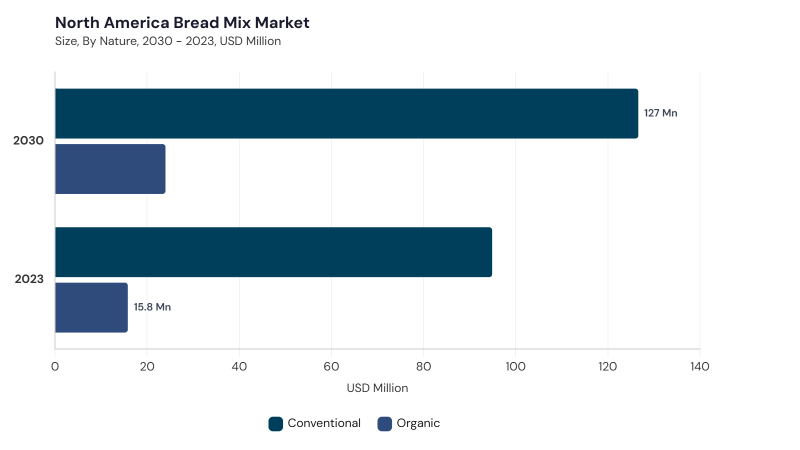
Based on Nature, the market is segmented into Conventional and Organic. The Conventional market dominated the North America Bread Mix Market by Nature in 2025, and would continue to be a dominant market till 2033; thereby, achieving a market value of USD 141.0 million by 2032, growing at a CAGR of 5.1 % during the forecast period. The Organic market is expected to witness a CAGR of 7% during (2026 - 2033).
Conventional bread mixes use standard flour, leavening agents, additives, preservatives, and other ingredients to provide predictable baking performance, cost efficiency, and compatibility with white, wheat, multigrain, and other mainstream bread varieties. The segment continues to adapt through reformulation aimed at improving fiber content, reducing sodium, and enhancing ingredient transparency. Organic bread mixes use certified organic grains and ingredients produced without synthetic pesticides, fertilizers, or genetically modified organisms, appealing to consumers prioritizing natural sourcing and clean-label positioning. Organic adoption is expanding across specialty and mainstream retail channels, although higher ingredient costs, certification requirements, seasonal availability, and more demanding quality-control processes affect scalability.
Based on Distribution Channel, the market is segmented into Retail and Foodservice. The Foodservice market dominated the North America Bread Mix Market by Distribution Channel in 2025, and would continue to be a dominant market till 2033; thereby, achieving a market value of USD 121.9 million by 2032, growing at a CAGR of 5.2 % during the forecast period. The Retail market is expected to witness a CAGR of 6.1% during (2026 - 2033).
Retail distribution serves households and individual consumers through supermarkets, grocery stores, specialty food outlets, health-focused stores, and online platforms offering packaged bread mixes for convenient home preparation. Demand is supported by home baking, specialty diets, product variety, clean-label preferences, and growing digital shopping. Foodservice distribution serves restaurants, cafés, bakeries, institutional kitchens, catering operations, and other professional users requiring bulk mixes with dependable quality, scalability, and standardized baking performance. Labor shortages, operating efficiency requirements, menu diversification, and demand for artisan and specialty breads are encouraging foodservice operators to use standardized mixes capable of reducing preparation complexity while maintaining consistent output.
Based on Retail, the market is segmented into Supermarkets & Hypermarkets, Online, Convenience Stores, and Other Retail. Supermarkets & Hypermarkets are characterized as the principal retail channel in the provided content because of their broad product assortments, shelf visibility, consumer traffic, and ability to accommodate both mainstream and specialty bread mix products. Supermarkets & Hypermarkets provide extensive selections of conventional, whole-grain, organic, high-fiber, protein-enriched, and specialty mixes supported by promotions, private labels, and omnichannel merchandising.
Online retail is expanding through e-commerce platforms and manufacturer websites that provide wider assortment, nutritional information, reviews, subscription options, and direct access to niche products. Convenience Stores emphasize accessibility, compact packaging, recognizable brands, and quick-purchase formats suited to convenience-oriented consumers. Other Retail includes specialty food stores, bakeries, health-food outlets, ethnic retailers, and discount stores, supporting demand for artisan, organic, allergen-free, ethnic, premium, and value-oriented bread mixes across diverse consumer groups.
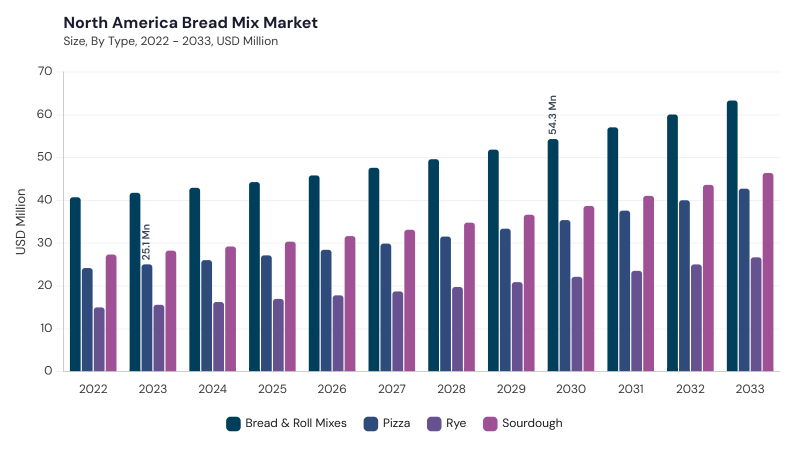
Based on Type, the market is segmented into Bread & Roll Mixes, Sourdough Mixes, Pizza Mixes, and Rye Mixes. Bread & Roll Mixes provide pre-measured formulations for white, wheat, multigrain, and various roll products, benefiting from convenience, widespread familiarity, clean-label reformulation, and improved shelf-life technologies. Sourdough Mixes simplify fermentation-based baking while addressing consumer interest in artisan preparation, natural processes, distinctive flavor, and premium bread experiences.
Pizza Mixes are formulated for crust elasticity, texture, and preparation consistency across household and foodservice applications, including different pizza styles and healthier crust variants. Rye Mixes serve a more specialized market associated with traditional European-style breads, artisanal positioning, dietary variety, and higher-fiber formulations, with improved blending technologies helping address density and texture challenges.
Free Valuable Insights: The Global Bread Mix Market will hit USD 632.2 Million billion by 2033, at a CAGR of 6.1%
Based on Country, the market is segmented into US, Canada, Mexico, and Rest of North America. The US market dominated the North America Bread Mix Market by Country in 2025, and would continue to be a dominant market till 2033; thereby, achieving a market value of USD 124.0 million by 2032, growing at a CAGR of 4.7 % during the forecast period. The Canada market is expected to witness a CAGR of 7.6% during (2026 - 2033). Additionally, The Mexico market is expected to witness a CAGR of 6.7% during (2026 - 2033).
Across North America, bread mix demand reflects differences in dietary preferences, ingredient sourcing, baking traditions, retail structures, and technological adoption. The US emphasizes clean-label formulations, non-GMO ingredients, specialty grains, gluten-free products, automated manufacturing, sustainable sourcing, e-commerce, and personalized digital engagement, while Canada focuses on whole grains, organic ingredients, gluten-free and low-GI formulations, sustainable supply chains, local ingredient partnerships, and digital retail. Mexico combines traditional baking preferences with enriched formulations, whole grains, functional ingredients, user-friendly packaging, local sourcing, industrial automation, and expanding e-commerce, whereas Rest of North America increasingly emphasizes clean-label compositions, enzyme technologies, automated production, regional flavor adaptation, localized manufacturing, sustainable sourcing, and solutions balancing artisan quality with commercial production consistency.
By Country
Set to reach $168.7 Million by 2032, growing at 5.4% CAGR during 2026-2033.
The US leads with $124.0 million by 2032, growing at a CAGR of 4.7% during 2026-2033.
The Conventional segment dominates, reaching $141.0 million by 2032, with a 5.1% CAGR during 2026-2033.
The Organic segment is expected to witness a CAGR of 7% during 2026-2033.
The Canada market is expected to witness a CAGR of 7.6% during 2026-2033.
The Foodservice segment will reach $121.9 million by 2032, growing at a 5.2% CAGR during 2026-2033.
Our team of dedicated experts can provide you with attractive expansion opportunities for your business.



 Unique Offerings
