
“Global Bread Mix Market to reach a market value of USD 632.26 Million by 2033 growing at a CAGR of %”
The Global Bread Mix Market is expected to reach USD 632.3 million by 2033, growing at a CAGR of 6.1% during (2026 - 2033).
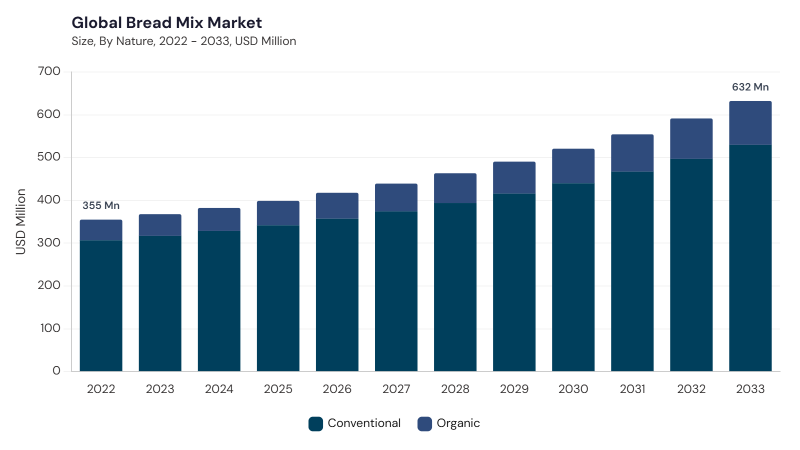
Growing demand for convenient baking solutions, expanding home baking trends, consistent product quality, time-saving preparation, and rising bakery consumption is driving the Bread Mix Market across households, foodservice operators, artisanal bakeries, and commercial baking facilities. Adoption is further strengthened by clean-label ingredients, healthier bakery options, gluten-free alternatives, organic formulations, functional nutrition, specialty bread mixes, customized flavor profiles, and wider availability through supermarkets, specialty stores, foodservice channels, and e-commerce platforms.
Growth in the Bread Mix Market is driven by convenience, consistency, health-focused reformulation, and rising demand for accessible bakery solutions across household and commercial settings. Bread mixes reduce preparation complexity while helping users achieve predictable baking outcomes across bread, rolls, sourdough, pizza crusts, rye breads, and specialty bakery products. Foodservice operators and commercial bakeries use mixes to improve production efficiency, reduce labor dependency, control ingredient variability, and maintain standardized quality. Consumer demand is also expanding through home baking, premium artisanal products, specialty diets, online grocery access, and ready-to-use baking formats that combine convenience with product variety.
The competitive environment is fragmented and bakery-ingredients-driven, with global bakery ingredient suppliers, industrial premix manufacturers, yeast and fermentation specialists, retail baking-mix brands, regional flour millers, private-label suppliers, and specialty natural-food companies competing across the market. Puratos Group, Bakels Group, Sonneveld Group, AB Mauri, and CSM Ingredients maintain strong B2B bakery-solution positions through mixes, bread improvers, sourdough systems, fermentation technologies, technical support, and professional bakery relationships. General Mills, King Arthur Baking Company, Royal Zeelandia Group, Bob’s Red Mill Natural Foods, and Continental Mills strengthen the market through retail baking mixes, premium home-baking products, gluten-free and whole-grain offerings, packaged convenience, and brand-led consumer engagement.
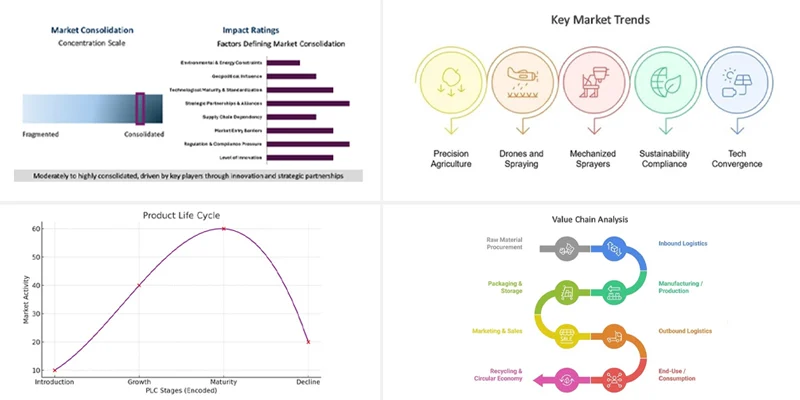

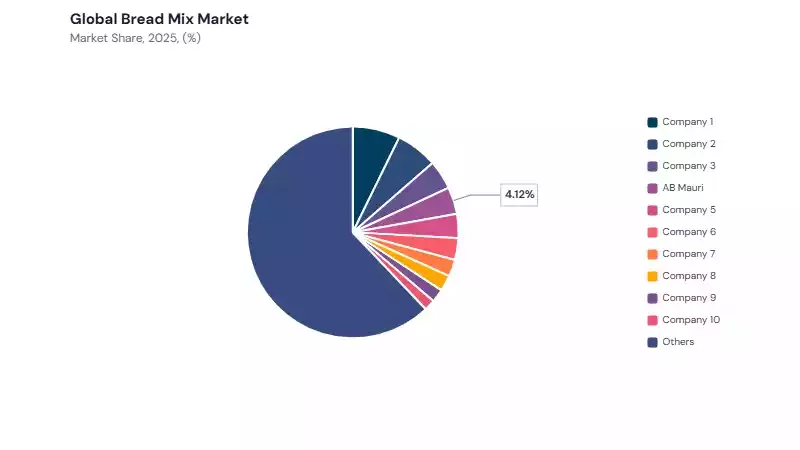
The global Bread Mix Market reflects a highly fragmented, bakery-ingredients-led, and regionally diverse competitive structure, with global bakery ingredient suppliers, industrial premix manufacturers, yeast and fermentation specialists, retail baking-mix brands, flour millers, private-label suppliers, artisan bakery specialists, and local premix producers competing across multiple customer groups. Puratos Group leads the identified competitive set through its broad bakery ingredient portfolio, global bakery relationships, sourdough systems, bread improvers, enzymes, grains, and specialty bakery solutions. Bakels Group, Sonneveld Group, AB Mauri, and CSM Ingredients strengthen the professional bakery tier through bread mixes, concentrates, improvers, fermentation technologies, functional ingredients, and regional formulation capabilities.
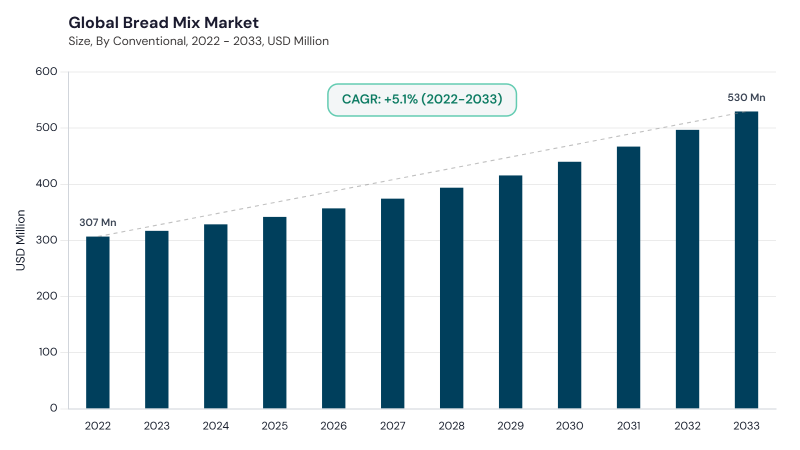
Based on Nature, the market is segmented into Conventional and Organic. The Conventional market dominated the Global Bread Mix Market by Nature in 2025, and would continue to be a dominant market till 2033; thereby, achieving a market value of USD 529.7 million by 2033, growing at a CAGR of 5.8 % during the forecast period. The Organic market is expected to witness a CAGR of 7.8% during (2026 - 2033).
Conventional bread mixes remain the core nature category due to their broad affordability, stable supply chains, high-volume manufacturing suitability, and compatibility with mass-market bakery needs. These mixes are widely used across households, retail channels, foodservice operators, and commercial bakeries that prioritize cost efficiency, shelf stability, consistent dough performance, and reliable product availability. Organic bread mixes represent a smaller but expanding category supported by demand for certified organic grains, clean-label ingredients, non-GMO positioning, sustainable agriculture, and food purity. Organic mixes are gaining relevance among health-conscious consumers, premium retailers, specialty stores, and brands focused on traceable sourcing, natural formulations, and environmentally responsible bakery products.
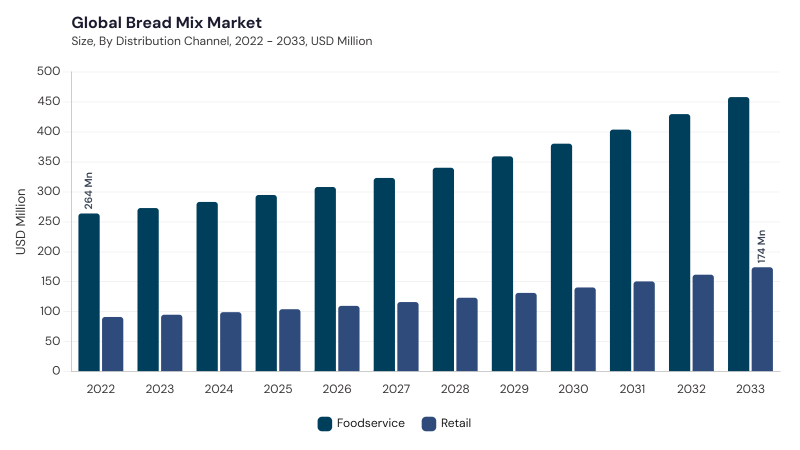
Based on Distribution Channel, the market is segmented into Foodservice and Retail. The Foodservice market dominated the Global Bread Mix Market by Distribution Channel in 2025, and would continue to be a dominant market till 2033; thereby, achieving a market value of USD 458.1 million by 2033, growing at a CAGR of 5.8 % during the forecast period. The Retail market is expected to witness a CAGR of 6.8% during (2026 - 2033).
Foodservice remains important as bakeries, hotels, restaurants, cafés, catering operators, quick-service outlets, and institutional kitchens use bread mixes for bulk production, consistent quality, labor savings, and operational efficiency. Commercial users require mixes that deliver predictable dough handling, texture, volume, taste, and shelf-life performance across different production environments. Retail channels serve household consumers and smaller baking users through supermarkets, hypermarkets, convenience stores, specialty outlets, health-food stores, online platforms, and brand-owned digital channels. Retail demand is supported by home baking, clean-label choices, small pack sizes, recipe-driven usage, specialty diets, convenience, and growing online discovery of premium or niche bread mix products.
Retail segment again segmented into Supermarkets & Hypermarkets, Online, Convenience Stores, and Other Retail. Supermarkets & Hypermarkets remain a major retail format because they provide high product visibility, broad assortment, promotional reach, private-label participation, and access to mainstream household buyers. Online channels are expanding through e-commerce platforms, brand websites, digital grocery apps, customer reviews, subscription models, and access to specialty bread mixes beyond local store availability. Convenience Stores serve quick-purchase and smaller-format demand, supporting consumers seeking easy-to-prepare baking solutions in urban and high-traffic locations. Other Retail includes specialty stores, health-food outlets, bakeries, local grocers, and niche retailers that support organic, artisanal, ethnic, gluten-free, vegan, allergen-free, and premium bread mix products.
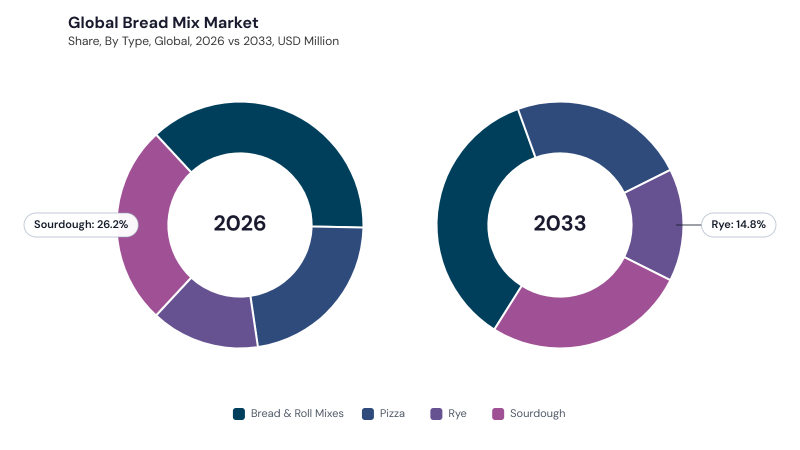
Based on Type, the market is segmented into Bread & Roll Mixes, Sourdough, Pizza, and Rye. The Bread & Roll Mixes market dominated the Global Bread Mix Market by Type in 2025, and would continue to be a dominant market till 2033; thereby, achieving a market value of USD 224.7 million by 2033, growing at a CAGR of 5.4 % during the forecast period. The Sourdough market is expected to witness a CAGR of 6.3% during (2026 - 2033). Additionally, The Pizza market is expected to witness highest CAGR of 6.6% during (2026 - 2033).
Bread & Roll Mixes remain the broadest type category due to their everyday use across white bread, whole wheat bread, multigrain bread, dinner rolls, soft rolls, and commercial bakery applications. These mixes support convenient preparation, consistent results, and wide compatibility across household and foodservice settings. Sourdough mixes are gaining importance through demand for natural fermentation, artisanal flavor, premium bread experiences, and digestibility-oriented positioning. Pizza mixes support home cooking, pizzerias, restaurants, foodservice operators, and ready-to-use dough preparation across different crust styles. Rye mixes serve a niche but meaningful category linked to heritage breads, whole-grain preferences, fiber-rich diets, regional traditions, and specialty bakery demand.
Free Valuable Insights: Bread Mix Market Size to reach $632.2 Million by 2033
Region-wise, the Bread Mix Market is analyzed across North America, Europe, Asia Pacific, and LAMEA. The Europe market dominated the Global Bread Mix Market by Region in 2025, and would continue to be a dominant market till 2033; thereby, achieving a market value of $223.0 million by 2033, growing at a CAGR of 5.9 % during the forecast period. The Asia Pacific market is expected to witness a CAGR of 6.7% during (2026 - 2033). Additionally, The LAMEA market is expected to witness a CAGR of 7.3% during (2026 - 2033).
North America benefits from strong packaged food adoption, commercial bakery maturity, home baking interest, clean-label demand, gluten-free products, and expanding retail and e-commerce availability across the US, Canada, Mexico, and Rest of North America. Europe is shaped by traditional bread culture, artisan and sourdough demand, organic and clean-label adoption, rye and specialty bread consumption, and strong food safety and sustainability expectations across Germany, the UK, France, Russia, Spain, Italy, and Rest of Europe. Asia Pacific is expanding through urbanization, western-style bakery consumption, organized retail growth, foodservice development, home baking interest, and rising demand across China, Japan, India, South Korea, Singapore, Malaysia, and Rest of Asia Pacific. LAMEA is developing through bakery modernization, retail expansion, foodservice growth, affordability-focused mixes, localized flavors, and gradual adoption of convenient baking solutions across Brazil, Argentina, UAE, Saudi Arabia, South Africa, Nigeria, and Rest of LAMEA.
| Report Attribute | Details |
|---|---|
| Market size value in 2026 | USD 417.7 million |
| Market size forecast in 2033 | USD 632.2 million |
| Base Year | 2025 |
| Historical Period | 2022 to 2024 |
| Forecast Period | 2026 to 2033 |
| Revenue Growth Rate | CAGR of 6.1% from 2026 to 2033 |
| Number of Pages | 562 |
| Tables | 480 |
| Report Coverage | Market Trends, Revenue Estimation and Forecast, Segmentation Analysis, Regional and Country Breakdown, Competitive Landscape, Market Share Analysis, Company Profiling, Companies Strategic Developments, SWOT Analysis, Product Life Cycle Analysis, Value Chain Analysis, Market Consolidation Analysis, Key Customer Criteria, Pandemic Impact Analysis, and Winning Imperatives |
| Segments Covered | Nature, Distribution Channel, Retail, Type, and Geography |
| Country Scope |
|
| Companies Included | Puratos Group; Bakels Group; Sonneveld Group; AB Mauri; CSM Ingredients; General Mills, Inc.; King Arthur Baking Company; Royal Zeelandia Group; Bob’s Red Mill Natural Foods; Continental Mills, Inc. |
By Geography
Expected to reach USD 632.3 million by 2033, growing at 6.1% CAGR during the forecast period (2026-2033).
No specific segment leadership data provided.
Puratos Group, Bakels Group, Sonneveld Group, AB Mauri, CSM Ingredients, General Mills, Inc., King Arthur Baking Company, Royal Zeelandia Group, Bob’s Red Mill Natural Foods, Continental Mills, Inc.
No specific regional dominance data provided.
Rising consumer demand for convenient baking solutions and emphasis on food safety and quality standards.
No specific current market size data provided for 2026.
Our team of dedicated experts can provide you with attractive expansion opportunities for your business.




 Unique Offerings
