
The Asia Pacific Bread Mix Market is expected to reach USD 142.9 million by 2030, growing at a CAGR of 6.7% during (2026 - 2033).
The Asia Pacific Bread Mix Market evolved from traditional baking practices involving manual combination of flour and other dry ingredients toward standardized, ready-to-use formulations designed for greater convenience and consistency. Improvements in milling, ingredient formulation, preservation, packaging, and industrial automation gradually enhanced product quality, shelf life, and manufacturing scalability. Rising urbanization and the expansion of organized bakery production further accelerated adoption across households, commercial bakeries, and foodservice establishments. The incorporation of fortified flours, alternative grains, cleaner ingredient systems, and specialty formulations broadened product diversity, while expanding supermarkets and e-commerce channels improved accessibility across developed and emerging Asia Pacific economies.
Health-oriented formulations, clean-label ingredients, regional flavor customization, sustainability, e-commerce, and advanced manufacturing are shaping current market development. Consumers increasingly seek gluten-free, high-fiber, low-carbohydrate, fortified, multigrain, organic, and naturally formulated mixes that combine convenience with nutritional value. Manufacturers are responding through functional ingredients, plant-based additives, regional flavor profiles, improved dough performance, automated blending, digital quality control, and packaging innovations suited to diverse climatic conditions. Expanding bakery chains, cafés, hotels, institutional foodservice, and online grocery platforms are widening commercial opportunities. However, raw-material volatility, fragmented food regulations, technological gaps, infrastructure limitations, strong price sensitivity, and competition from fresh and artisanal bakery products continue to influence adoption.
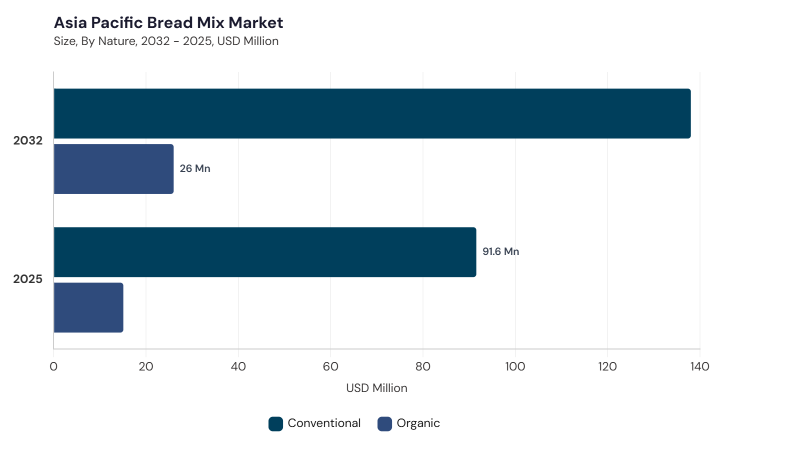
Based on Nature, the market is segmented into Conventional and Organic. The Conventional market dominated the Asia Pacific Bread Mix Market by Nature in 2025, and would continue to be a dominant market till 2033; thereby, achieving a market value of USD 120.9 million by 2030, growing at a CAGR of 6.4 % during the forecast period. The Organic market is expected to witness a CAGR of 8.4% during (2026 - 2033).
Conventional bread mixes use standard wheat flour, leavening agents, preservatives, and functional additives to provide consistent texture, shelf stability, and predictable baking performance across household and commercial applications. Their affordability and established supply networks support broad adoption, while manufacturers increasingly reformulate products with cleaner labels and enhanced nutritional profiles. Organic bread mixes use certified organic ingredients and appeal to consumers prioritizing natural sourcing, food safety, sustainability, and reduced synthetic inputs. Rising disposable incomes and health awareness are supporting organic adoption, although higher ingredient costs, certification requirements, fragmented supply chains, and limited scale continue to restrict broader penetration.
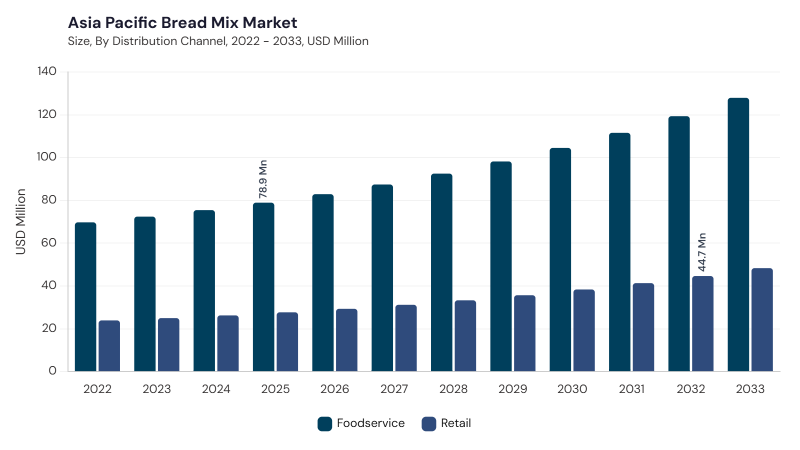
Based on Distribution Channel, the market is segmented into Retail and Foodservice. The Foodservice market dominated the Asia Pacific Bread Mix Market by Distribution Channel in 2025, and would continue to be a dominant market till 2033; thereby, achieving a market value of USD 104.5 million by 2030, growing at a CAGR of 6.4 % during the forecast period. The Retail market is expected to witness a CAGR of 7.4% during (2026 - 2033).
Retail distribution serves households, home bakers, and smaller bakery operators through supermarkets, hypermarkets, convenience stores, specialty outlets, and online platforms. This channel benefits from rising home-baking interest, growing urban populations, product diversification, digital shopping, and demand for easy-to-use specialty mixes. Foodservice distribution serves commercial bakeries, hotels, restaurants, cafés, catering operations, and institutional customers requiring bulk quantities, standardized quality, and reliable product performance. Expansion of hospitality and foodservice infrastructure, adoption of automated bakery equipment, demand for consistent output, and the need for customized formulations are strengthening professional use of bread mixes across the region.
Based on Retail, the market is segmented into Supermarkets & Hypermarkets, Online, Convenience Stores, and Other Retail. Supermarkets & Hypermarkets represent an important retail channel, offering extensive assortments, competitive pricing, private-label options, strong product visibility, and access to conventional and specialty bread mixes. Online retail is expanding rapidly through e-commerce marketplaces, specialty food platforms, and direct-to-consumer websites that improve access to niche, premium, and health-oriented products beyond major urban centers.
.Convenience Stores address quick-purchase demand through compact and easy-to-use formats suited to fast-paced lifestyles, while Other Retail includes independent grocery stores, specialty outlets, bakery supply stores, and local retailers serving region-specific preferences. Digital merchandising, AI-supported demand forecasting, localized assortments, and broader omnichannel integration are progressively reshaping retail distribution.
Based on Type, the market is segmented into Bread & Roll Mixes, Sourdough Mixes, Pizza Mixes, and Rye Mixes. Bread & Roll Mixes cover white bread, whole wheat, multigrain, and soft-roll formulations used by home bakers and commercial bakeries seeking convenience and consistent output. Sourdough Mixes address growing demand for natural fermentation, premium artisanal characteristics, improved digestibility, and cleaner ingredient profiles while simplifying traditional starter preparation.
Pizza Mixes support expanding quick-service, restaurant, delivery, and home-meal applications by providing consistent crust texture and preparation efficiency. Rye Mixes remain more specialized, serving consumers seeking dense texture, distinctive flavor, higher-fiber positioning, and European-style bakery products, with blended formulations helping adapt rye-based products to regional taste preferences.
Free Valuable Insights: Bread Mix Market is Predicted to reach USD 632.2 Million billion by 2033, at a CAGR of 6.1%
Based on Country, the market is segmented into China, Japan, India, South Korea, Singapore, Malaysia, and Rest of Asia Pacific. The China market dominated the Asia Pacific Bread Mix Market by Country in 2025, and would continue to be a dominant market till 2033; thereby, achieving a market value of USD 48.5 million by 2030, growing at a CAGR of 5.1 % during the forecast period. The Japan market is expected to witness a CAGR of 5.9% during (2026 - 2033). Additionally, The India market is expected to witness a CAGR of 7.5% during (2026 - 2033).
Across Asia Pacific, bread mix development reflects differences in dietary preferences, bakery traditions, health awareness, technology adoption, and retail infrastructure. China emphasizes health-oriented formulations, e-commerce, automated manufacturing, clean-label ingredients, and localized flavors such as red bean, green tea, and sesame, while Japan focuses on whole grains, reduced additives, natural ingredients, smart kitchen integration, sustainable packaging, and mixes adapted to softer texture preferences. India is advancing millet-based, gluten-free, vegan, fortified, and convenient ready-to-bake formulations alongside automated production and wider digital distribution, whereas South Korea emphasizes natural ingredients, fiber enrichment, specialty grains, localized flavors, e-commerce, and AI-supported manufacturing. Singapore focuses on clean-label and functional mixes, sustainable sourcing, advanced ingredient systems, automated bakery production, and premium customization, while Malaysia emphasizes enzyme technologies, localized formulations, multicultural flavor adaptation, automated blending, and bakery-industry collaboration. Rest of Asia Pacific continues to develop functional nutrition, regional flavors, natural preservatives, e-commerce, sustainable packaging, localized production, and value-added formulations suited to varied consumer and bakery requirements.

By Country
Set to reach $142.9 Million by 2030, growing at 6.7% CAGR during 2026-2033.
China leads with $48.5 million by 2030, growing at a CAGR of 5.1% during the forecast period.
The Organic segment is expected to witness a CAGR of 8.4% during 2026-2033.
The Conventional segment will achieve $120.9 million by 2030, growing at a CAGR of 6.4% during the forecast period.
India is expected to witness a CAGR of 7.5% during 2026-2033.
The Foodservice channel will achieve $104.5 million by 2030, growing at a CAGR of 6.4% during the forecast period.
Our team of dedicated experts can provide you with attractive expansion opportunities for your business.



 Unique Offerings
