
The LAMEA Bread Mix Market is expected to reach USD 39.8 million by 2029, growing at a CAGR of 7.3% during (2026 - 2033).
The LAMEA Bread Mix Market evolved alongside expanding demand for convenient food products across Latin America, the Middle East, and Africa, where urbanization and changing lifestyles encouraged simpler baking solutions. Early products relied on dry blending technologies that extended shelf life, eased transportation, and supported consistent preparation, while later advances introduced enriched ingredients, improved preservation, localized flavor profiles, and stronger packaging performance. Expansion of multinational food manufacturers and regional producers broadened market availability, while improved retail infrastructure and e-commerce accelerated consumer access. Current development combines affordability, localized formulations, premium variants, advanced processing, sustainable sourcing, and integrated distribution to address highly diverse culinary and socioeconomic conditions.
Convenience, health-oriented formulations, localization, sustainability, and digital distribution are shaping current market development. Consumers increasingly seek wholegrain, gluten-free, fortified, organic, high-protein, and clean-label mixes that provide nutritional value while reducing preparation time. Manufacturers are responding with functional ingredients, locally relevant grains, culturally adapted formulations, improved preservation, eco-friendly packaging, and automated production technologies. Growing supermarkets, online grocery platforms, bakeries, cafés, hotels, and foodservice operations are improving market accessibility, while digital marketing strengthens consumer engagement. However, high production costs, volatile ingredient prices, fragmented regulations, limited raw-material availability, strong price sensitivity, infrastructure gaps, and continued preference for traditionally baked bread remain important constraints.
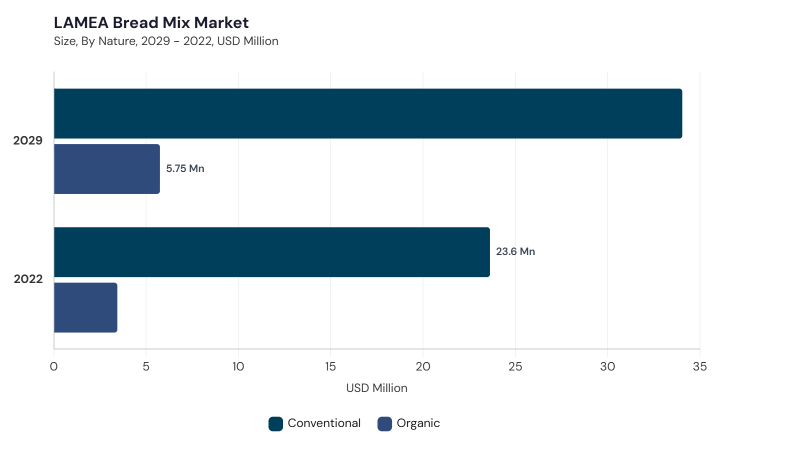
Based on Nature, the market is segmented into Conventional and Organic. The Conventional market dominated the LAMEA Bread Mix Market by Nature in 2025, and would continue to be a dominant market till 2033; thereby, achieving a market value of USD 34.0 million by 2029, growing at a CAGR of 7 % during the forecast period. The Organic market is expected to witness a CAGR of 9.2% during (2026 - 2033).
Conventional bread mixes primarily contain standard wheat flour, yeast, additives, preservatives, and functional ingredients designed to provide reliable performance, shelf stability, and cost efficiency. Manufacturers increasingly adapt these formulations to local bread preferences while improving nutrition and reducing unnecessary additives. Organic bread mixes use certified organic grains and ingredients produced without synthetic fertilizers, pesticides, or artificial additives, appealing to consumers prioritizing health, natural sourcing, and environmental responsibility. Demand is expanding among affluent urban consumers, specialty retailers, and artisanal bakeries, although higher production costs, limited organic grain supply, certification complexity, and premium pricing continue to restrict broader adoption.
Based on Distribution Channel, the market is segmented into Retail and Foodservice. The Foodservice market dominated the LAMEA Bread Mix Market by Distribution Channel in 2025, and would continue to be a dominant market till 2033; thereby, achieving a market value of USD 29.4 million by 2029, growing at a CAGR of 7 % during the forecast period. The Retail market is expected to witness a CAGR of 8.1% during (2026 - 2033).
Retail serves households and individual consumers through supermarkets, hypermarkets, convenience stores, specialty outlets, and increasingly integrated digital platforms. This channel benefits from urbanization, rising disposable incomes, home baking, product diversification, improved packaging, and omnichannel accessibility. Foodservice includes bakeries, cafés, hotels, restaurants, catering operations, schools, hospitals, and other institutional users requiring bulk quantities, consistent quality, and specialized formulations. Demand in this channel is influenced by tourism, urban dining, quick-service expansion, menu diversification, labor efficiency, and growing use of health-oriented and customized bread mixes suited to professional baking environments.
Based on Retail, the market is segmented into Supermarkets & Hypermarkets, Online, Convenience Stores, and Other Retail. Supermarkets & Hypermarkets are characterized as the dominant retail channel in the provided content, supported by broad product assortments, organized distribution, promotional activity, private-label offerings, and strong reach among urban and semi-urban consumers. Supermarkets & Hypermarkets provide conventional and specialty bread mixes across multiple price points while supporting bulk purchases, promotional programs, and growing product visibility.
Online retail is gaining traction through e-commerce and grocery delivery platforms offering wider assortment, detailed information, subscription options, and access to niche or artisanal products. Convenience Stores cater to quick purchases and smaller pack sizes suited to time-constrained consumers, while Other Retail includes independent grocery outlets, local markets, specialty health stores, and bakery supply stores serving regional and dietary niches. Expanding digital payments, improved logistics, tailored packaging, and localized assortment strategies are progressively reshaping retail access across LAMEA.
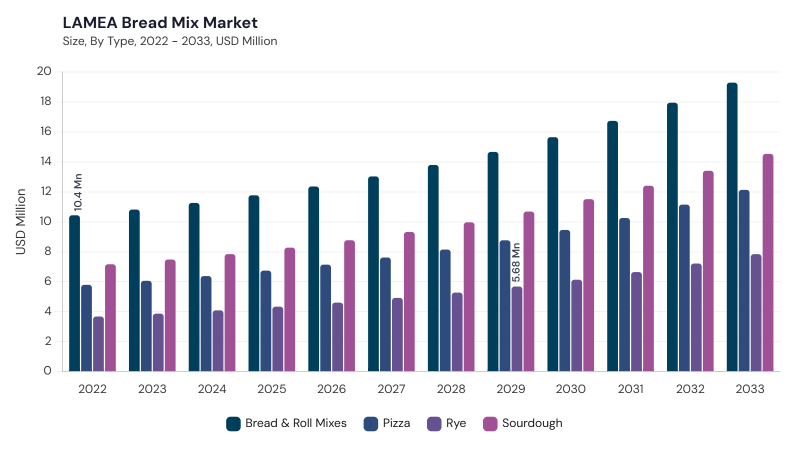
Based on Type, the market is segmented into Bread & Roll Mixes, Sourdough, Pizza, and Rye. Bread & Roll Mixes hold a foundational position in the market, supporting white, whole wheat, multigrain, and roll products used by households, bakeries, and institutional kitchens seeking convenience and consistent preparation. Sourdough mixes address growing demand for natural fermentation, artisanal flavor, improved digestibility, and premium bakery experiences while simplifying starter preparation.
Pizza mixes support pizzerias, foodservice operators, and home users requiring consistent dough texture and preparation efficiency, with gluten-free and whole wheat variants widening appeal. Rye mixes remain more specialized, serving consumers seeking denser texture, heritage-style breads, higher-fiber positioning, and distinctive grain profiles, particularly within niche and culturally influenced markets.
Free Valuable Insights: Bread Mix Market Size Worth USD 632.2 Million billion by 2033
Based on Country, the market is segmented into Brazil, Argentina, UAE, Saudi Arabia, South Africa, Nigeria, and Rest of LAMEA. The Brazil market dominated the LAMEA Bread Mix Market by Country in 2025, and would continue to be a dominant market till 2033; thereby, achieving a market value of USD 10.1 million by 2029, growing at a CAGR of 6 % during the forecast period. The Argentina market is expected to witness a CAGR of 8.5% during (2026 - 2033). Additionally, The UAE market is expected to witness a CAGR of 5.8% during (2026 - 2033).
Across LAMEA, bread mix development reflects varying culinary traditions, income levels, health priorities, retail maturity, and manufacturing capabilities. Brazil emphasizes functional ingredients, artisanal mixes, local grain sourcing, e-commerce, and automated processing, while Argentina focuses on gluten-free formulations, alternative flours, organic ingredients, traceability, and digitally enabled distribution. The UAE combines health-oriented products, multicultural formulations, smart manufacturing, sustainable packaging, and specialized mixes suited to local climatic conditions, whereas Saudi Arabia emphasizes fortification, local production, e-commerce, automation, and customized formulations aligned with food-security priorities. South Africa focuses on fortified products, alternative grains, convenience, sustainable sourcing, and automated quality control, while Nigeria emphasizes cassava and sorghum integration, mechanized production, shelf-life improvement, local sourcing, and enriched formulations. Rest of LAMEA continues to develop health-oriented, organic, sustainable, localized, and digitally distributed bread mixes adapted to diverse regional tastes and infrastructure conditions.

By Country
Set to reach $39.8 Million by 2029, growing at 7.3% CAGR during 2026-2033.
Brazil leads with $10.1 million by 2029, growing at a CAGR of 6% during the forecast period.
The Conventional segment dominates, reaching $34.0 million by 2029 at a CAGR of 7% during 2026-2033.
The Organic segment is expected to grow at a CAGR of 9.2% during 2026-2033.
The UAE market is expected to witness a CAGR of 5.8% during 2026-2033.
The Foodservice channel is set to reach $29.4 million by 2029, growing at a CAGR of 7% during 2026-2033.
Our team of dedicated experts can provide you with attractive expansion opportunities for your business.



 Unique Offerings
