The sample copy of this report is available for access.
The North America Automotive Semiconductor Market is expected to reach USD 28.3 billion by 2032, growing at a CAGR of 10.6% during (2026 - 2033).
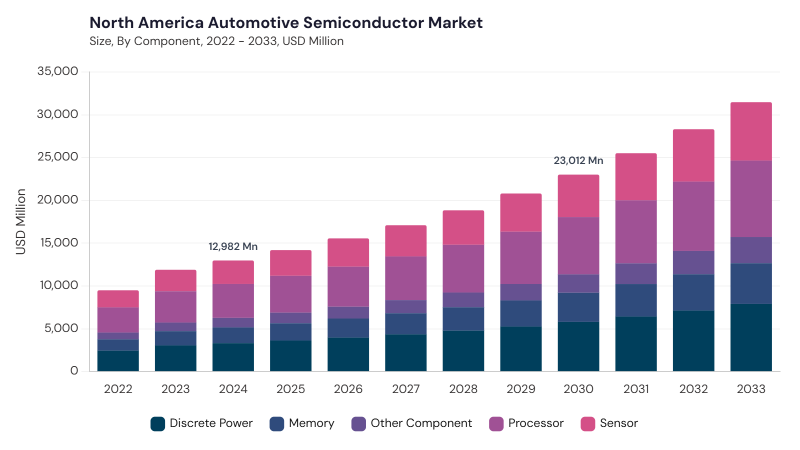
The North America Automotive Semiconductor Market evolved from basic electronic control and power-management components into a sophisticated semiconductor ecosystem supporting electrification, connectivity, safety, and software-defined vehicle architectures. Early applications centered on engine control, anti-lock braking, and basic microcontrollers, while subsequent advances enabled infotainment, electronic stability, advanced driver-assistance systems, and vehicle networking. The transition toward electric and autonomous vehicles further increased demand for high-performance processors, sensors, power semiconductors, and communication devices. Current development increasingly emphasizes centralized computing, AI-enabled processing, wide-bandgap materials, functional safety, and resilient regional semiconductor supply chains.
Electrification, ADAS, connected vehicles, software-defined architectures, and supply chain localization are shaping current market development. Semiconductor suppliers are increasingly advancing silicon carbide and gallium nitride power devices for electric drivetrains, high-performance processors for autonomous functions, sensor-fusion platforms, and secure connectivity solutions for real-time vehicle communication. Rising semiconductor content per vehicle is also being driven by digital cockpits, over-the-air functionality, battery management, and vehicle-to-everything communication. At the same time, high fabrication costs, automotive qualification requirements, cybersecurity, geopolitical risks, supply chain vulnerabilities, and regulatory compliance continue to influence investment and technology deployment.
Based on Component, the market is segmented into Processor, Discrete Power, Sensor, Memory, and Other Component. The Processor market dominated the North America Automotive Semiconductor Market by Component in 2025, and would continue to be a dominant market till 2033; thereby, achieving a market value of USD 8.1 billion by 2032, growing at a CAGR of 9.7 % during the forecast period. The Discrete Power market is expected to witness a CAGR of 10.3% during (2026 - 2033). The Other Component market is expected to witness a CAGR of 12.1% during (2026 - 2033).
Processor components include automotive microcontrollers and microprocessors supporting powertrain control, ADAS, connectivity, infotainment, and centralized vehicle computing. Discrete Power includes transistors, diodes, and other devices used for high-voltage switching, battery systems, electric drives, onboard charging, and energy management, with SiC and GaN technologies gaining importance. Sensor includes radar, lidar, pressure, temperature, inertial, and other sensing technologies supporting safety and automation. Memory supports firmware, navigation, ADAS algorithms, infotainment, and vehicle data storage, while Other Component includes analog ICs, interface devices, timing solutions, power-management ICs, and communication components.
Based on Application, the market is segmented into Powertrain, Safety, Body Electronics, Telematics & Infotainment, and Chassis. The Powertrain market dominated the North America Automotive Semiconductor Market by Application in 2025, and would continue to be a dominant market till 2033; thereby, achieving a market value of USD 7.5 billion by 2032, growing at a CAGR of 9.6 % during the forecast period. The Safety market is expected to witness a CAGR of 10.3% during (2026 - 2033). Additionally, The Body Electronics market is expected to witness highest CAGR of 10.9% during (2026 - 2033).
Powertrain applications rely on microcontrollers, power devices, battery-management solutions, and wide-bandgap semiconductors for efficient engine, transmission, hybrid, and electric drivetrain control. Safety applications use sensors, processors, and dedicated ICs for ADAS, collision avoidance, electronic stability, airbags, and automated braking. Body Electronics covers lighting, climate control, access systems, seating, and other comfort functions, while Telematics & Infotainment supports navigation, connectivity, digital displays, multimedia, V2X, and over-the-air updates. Chassis applications include electronic braking, steering, suspension, and vehicle-dynamics control requiring reliable real-time semiconductor operation.
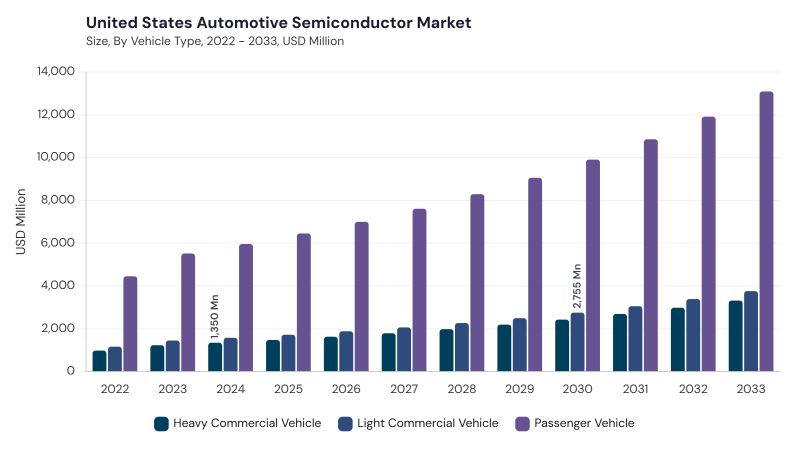
Based on Vehicle Type, the market is segmented into Passenger Vehicle, Light Commercial Vehicle, and Heavy Commercial Vehicle. Passenger Vehicles require extensive semiconductor integration across powertrain, battery management, safety, infotainment, connectivity, sensing, and autonomous-driving functions. Light Commercial Vehicles increasingly use semiconductors for fleet telematics, electric drivetrains, battery management, driver monitoring, collision avoidance, and delivery-fleet optimization.
Heavy Commercial Vehicles require durable automotive-grade devices for powertrain control, electronic braking, fleet telematics, high-voltage systems, predictive maintenance, and gradual electrification and automation. Semiconductor requirements across all three categories are increasingly influenced by reliability, functional safety, connected architectures, and energy efficiency.
Free Valuable Insights: The Global Automotive Semiconductor Market will hit USD 138.1 Billion billion by 2033, at a CAGR of 11.1%
Based on Country, the market is segmented into US, Canada, Mexico, and Rest of North America. The US market dominated the North America Automotive Semiconductor Market by Country in 2025, and would continue to be a dominant market till 2033; thereby, achieving a market value of USD 18.2 billion by 2032, growing at a CAGR of 9.8 % during the forecast period. The Canada market is expected to witness a CAGR of 13.2% during (2026 - 2033). Additionally, The Mexico market is expected to witness a CAGR of 11.2% during (2026 - 2033).
Across North America, automotive semiconductor adoption is being shaped by vehicle electrification, ADAS, software-defined architectures, connected mobility, and semiconductor supply chain localization. The US emphasizes SiC and GaN power devices, AI-enabled processors, V2X connectivity, autonomous-driving platforms, advanced packaging, and domestic manufacturing, while Canada focuses on EV power electronics, centralized computing, secure software-defined vehicles, regional R&D, and SiC and GaN technologies. Mexico is advancing nearshoring, localized semiconductor supply chains, EV and AI-oriented components, testing and manufacturing infrastructure, and USMCA-supported integration, whereas Rest of North America emphasizes wide-bandgap devices, connected and autonomous vehicle semiconductors, localized production, diversified sourcing, and automotive-grade integration.

By Component
By Application
By Vehicle Type
By Country
Set to reach $28.3 Billion by 2032, growing at 10.6% CAGR during 2026-2033.
The US leads with $18.2 billion by 2032, growing at 9.8% CAGR during the forecast period.
The Processor segment will achieve $8.1 billion by 2032, growing at a CAGR of 9.7% during 2026-2033.
Powertrain will reach $7.5 billion by 2032, with a 9.6% CAGR during 2026-2033.
The Canada market is expected to witness a CAGR of 13.2% during 2026-2033.
Body Electronics is expected to witness the highest CAGR of 10.9% during 2026-2033.
Our team of dedicated experts can provide you with attractive expansion opportunities for your business.




 Unique Offerings