The sample copy of this report is available for access.
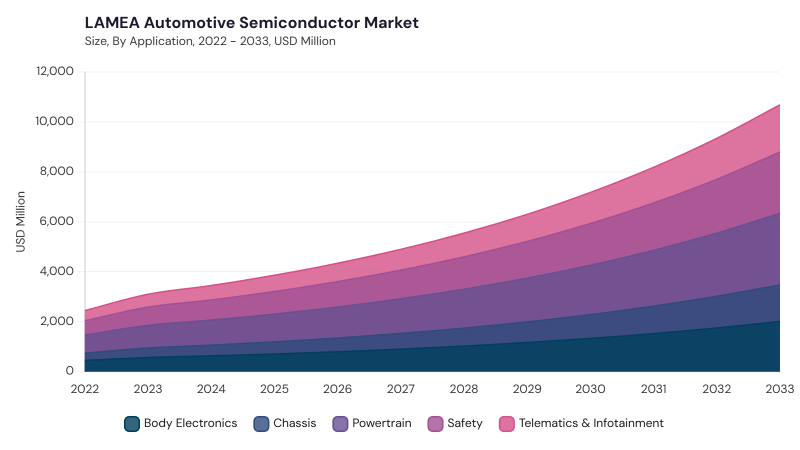
The LAMEA Automotive Semiconductor Market is expected to reach USD 6.2 billion by 2029, growing at a CAGR of 13.7% during (2026 - 2033).
The LAMEA Automotive Semiconductor Market evolved from basic imported electronic components for engine management and safety into a more integrated semiconductor ecosystem supporting electrification, connectivity, ADAS, and software-driven vehicle functions. Early adoption centered on conventional control units and analog systems, while advances in power electronics, processors, sensors, infotainment, and vehicle networking gradually increased semiconductor content. Automotive quality standards such as AEC-Q100 and AEC-Q200 further strengthened reliability requirements across diverse operating environments. Current development increasingly emphasizes power semiconductors, AI-capable processors, connected vehicle architectures, localized assembly, advanced testing, and automotive-grade semiconductor platforms.
Electrification, connected mobility, advanced safety systems, semiconductor localization, and stricter quality requirements are shaping current market development. Suppliers are increasingly advancing SiC and GaN power devices for electric drivetrains, high-performance processors for ADAS and autonomous functions, and communication ICs supporting V2X, telematics, and real-time vehicle networking. Local assembly, packaging, testing, and design initiatives are also gaining importance as countries seek greater supply chain resilience and reduced import dependence. At the same time, high capital requirements, limited regional semiconductor expertise, fragmented regulations, certification complexity, infrastructure limitations, and supply chain disruptions continue to influence market expansion.
Based on Component, the market is segmented into Processor, Discrete Power, Sensor, Memory, and Other Component. The Processor market dominated the LAMEA Automotive Semiconductor Market by Component in 2025, and would continue to be a dominant market till 2033; thereby, achieving a market value of USD 1.8 billion by 2029, growing at a CAGR of 12.8 % during the forecast period. The Discrete Power market is expected to witness a CAGR of 13.5% during (2026 - 2033). The Other Component market is expected to witness a CAGR of 15.6% during (2026 - 2033).
Processor semiconductors include microcontrollers, ASICs, and system-on-chip solutions supporting engine management, ADAS, infotainment, connectivity, and centralized vehicle control. Discrete Power includes transistors, diodes, rectifiers, SiC, and GaN devices used for power conversion, electric drivetrains, battery management, and charging systems. Sensor includes radar, lidar, ultrasonic, temperature, pressure, and position devices supporting safety and vehicle monitoring. Memory supports infotainment, navigation, telematics, software, and onboard data processing, while Other Component includes analog ICs, PMICs, interfaces, signal-conditioning devices, and communication components.
Based on Application, the market is segmented into Powertrain, Safety, Body Electronics, Telematics & Infotainment, and Chassis. The Powertrain market dominated the LAMEA Automotive Semiconductor Market by Application in 2025, and would continue to be a dominant market till 2033; thereby, achieving a market value of USD 1.7 billion by 2029, growing at a CAGR of 12.7 % during the forecast period. The Safety market is expected to witness a CAGR of 13.4% during (2026 - 2033). Additionally, The Body Electronics market is expected to witness highest CAGR of 14.1% during (2026 - 2033).
Powertrain applications use microcontrollers, power devices, sensors, battery-management systems, and wide-bandgap semiconductors for combustion, hybrid, and electric propulsion. Safety applications rely on processors, radar, lidar, cameras, and sensor-fusion technologies for ADAS, collision avoidance, driver monitoring, and active safety functions. Body Electronics supports lighting, climate control, electronic access, windows, and cabin automation, while Telematics & Infotainment enables fleet tracking, navigation, connected services, smartphone integration, and over-the-air functionality. Chassis applications include electronic braking, steering, stability, and suspension systems requiring dependable real-time semiconductor control.
Based on Vehicle Type, the market is segmented into Passenger Vehicle, Light Commercial Vehicle, and Heavy Commercial Vehicle. Passenger Vehicles require semiconductor integration across powertrain management, ADAS, infotainment, connectivity, sensing, battery systems, and vehicle control. Light Commercial Vehicles increasingly use semiconductors for telematics, fleet management, powertrain control, emissions management, connected logistics, and gradual electrification driven by delivery and commercial transport demand.
Heavy Commercial Vehicles depend on durable semiconductor solutions for engine management, braking, safety, fleet telematics, emissions control, and alternative powertrains. Across all vehicle categories, reliability, thermal endurance, cost efficiency, connectivity, and compliance with automotive-grade standards remain important requirements.
Free Valuable Insights: Automotive Semiconductor Market Size Worth USD 138.1 Billion billion by 2033
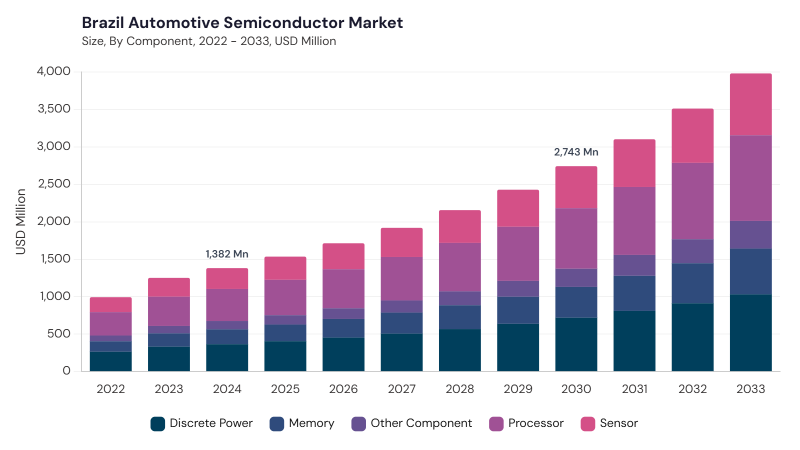
Based on Country, the market is segmented into Brazil, Argentina, UAE, Saudi Arabia, South Africa, Nigeria, and Rest of LAMEA. The Brazil market dominated the LAMEA Automotive Semiconductor Market by Country in 2025, and would continue to be a dominant market till 2033; thereby, achieving a market value of USD 2.4 billion by 2029, growing at a CAGR of 12.8 % during the forecast period. The Argentina market is expected to witness a CAGR of 14.4% during (2026 - 2033). Additionally, The UAE market is expected to witness a CAGR of 12% during (2026 - 2033).
Across LAMEA, automotive semiconductor adoption is being shaped by electrification, ADAS, digital connectivity, localization, and supply chain resilience. Brazil emphasizes SiC and GaN power devices, EV electronics, connected vehicles, localized supply chains, and advanced automotive chip integration, while Argentina focuses on EV power management, ADAS, infotainment, localized assembly, and semiconductor solutions adapted to regional conditions. The UAE is advancing high-performance power devices, AI-enabled processors, autonomous-driving sensors, localized testing, and semiconductor design capabilities, whereas Saudi Arabia emphasizes Vision 2030-supported localization, EV semiconductors, ADAS, autonomous mobility, and domestic semiconductor ecosystem development. South Africa focuses on EV power electronics, connected vehicles, ADAS, local assembly, testing, and supply diversification, while Nigeria emphasizes gradual electrification, safety and connectivity semiconductors, localization, cost-effective designs, and reduced import dependence. Rest of LAMEA continues to develop wide-bandgap power devices, sensor-fusion technologies, V2X connectivity, local manufacturing, and semiconductor platforms supporting smart and sustainable mobility.

By Component
By Application
By Vehicle Type
By Country
Set to reach $6.2 Billion by 2029, growing at 13.7% CAGR during 2026-2033.
Brazil leads with $2.4 billion by 2029, growing at a 12.8% CAGR during 2026-2033.
Processor segment to reach $1.8 billion by 2029, maintaining dominance with 12.8% CAGR during 2026-2033.
Powertrain to achieve $1.7 billion by 2029, growing at a 12.7% CAGR during 2026-2033.
Argentina market is expected to witness a 14.4% CAGR during 2026-2033.
Other Component market is expected to witness a 15.6% CAGR during 2026-2033.
Our team of dedicated experts can provide you with attractive expansion opportunities for your business.




 Unique Offerings