The sample copy of this report is available for access.
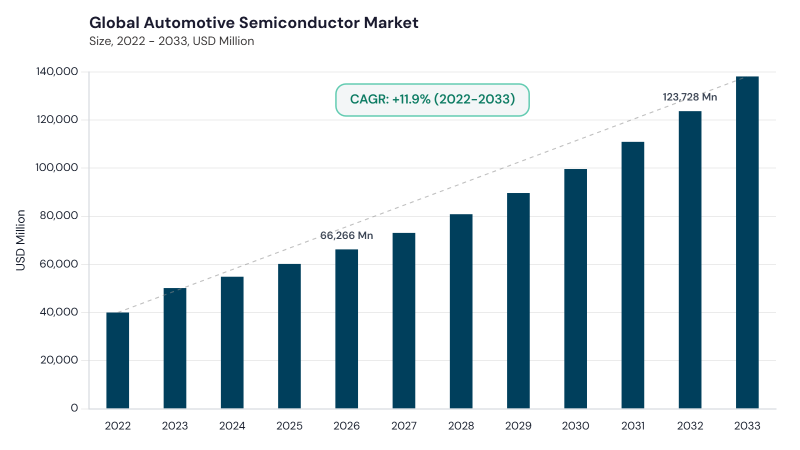
“Global Automotive Semiconductor Market to reach a market value of USD 138,153.95 Million by 2033 growing at a CAGR of 11.1%”
The Global Automotive Semiconductor Market is expected to reach USD 138.1 billion by 2033, growing at a CAGR of 11.1% during (2026 - 2033).
Rising electronic content in vehicles, rapid electrification, growing adoption of advanced driver-assistance systems, and the shift toward software-defined and connected vehicle architectures are driving the Automotive Semiconductor Market. Demand is increasing across powertrain control, safety, body electronics, telematics, infotainment, chassis, and vehicle connectivity systems. Growth is further strengthened by electric vehicle production, radar and camera systems, vehicle-to-everything communication, high-performance processors, sensors, memory, discrete power devices, and automotive-grade chip architectures.
Increasing vehicle electrification, ADAS deployment, connected mobility, software-defined architectures, and rising computing requirements are driving growth in the Automotive Semiconductor Market. Electric and hybrid vehicles require power semiconductors, battery management ICs, inverters, onboard chargers, thermal controllers, and high-voltage control devices. At the same time, ADAS and autonomous driving systems are increasing demand for processors, sensors, radar chips, memory, and AI-enabled computing platforms. Connected vehicles, V2X communication, digital cockpits, and over-the-air functionality are also expanding semiconductor value across modern vehicle platforms.
The competitive environment is technology-intensive and moderately fragmented, with automotive microcontroller manufacturers, power semiconductor suppliers, connectivity specialists, memory vendors, analog IC companies, and vertically integrated automotive electronics manufacturers competing across different vehicle subsystems. Infineon Technologies maintains leadership through power semiconductors, microcontrollers, sensors, connectivity products, and security solutions. NXP strengthens the market through automotive processors, vehicle networking, radar, secure access, and software-defined vehicle architectures, while Texas Instruments competes through analog, embedded processing, radar, power management, and battery-management solutions.
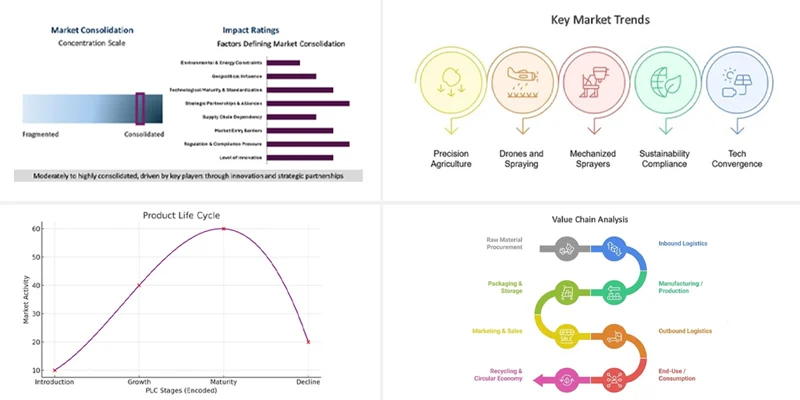

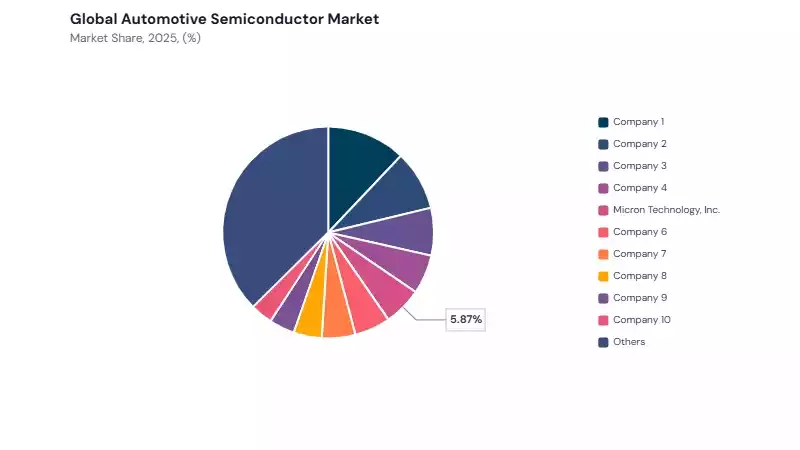
The global Automotive Semiconductor Market reflects a moderately fragmented and technology-intensive competitive structure, with leadership distributed across power semiconductors, automotive processors, microcontrollers, memory, sensors, connectivity chips, analog devices, and embedded systems. Infineon Technologies leads through its broad power semiconductor, MCU, sensor, connectivity, and security portfolio, while NXP Semiconductors holds a strong position in automotive processing, networking, radar, and secure vehicle architectures. Texas Instruments competes through analog and embedded processing strength across multiple vehicle subsystems, while STMicroelectronics, Micron, Renesas, Qualcomm, Analog Devices, onsemi, and Bosch strengthen the market through silicon carbide devices, automotive memory, software-defined vehicle platforms, digital cockpit computing, battery management, image sensors, MEMS, ASICs, and vehicle-system integration.
Based on Component, the market is segmented into Processor, Discrete Power, Sensor, Memory, and Other Component. The Processor market dominated the Global Automotive Semiconductor Market by Component in 2025, and would continue to be a dominant market till 2033; thereby, achieving a market value of USD 39.4 billion by 2033, growing at a CAGR of 10.2 % during the forecast period. The Discrete Power market is expected to witness a CAGR of 10.8% during (2026 - 2033). The Other Component market is expected to witness a CAGR of 12.7% during (2026 - 2033).
Processor remains the leading component category as vehicles require higher computing power for ADAS, powertrain control, infotainment, connectivity, digital cockpits, and software-defined architectures. Discrete Power is gaining strong relevance as electric and hybrid vehicles increase demand for power conversion, inverters, onboard chargers, battery management, and high-voltage semiconductor devices. Sensor adoption is expanding through radar, camera, pressure, temperature, position, and motion sensing technologies used in safety and automation systems. Memory supports growing onboard data storage and software workloads, while Other Component includes analog, interface, timing, connectivity, and specialized semiconductor devices that enable complete vehicle electronic architectures.
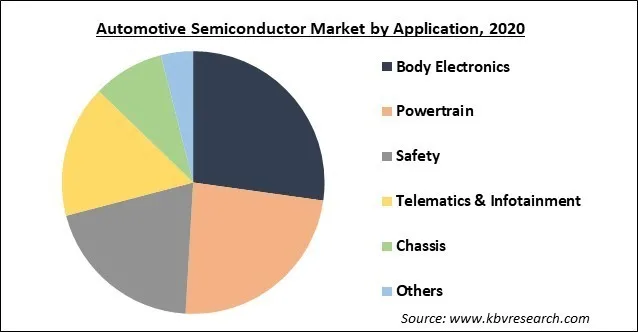
Based on Application, the market is segmented into Powertrain, Safety, Body Electronics, Telematics & Infotainment, and Chassis. The Powertrain market dominated the Global Automotive Semiconductor Market by Application in 2025, and would continue to be a dominant market till 2033; thereby, achieving a market value of USD 36.6 billion by 2033, growing at a CAGR of 10.1 % during the forecast period. The Safety market is expected to witness a CAGR of 10.8% during (2026 - 2033). Additionally, The Body Electronics market is expected to witness highest CAGR of 11.4% during (2026 - 2033).
Powertrain remains the primary application area as semiconductors support engine control, electric propulsion, hybrid systems, battery management, power conversion, and energy-efficiency optimization. Safety applications are expanding through ADAS, collision avoidance, driver monitoring, electronic stability control, airbag systems, and active safety technologies. Body Electronics uses semiconductors for lighting, climate control, access, seating, windows, comfort systems, and smart cabin functions. Telematics & Infotainment is supported by connected navigation, multimedia, smartphone integration, digital cockpit platforms, and OTA functionality, while Chassis applications rely on semiconductors for steering, braking, suspension, and vehicle dynamics control.
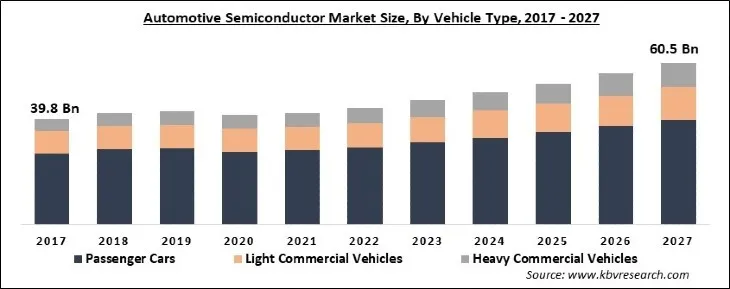
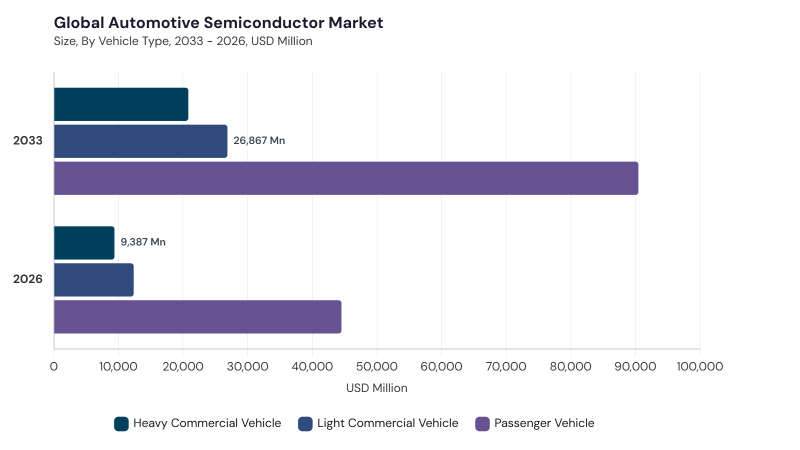
Based on Vehicle Type, the market is segmented into Passenger Vehicle, Light Commercial Vehicle, and Heavy Commercial Vehicle. The Passenger Vehicle market dominated the Global Automotive Semiconductor Market by Vehicle Type in 2025, and would continue to be a dominant market till 2033; thereby, achieving a market value of USD 90.4 billion by 2033, growing at a CAGR of 10.7 % during the forecast period. The Light Commercial Vehicle market is expected to witness a CAGR of 11.7% during (2026 - 2033). Additionally, The Heavy Commercial Vehicle market is expected to witness highest CAGR of 12.1% during (2026 - 2033).
Passenger Vehicle remains the dominant vehicle type due to high production volumes and increasing semiconductor integration across electrification, connectivity, infotainment, safety, and driver-assistance systems. Light Commercial Vehicle adoption is supported by fleet digitalization, logistics expansion, telematics, electrification, safety systems, and efficiency-focused semiconductor applications. Heavy Commercial Vehicle demand is shaped by fleet-management systems, telematics, powertrain controls, driver-assistance systems, emissions compliance, and gradual electrification. Semiconductor requirements across vehicle types differ by lifecycle, cost sensitivity, durability needs, and technology adoption pace.
Free Valuable Insights: Automotive Semiconductor Market Size to reach $138.1 Billion by 2033
Region-wise, the Automotive Semiconductor Market is analyzed across North America, Europe, Asia Pacific, and LAMEA. The Asia Pacific market dominated the Global Automotive Semiconductor Market by Region in 2025, and would continue to be a dominant market till 2033; thereby, achieving a market value of USD 63.4 billion by 2033, growing at a CAGR of 11.3 % during the forecast period. The Europe market is expected to witness a CAGR of 10.2% during (2026 - 2033). Additionally, The North America market is expected to witness a CAGR of 10.6% during (2026 - 2033).
North America benefits from electric and software-defined vehicle development, connected mobility, ADAS adoption, high-performance automotive computing, and semiconductor supply-chain investments. Europe is supported by vehicle electrification, stringent emissions and safety regulations, premium vehicle electronics, and advanced driver-assistance technologies. Asia Pacific leads the global market through extensive automotive production, strong electric vehicle manufacturing, rising semiconductor content per vehicle, and continued investment in electronics and semiconductor manufacturing capabilities. LAMEA is developing steadily through modernization of vehicle fleets, increasing electronic safety and connectivity adoption, and expanding vehicle electrification initiatives.
| Report Attribute | Details |
|---|---|
| Market size value in 2026 | USD 66.2 billion |
| Market size forecast in 2033 | USD 138.1 billion |
| Base Year | 2025 |
| Historical Period | 2022 to 2024 |
| Forecast Period | 2026 to 2033 |
| Revenue Growth Rate | CAGR of 11.1% from 2026 to 2033 |
| Number of Pages | 577 |
| Tables | 720 |
| Report Coverage | Market Trends, Revenue Estimation and Forecast, Segmentation Analysis, Regional and Country Breakdown, Competitive Landscape, Market Share Analysis, Company Profiling, Companies Strategic Developments, SWOT Analysis, Product Life Cycle Analysis, Value Chain Analysis, Market Consolidation Analysis, Key Customer Criteria, Pandemic Impact Analysis, and Winning Imperatives |
| Segments Covered | Component, Application, Vehicle Type, and Geography |
| Country Scope |
|
| Companies Included | Infineon Technologies AG; NXP Semiconductors N.V.; Texas Instruments Incorporated; STMicroelectronics N.V.; Micron Technology, Inc.; Renesas Electronics Corporation; Qualcomm Incorporated; Analog Devices, Inc.; onsemi; Robert Bosch GmbH |
By Component
By Application
By Vehicle Type
By Geography
Expected to reach USD 138.1 billion by 2033, growing at 11.1% CAGR during 2026-2033.
The Processor segment leads, projected to reach USD 39.4 billion by 2033.
Infineon, NXP, Texas Instruments, STMicroelectronics, Micron, Renesas, Qualcomm, Analog Devices, onsemi, Bosch.
Asia Pacific leads, expected to reach USD 63.4 billion by 2033.
Demand for ADAS, autonomous driving, EV proliferation, and connected vehicle ecosystems drive growth.
Passenger Vehicle segment leads, expected to reach USD 90.4 billion by 2033.
Our team of dedicated experts can provide you with attractive expansion opportunities for your business.








 Unique Offerings