The sample copy of this report is available for access.
The North America Automotive Control Panel Market is expected to reach USD 56.3 billion by 2032, growing at a CAGR of 5.9% during (2026 - 2033).
The North America Automotive Control Panel Market originated in the mid-20th century with basic electrical control systems used for lighting, ignition, and engine management through mechanical switches and relays. Over time, the market advanced from electro-mechanical interfaces to electronic control units, microprocessor-based systems, digital control panels, embedded software, and real-time data processing. The market now reflects a sophisticated stage where control panels function as multifunctional hubs integrating safety, comfort, infotainment, diagnostics, connectivity, and vehicle-management features.
Current market growth is shaped by smart and connected vehicles, software-defined control panels, safety and emissions compliance, energy-efficient designs, and lightweight materials. Automakers are increasingly adopting modular, software-upgradable panels that integrate with cloud platforms, mobile devices, sensor networks, and fail-safe mechanisms. Demand is also rising for control panels that support advanced driver assistance systems, in-vehicle infotainment, adaptive climate controls, electric vehicle interfaces, and sustainable electronic components.
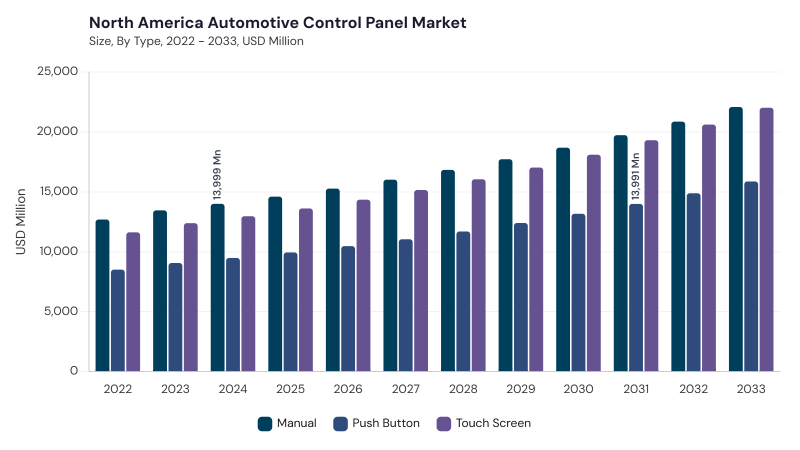
Based on Type, the market is segmented into Manual, Touch Screen, and Push Button. The Manual market dominated the North America Automotive Control Panel Market by Type in 2025, thereby, achieving a market value of USD 20.8 billion by 2032, growing at a CAGR of 5.4 % during the forecast period. The Touch Screen market is expected to witness a CAGR of 6.3% during (2026 - 2033). The Push Button market is expected to witness a CAGR of 6.1% during (2026 - 2033).
Manual control panels remain important in entry-level, mid-range, commercial fleet, and budget-oriented vehicles where simplicity, tactile feedback, cost-effectiveness, durability, and ease of maintenance are prioritized. Touch Screen holds a substantial share through expanding digital cockpits, infotainment systems, navigation, vehicle settings, ADAS interfaces, smartphone integration, haptic feedback, OLED displays, and software-driven feature expansion. Push Button represents the smallest but promising segment, supported by ignition, drive-mode selection, gear selection, climate functions, safety-related controls, tactile assurance, electronic control unit integration, and premium or performance vehicle applications requiring immediate response.
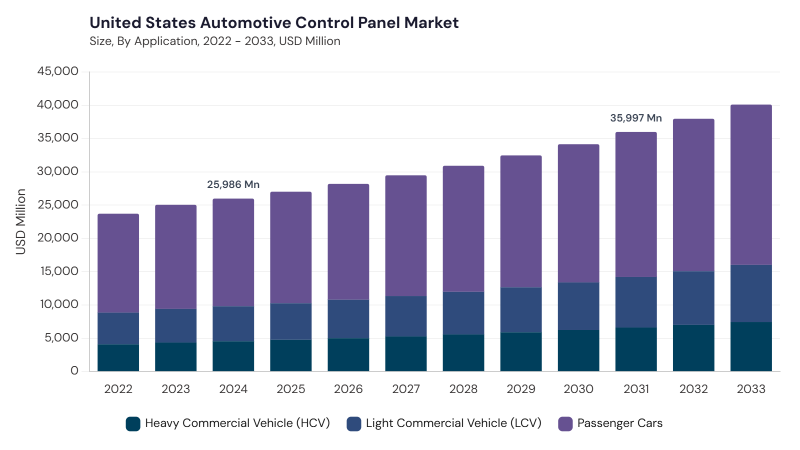
Based on Application, the market is segmented into Passenger Cars, Light Commercial Vehicle (LCV), and Heavy Commercial Vehicle (HCV). Passenger Cars remain the largest application segment as control panels integrate infotainment, climate control, driver-assistance interfaces, connectivity modules, digital clusters, touchscreen consoles, voice command recognition, telematics, haptic feedback, and smart customizable interfaces.
Light Commercial Vehicle (LCV) holds a significant share through fleet modernization, last-mile delivery growth, telematics, driver-assistance functions, diagnostics, route optimization, energy-management displays, and rugged controls suited to frequent stop-and-go operations. Heavy Commercial Vehicle (HCV) maintains the smallest but emerging presence through durable switches, grouped control architectures, fleet management systems, electronic logging, vehicle diagnostics, engine management, braking controls, load monitoring, powertrain monitoring, and smart panels supporting intensive-duty and long-haul operations.
Free Valuable Insights: The Global Automotive Control Panel Market will hit USD 203.5 Billion billion by 2033, at a CAGR of 6.6%
Based on Country, the market is segmented into US, Canada, Mexico, and Rest of North America. The US market dominated the North America Automotive Control Panel Market by Country in 2025, and would continue to be a dominant market till 2033; thereby, achieving a market value of USD 37.9 billion by 2032, growing at a CAGR of 5.2 % during the forecast period. The Canada market is expected to witness a CAGR of 7.6% during (2026 - 2033). Additionally, The Mexico market is expected to witness a CAGR of 6.9% during (2026 - 2033).
The US is shaped by digital customizable interfaces, ADAS integration, vehicle telematics, low-power displays, eco-friendly materials, and connected cockpit development, while Canada reflects smart interfaces, voice recognition, augmented reality features, ADAS-enabled alerts, lightweight materials, and energy-efficient electronics. Mexico is supported by digitized and modular control panels, EV-focused battery and energy displays, manufacturing execution systems, localized production, and Industry 4.0-enabled control panel fabrication, whereas Rest of North America is influenced by electrification, HMI advancement, OLED and AMOLED displays, voice and gesture recognition, sustainable materials, energy-efficient components, and modular software-driven architectures.

By Type
By Application
By Country
Set to reach $56.3 Billion by 2032, growing at 5.9% CAGR during 2026-2033.
The US leads with $37.9 billion by 2032, growing at a 5.2% CAGR during the forecast period.
Manual type dominated with $20.8 billion by 2032, growing at a 5.4% CAGR during the forecast period.
Canada's market is expected to witness a 7.6% CAGR during 2026-2033.
The Touch Screen market is expected to witness a 6.3% CAGR during 2026-2033.
Our team of dedicated experts can provide you with attractive expansion opportunities for your business.




 Unique Offerings
