The sample copy of this report is available for access.
“Global Automotive Control Panel Market to reach a market value of USD 203554.35 Million by 2033 growing at a CAGR of %”
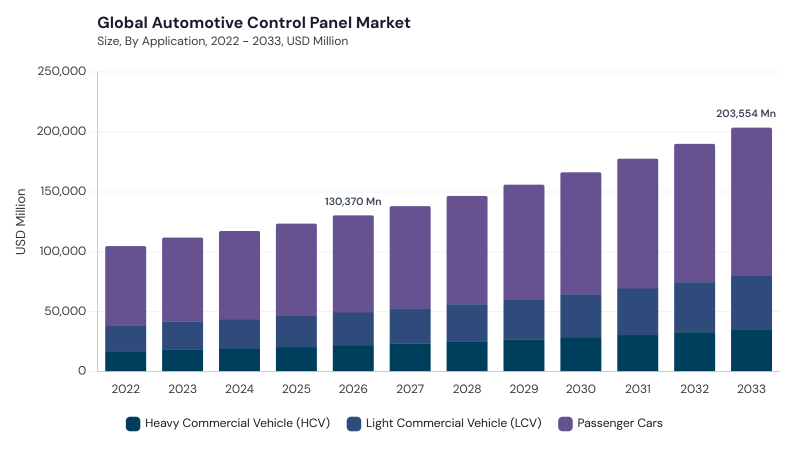
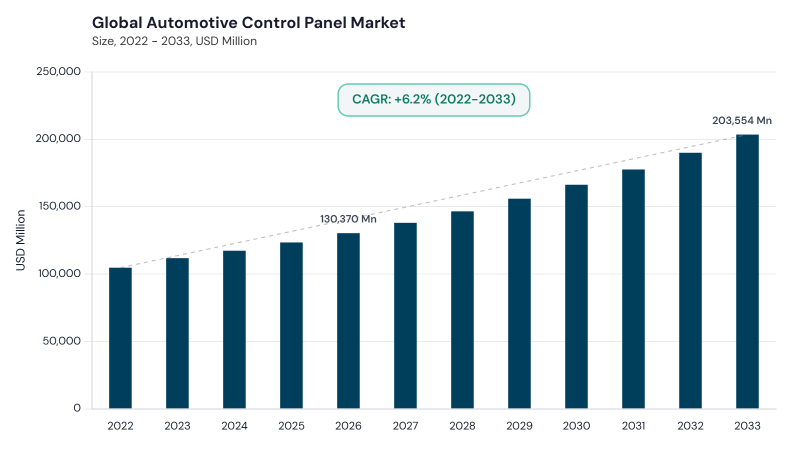
The Global Automotive Control Panel Market is expected to reach USD 203.5 billion by 2033, growing at a CAGR of 6.6% during (2026 - 2033).
Automotive control panels are becoming more advanced as vehicle electrification, electronic system integration, and demand for connected, intuitive, and feature-rich interiors reshape modern mobility. Automakers are using these panels to give drivers and passengers easier control over climate settings, infotainment, lighting, driving functions, safety features, and other in-vehicle systems. Market development is supported by digital cockpits, touch-sensitive displays, connected vehicle technologies, ADAS integration, and sophisticated human-machine interfaces across passenger cars, commercial vehicles, electric vehicles, and premium platforms.
Increasing adoption of digital cockpits, connected vehicles, electric mobility, and advanced driver-assistance systems is expanding the functional role of automotive control panels. Automakers are shifting from basic control layouts toward integrated cockpit systems that combine infotainment, navigation, climate control, diagnostics, driver assistance, and vehicle settings through digital and tactile interfaces. Consumer demand for premium interiors, ambient lighting, intuitive user interfaces, and customizable control experiences is increasing design complexity and technology content. At the same time, commercial vehicles require durable, accessible, and connected panels for fleet operations, driver monitoring, telematics, and diagnostics. Continued innovation in displays, semiconductors, software, haptics, voice control, and sustainable materials is expected to strengthen market development across vehicle classes.
Competition in the Automotive Control Panel Market is shaped by technology innovation, OEM relationships, cost efficiency, reliability, and integration capabilities. Tier-1 suppliers, cockpit electronics specialists, HMI technology providers, and vehicle interior system manufacturers compete through digital cockpit platforms, touch interfaces, physical controls, haptic feedback, displays, and software-defined architectures. Global suppliers benefit from scale, R&D strength, and multi-region OEM programs, while regional and specialist firms compete through customization, local production, niche HMI expertise, and cost competitiveness. As vehicles become more connected and electrified, suppliers that can integrate hardware, software, displays, safety requirements, cybersecurity, and ergonomic design are better positioned to capture higher-value programs.
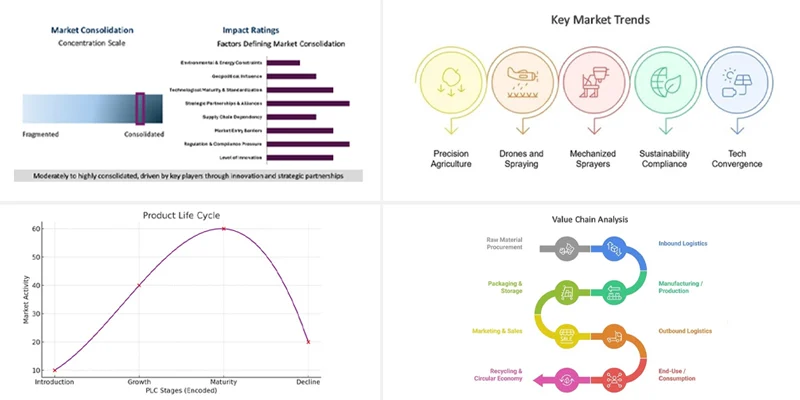

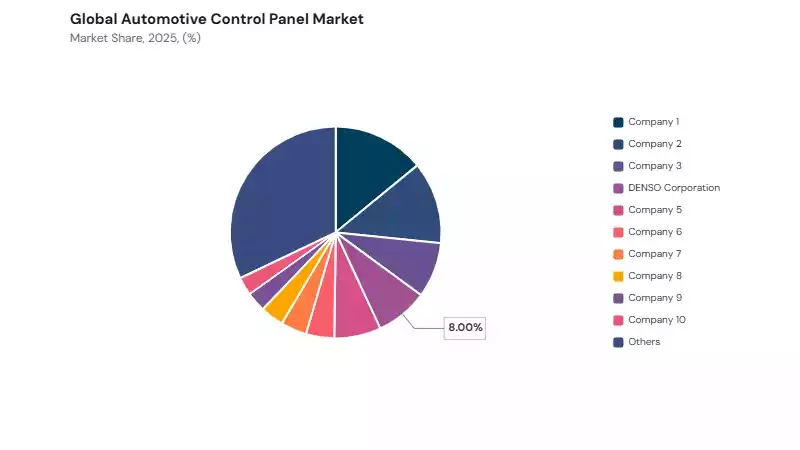
The Automotive Control Panel Market is moderately concentrated, with major automotive electronics suppliers and cockpit technology providers holding strong positions through OEM relationships, manufacturing scale, software integration, and automotive-grade reliability. Continental AG, Robert Bosch GmbH, Visteon Corporation, DENSO Corporation, FORVIA, and Panasonic Automotive Systems represent the company snapshot group for this report. Competition is increasingly shaped by digital cockpit integration, touch and haptic technologies, software-defined vehicle architectures, EV interior transformation, display integration, voice and AI interfaces, premium surface design, functional safety, and secure vehicle-network compatibility. Suppliers able to combine physical controls with advanced displays and software-led HMI platforms are positioned strongly as cockpit systems become more centralized and intelligent.
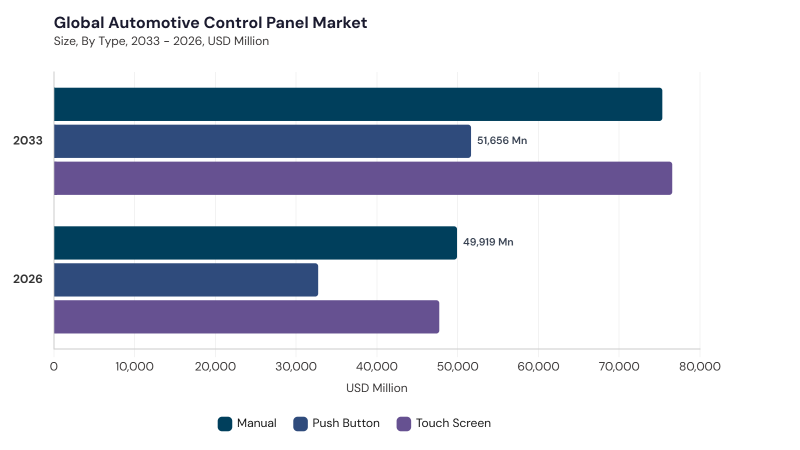
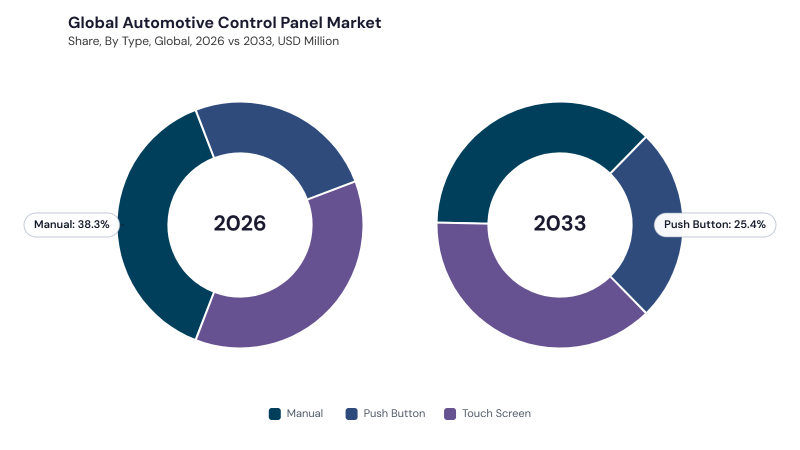
Based on type, the market is segmented into Manual, Touch Screen, and Push Button. The Manual market dominated the Global Automotive Control Panel Market by Type in 2025,thereby, achieving a market value of USD 75.3 billion by 2033, growing at a CAGR of 6.1 % during the forecast period. The Touch Screen market is expected to witness a CAGR of 7% during (2026 - 2033). The Push Button market is expected to witness a CAGR of 6.7% during (2026 - 2033).
Manual control panels remain important in entry-level, economy, utility, and commercial vehicles where reliability, low cost, tactile feedback, and straightforward operation are valued. Touch Screen panels are gaining strong adoption in mid-range, premium, connected, and electric vehicles because they consolidate infotainment, navigation, climate, vehicle settings, and smart cabin functions into centralized digital interfaces. Push Button panels continue to serve functions requiring fast, direct, and dependable interaction, including ignition, drive modes, safety features, climate shortcuts, and steering or console controls. The market is increasingly moving toward hybrid interiors where physical controls, push buttons, haptic surfaces, and touchscreens coexist to balance convenience, safety, cost, and user experience.
Based on application, the market is segmented into Passenger Cars, Light Commercial Vehicle (LCV), and Heavy Commercial Vehicle (HCV). The Passenger Cars market dominated the Global Automotive Control Panel Market by Application in 2025, and would continue to be a dominant market till 2033; thereby, achieving a market value of USD 123.1 billion by 2033, growing at a CAGR of 6.2 % during the forecast period. The Light Commercial Vehicle (LCV) market is expected to witness a CAGR of 7.3% during (2026 - 2033). Additionally, The Heavy Commercial Vehicle (HCV) market is expected to witness highest CAGR of 7.2% during (2026 - 2033).
Passenger Cars represent the most technology-intensive application as automakers integrate infotainment systems, digital instrument clusters, advanced climate controls, connected features, EV information, and ADAS interfaces into increasingly sophisticated cabin layouts. LCVs require durable and ergonomic panels that support logistics operations, driver convenience, fleet connectivity, telematics, diagnostics, and urban delivery workflows. HCVs emphasize rugged, accessible, and safety-focused controls suited for long-haul and intensive-duty operations, including vehicle diagnostics, navigation, fleet communication, driver monitoring, and ADAS-related functions. Across all applications, control panels are evolving from isolated interface modules into integrated cockpit systems supporting vehicle intelligence, operational efficiency, and safer driver interaction.
Free Valuable Insights: Automotive Control Panel Market Size to reach $203.5 Billion by 2033
Region-wise, the Automotive Control Panel Market is analyzed across North America, Europe, Asia Pacific, and LAMEA. The Asia Pacific market dominated the Global Automotive Control Panel Market by Region in 2025, and would continue to be a dominant market till 2033; thereby, achieving a market value of USD 75.2 billion by 2033, growing at a CAGR of 7 % during the forecast period. The North America market is expected to witness a CAGR of 5.9% during (2026 - 2033). Additionally, The Europe market is expected to witness a CAGR of 6.4% during (2026 - 2033).
North America is shaped by connected vehicles, software-defined panels, ADAS integration, safety regulation, and demand for smart, modular, and updateable cockpit systems. Europe is driven by digital cockpit adoption, EV-specific displays, emissions and safety requirements, V2X integration, and sophisticated HMI design. Asia Pacific benefits from large-scale vehicle production, rapid electrification, autonomous and semi-autonomous technology adoption, smartphone-style connectivity, and rising preference for digitally enhanced interiors. LAMEA reflects a mix of legacy systems and emerging smart technologies, with demand supported by ADAS adoption, EV-ready control panels, cost-effective connected features, and durable interfaces suited to varied operating environments.
| Report Attribute | Details |
|---|---|
| Market size value in 2026 | USD 130.3 billion |
| Market size forecast in 2033 | USD 203.5 billion |
| Base Year | 2025 |
| Historical Period | 2022 to 2024 |
| Forecast Period | 2026 to 2033 |
| Revenue Growth Rate | CAGR of 6.6% from 2026 to 2033 |
| Number of Pages | 414 |
| Tables | 270 |
| Report Coverage | Market Trends, Revenue Estimation and Forecast, Segmentation Analysis, Regional and Country Breakdown, Competitive Landscape, Market Share Analysis, Company Profiling, Companies Strategic Developments, SWOT Analysis, Product Life Cycle Analysis, Value Chain Analysis, Market Consolidation Analysis, Key Customer Criteria, Pandemic Impact Analysis, and Winning Imperatives |
| Segments Covered | Type, Application, and Geography |
| Country Scope |
|
| Companies Included | Continental AG; Robert Bosch GmbH; Visteon Corporation; DENSO Corporation; FORVIA; Panasonic Automotive Systems |
By Type
By Application
By Geography
Valued at USD 130.3 billion in 2026, it's projected to reach USD 203.5 billion by 2033, growing at 6.6% CAGR during 2026-2033.
The Manual segment leads, expected to reach USD 75.3 billion by 2033.
Continental AG, Robert Bosch GmbH, Visteon Corporation, DENSO Corporation, FORVIA, and Panasonic Automotive Systems are key players.
Passenger Cars lead, projected to hit USD 123.1 billion by 2033.
Asia Pacific leads with a market value of USD 75.2 billion by 2033.
Enhanced vehicle safety regulations and increasing integration of connected vehicle technologies drive market growth.
Our team of dedicated experts can provide you with attractive expansion opportunities for your business.






 Unique Offerings
