The sample copy of this report is available for access.
The Asia Pacific Automotive Control Panel Market is expected to reach USD 60.7 billion by 2030, growing at a CAGR of 7% during (2026 - 2033).
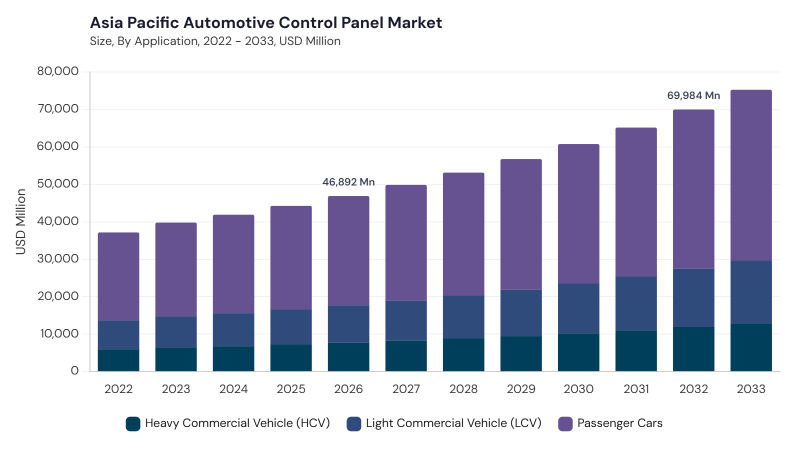
The Asia Pacific Automotive Control Panel Market originated alongside the broader automotive electronics industry, moving from mechanical dials and analog gauges to electro-mechanical and fully digital vehicle interfaces. Over time, microprocessor-based controls, LCD technology, touchscreens, heads-up displays, and customizable digital dashboards transformed control panels from basic instrumentation into multifunctional digital systems. The market now reflects intelligent control hubs that manage vehicle functions, infotainment, navigation, ADAS, and connected vehicle interactions across increasingly electric, autonomous, and software-enabled vehicle platforms.
Current market growth is shaped by vehicle electrification, autonomous and semi-autonomous driving technologies, personalized connected cabins, and software-upgradeable control platforms. Automakers are increasingly developing panels that display battery status, energy consumption, thermal management data, sensor information, driver-assistance alerts, and infotainment controls through modular digital interfaces. Demand is also rising for high-resolution displays, touch-sensitive surfaces, haptic feedback, AI-driven user interfaces, augmented reality displays, localized manufacturing, and control panels aligned with regional safety, environmental, and consumer requirements.
Based on Type, the market is segmented into Manual, Touch Screen, and Push Button. The Manual market dominated the Asia Pacific Automotive Control Panel Market by Type in 2025, thereby, achieving a market value of USD 22.8 billion by 2030, growing at a CAGR of 6.5 % during the forecast period. The Touch Screen market is expected to witness a CAGR of 7.4% during (2026 - 2033). The Push Button market is expected to witness a CAGR of 7.2% during (2026 - 2033).
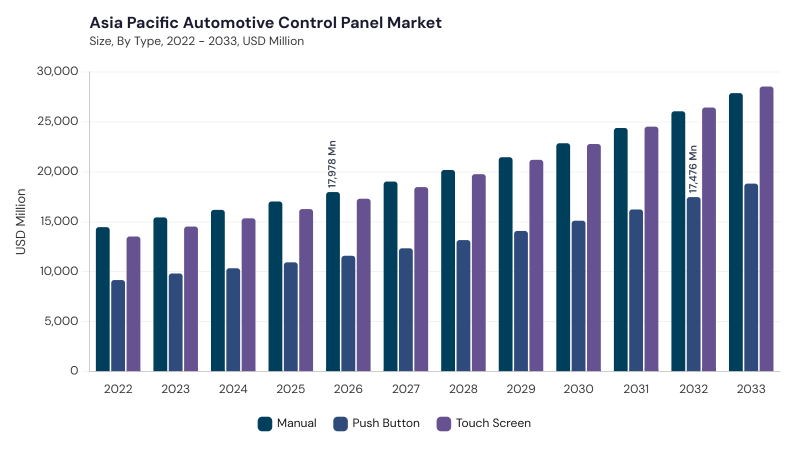
Manual control panels remain important in entry-level vehicles, commercial vehicles, budget models, and harsh operating environments where reliability, cost-effectiveness, simple integration, tactile feedback, durability, and ease of maintenance are prioritized. Touch Screen holds a substantial share through smart cockpits, connected infotainment systems, electric vehicles, display-centric dashboards, smartphone connectivity, navigation, multimedia controls, haptic feedback, and digital cockpit adoption. Push Button represents the smallest but promising segment, supported by start-stop systems, transmission selectors, steering controls, drive mode selection, climate presets, backlit controls, ergonomic design, and functions requiring immediate tactile response.
Based on Application, the market is segmented into Passenger Cars, Light Commercial Vehicle (LCV), and Heavy Commercial Vehicle (HCV). Passenger Cars remain the leading application segment as control panels integrate instrument clusters, infotainment systems, climate controls, touchscreen displays, heads-up displays, smartphone connectivity, EV energy management, voice activation, adaptive controls, OLED displays, and haptic feedback.
Light Commercial Vehicle (LCV) holds a significant share through e-commerce distribution, urban freight movement, last-mile delivery, small-business transportation, telematics, fleet management, driver assistance controls, battery-status displays, and simplified durable interfaces. Heavy Commercial Vehicle (HCV) maintains the smallest but emerging presence through digital instrumentation, driver-monitoring interfaces, telematics controls, engine management, safety monitoring, fatigue monitoring, electronic logging devices, vehicle diagnostics, navigation, communication tools, and rugged multi-functional panels for intensive freight and logistics operations.
Free Valuable Insights: Automotive Control Panel Market is Predicted to reach USD 203.5 Billion billion by 2033, at a CAGR of 6.6%
Based on Country, the market is segmented into China, Japan, India, South Korea, Australia, Malaysia, and Rest of Asia Pacific. The China market dominated the Asia Pacific Automotive Control Panel Market by Country in 2025, and would continue to be a dominant market till 2033; thereby, achieving a market value of USD 24.5 billion by 2030, growing at a CAGR of 5.7 % during the forecast period. The Japan market is expected to witness a CAGR of 6.2% during (2026 - 2033). Additionally, The India market is expected to witness a CAGR of 7.8% during (2026 - 2033).
China is shaped by digital clusters, OLED and LCD displays, connected vehicles, IoT-enabled control panels, voice-activated interfaces, ADAS integration, and over-the-air updates, while Japan reflects OLED and LCD advancement, heads-up displays, ADAS indicators, emission monitoring, connectivity, infotainment integration, and modular user-centric designs. India is supported by touchscreen adoption, EV-focused battery and energy displays, ADAS alerts, smartphone integration, localized cost-sensitive designs, and AI-enabled predictive maintenance. South Korea is advancing through smart connected vehicle technologies, software-defined clusters, V2X communication, EV-compatible displays, semiconductor innovation, and high-resolution interfaces, whereas Australia is influenced by EV and hybrid control needs, touchscreens, voice-command interfaces, tactile feedback, heads-up displays, and modular scalable panels. Malaysia is progressing through digital instrument clusters, infotainment systems, sensor-based controls, EV-compatible control panels, localization, cost optimization, and ADAS-ready interfaces, while Rest of Asia Pacific is shaped by customizable digital clusters, IoT connectivity, predictive maintenance, OTA updates, lightweight energy-efficient designs, flexible circuits, and sustainable production processes.

By Type
By Application
By Country
Set to reach $60.7 Billion by 2030, growing at 7% CAGR during 2026-2033.
China dominates with a market value of USD 24.5 billion by 2030, growing at a CAGR of 5.7% during 2026-2033.
The manual segment leads with a market value of USD 22.8 billion by 2030, growing at a CAGR of 6.5% during 2026-2033.
The touch screen market is expected to witness a CAGR of 7.4% during 2026-2033.
The India market is expected to witness a CAGR of 7.8% during 2026-2033.
The push button market is expected to witness a CAGR of 7.2% during 2026-2033.
Our team of dedicated experts can provide you with attractive expansion opportunities for your business.




 Unique Offerings
