The sample copy of this report is available for access.
The Europe Automotive Control Panel Market is expected to reach USD 44.4 billion by 2031, growing at a CAGR of 6.4% during (2026 - 2033).
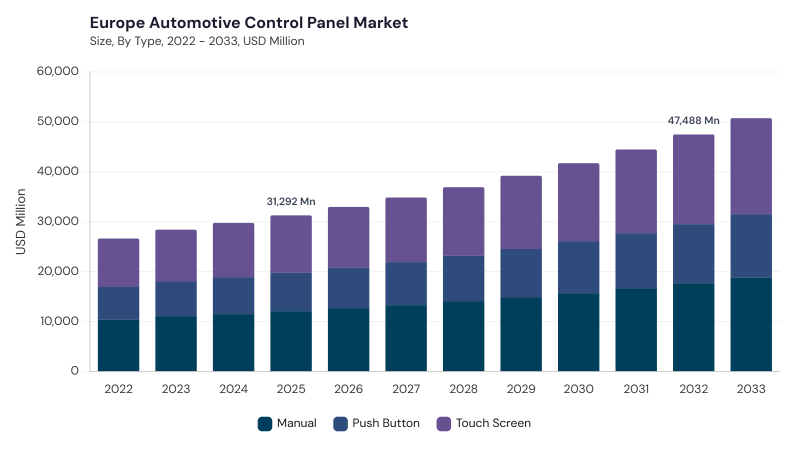
The Europe Automotive Control Panel Market originated with analog gauges and mechanical switches designed to provide basic vehicle information such as speed, fuel level, and engine status. Over time, electronic systems, ECUs, microprocessors, embedded software, CAN communication, multifunctional digital clusters, touchscreen interfaces, and high-resolution dashboards transformed control panels into connected driver-interface platforms. The market now reflects strong integration with ADAS data, V2X communication, electrified vehicle systems, and user-centric digital cockpit designs.
Current market growth is shaped by digital cockpit systems, electric vehicle-specific interfaces, safety and emissions compliance, and advanced human-machine interface platforms. Manufacturers are increasingly developing customizable, software-defined control panels that integrate infotainment, diagnostics, adaptive display features, EV battery data, energy recovery metrics, ADAS alerts, and real-time vehicle performance feedback. Demand is also rising for scalable hardware, frequent software updates, AI-enabled display optimization, multilingual interfaces, and interoperable cockpit solutions aligned with Europe’s connected and electrified vehicle ecosystem.
Based on Type, the market is segmented into Manual, Touch Screen, and Push Button. The Manual market dominated the Europe Automotive Control Panel Market by Type in 2025, thereby, achieving a market value of USD 16.6 billion by 2031, growing at a CAGR of 5.8 % during the forecast period. The Touch Screen market is expected to witness a CAGR of 6.8% during (2026 - 2033). The Push Button market is expected to witness a CAGR of 6.5% during (2026 - 2033).
Manual control panels remain relevant in economy, mid-range, utility, and safety-sensitive vehicle environments where tactile feedback, reliability, affordability, distraction reduction, ease of repair, and intuitive operation are important. Touch Screen holds a substantial share through software-defined interiors, integrated infotainment, digital climate interfaces, connected car platforms, OLED displays, haptic feedback, AI-driven user interfaces, and EV or premium vehicle applications. Push Button represents the smallest but promising segment, supported by start/stop functions, drive-mode selection, multimedia controls, LED status feedback, ergonomic layouts, hybrid physical-digital interfaces, and functions requiring dependable tactile response.
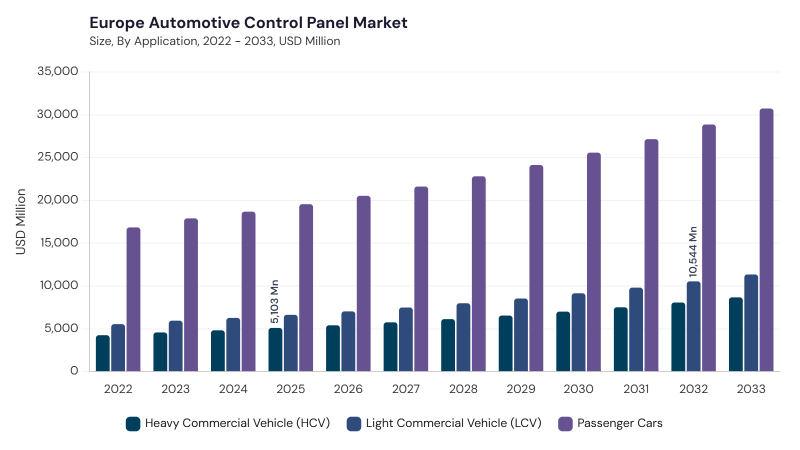
Based on Application, the market is segmented into Passenger Cars, Light Commercial Vehicle (LCV), and Heavy Commercial Vehicle (HCV). Passenger Cars remain the largest and most advanced application segment as control panels integrate digital dashboards, touchscreens, ADAS, instrument clusters, multimedia controls, climate interfaces, smartphone connectivity, energy management displays, real-time monitoring, and personalized software settings.
Light Commercial Vehicle (LCV) holds a significant share through urban logistics, delivery fleet renewal, commercial vehicle electrification, navigation, telematics, fleet management, diagnostics, eco-driving support, and durable interfaces for intensive daily use. Heavy Commercial Vehicle (HCV) maintains the smallest but emerging presence through rugged panels supporting engine management, braking systems, cargo operations, fleet telematics, driver-hour compliance, emissions monitoring, multi-screen layouts, autonomous driving features, and real-time vehicle-status controls.
Free Valuable Insights: The Worldwide Automotive Control Panel Market is projected to reach USD 203.5 Billion billion by 2033, at a CAGR of 6.6%
Based on Country, the market is segmented into Germany, UK, France, Russia, Spain, Italy, and Rest of Europe. The Germany market dominated the Europe Automotive Control Panel Market by Country in 2025, and would continue to be a dominant market till 2033; thereby, achieving a market value of USD 15.8 billion by 2031, growing at a CAGR of 5.5 % during the forecast period. The UK market is expected to witness a CAGR of 5.7% during (2026 - 2033). Additionally, The France market is expected to witness a CAGR of 7.2% during (2026 - 2033).
Germany is shaped by digitization, EV powertrain information, ADAS integration, AI-enabled interfaces, smart factories, and software-driven control panels, while the UK reflects electrification, digital instrument clusters, ADAS visualization, smartphone mirroring, voice controls, and over-the-air updates. France is supported by customizable instrument clusters, ADAS controls, smart connectivity, OLED and augmented reality interfaces, and AI-driven adaptive panels, whereas Russia emphasizes digitalization, safety and emissions monitoring, touch and voice-enabled controls, localized manufacturing, and ADAS-compatible interfaces. Spain is advancing through configurable dashboards, haptic feedback, EV battery and charging displays, OLED and micro-LED exploration, and connected control panel software, while Italy is driven by digital clusters, ADAS integration, smartphone connectivity, voice control, remote diagnostics, and modular software-upgradeable platforms. Rest of Europe is influenced by digital interactive displays, electrification, autonomous vehicle features, safety and emissions monitoring, AI-driven customization, haptic feedback, and scalable connected cockpit architectures.

By Type
By Application
By Country
Set to reach $44.4 Billion by 2031, growing at 6.4% CAGR during 2026-2033.
Germany leads with a market value of $15.8 billion by 2031, growing at a 5.5% CAGR during the forecast period.
Rising demand for touch screen panels, witnessing a 6.8% CAGR during 2026-2033, is a key growth driver.
Manual control panels are projected to reach $16.6 billion by 2031, growing at a 5.8% CAGR during 2026-2033.
The UK market is expected to witness a 5.7% CAGR during 2026-2033.
The France market is expected to grow at a 7.2% CAGR during 2026-2033.
Our team of dedicated experts can provide you with attractive expansion opportunities for your business.




 Unique Offerings
