The sample copy of this report is available for access.
The North America Automated And Closed Cell Therapy Processing Systems Market is expected to reach USD 2.6 billion by 2032, growing at a CAGR of 19.5% during (2026 – 2033).
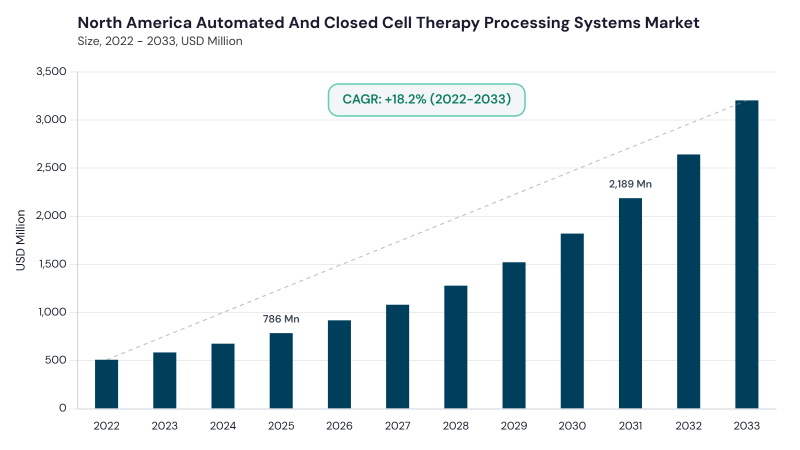
The North America Automated And Closed Cell Therapy Processing Systems Market has evolved from manual, open, and labor-intensive cell therapy manufacturing workflows into a highly controlled automation-driven processing ecosystem. In the early stage, cell therapy production relied heavily on operator-dependent methods for cell isolation, washing, expansion, formulation, and storage, which created risks related to contamination, process inconsistency, batch variability, and limited scalability. As CAR-T therapies, stem cell research, regenerative medicine, and personalized therapies advanced, manufacturers required safer and more reproducible production systems. This need accelerated the adoption of automated and closed platforms capable of maintaining aseptic conditions, reducing manual handling, improving traceability, and supporting GMP-compliant workflows.
The current market is shaped by rising cell and gene therapy pipelines, growing commercialization of immune cell therapies, strict regulatory expectations, higher investment in advanced therapy manufacturing, and increasing demand for scalable closed-system platforms. Manufacturers, CDMOs, hospitals, research institutes, and biotechnology companies are seeking systems that can automate complex workflows, reduce contamination risk, improve cell viability, standardize production, and support faster clinical-to-commercial transition. Demand is also increasing for modular platforms, single-use technologies, AI-enabled process monitoring, real-time analytics, electronic batch records, and integrated systems that combine separation, expansion, washing, fill-finish, and cryopreservation.
Based on Type, the market is segmented into Non Stem Cell Therapy and Stem Cell Therapy. The Non Stem Cell Therapy market dominated the North America Automated And Closed Cell Therapy Processing Systems Market by Type in 2025, and would continue to be a dominant market till 2033; thereby, achieving a market value of USD 1.5 billion by 2032, growing at a CAGR of 19.1 % during the forecast period. The Stem Cell Therapy market is expected to witness a CAGR of 20% during (2026 - 2033).
Non Stem Cell Therapy holds the leading position due to the growing commercialization of CAR-T, TCR-based therapies, NK cell therapies, and other immune cell-based therapeutic products. These therapies require precise, sterile, and reproducible processing for cell isolation, activation, genetic modification, expansion, washing, formulation, and final preparation. Automated and closed systems reduce operator intervention and help improve consistency across patient-specific and donor-derived workflows. Stem Cell Therapy is also gaining relevance as regenerative medicine research, clinical trials, and advanced therapeutic applications expand across North America. Automated closed systems support stem cell isolation, culture expansion, differentiation, harvesting, and cryopreservation while maintaining viability and reducing contamination exposure. The segment is supported by increasing research in tissue repair, autoimmune conditions, neurological disorders, orthopedic applications, and broader regenerative medicine development.
Based on Scale, the market is segmented into Pre-Commercial / R&D Scale and Commercial Scale. The Pre-Commercial / R&D Scale market dominated the North America Automated And Closed Cell Therapy Processing Systems Market by Scale in 2025, and would continue to be a dominant market till 2033; thereby, achieving a market value of USD 1.9 billion by 2032, growing at a CAGR of 19.3 % during the forecast period. The Commercial Scale market is expected to witness a CAGR of 20% during (2026 - 2033).
Pre-Commercial / R&D Scale leads the market because a large number of cell therapy programs remain in discovery, process development, translational research, and clinical trial stages. Academic centers, biotechnology startups, hospitals, and CDMOs require flexible automated systems that can support small-batch production, protocol optimization, early-stage validation, and clinical material manufacturing. These systems help researchers improve process control while maintaining adaptability for different cell types and therapeutic approaches. Commercial Scale is gaining importance as more cell therapies advance toward approval and market launch, creating demand for high-throughput, standardized, and GMP-compliant manufacturing platforms. Commercial-scale systems focus on reproducibility, automation depth, traceability, batch consistency, process analytics, and reduced labor dependency. As approved therapies increase and manufacturing capacity expands, commercial-scale adoption is expected to strengthen across biopharmaceutical and contract manufacturing facilities.
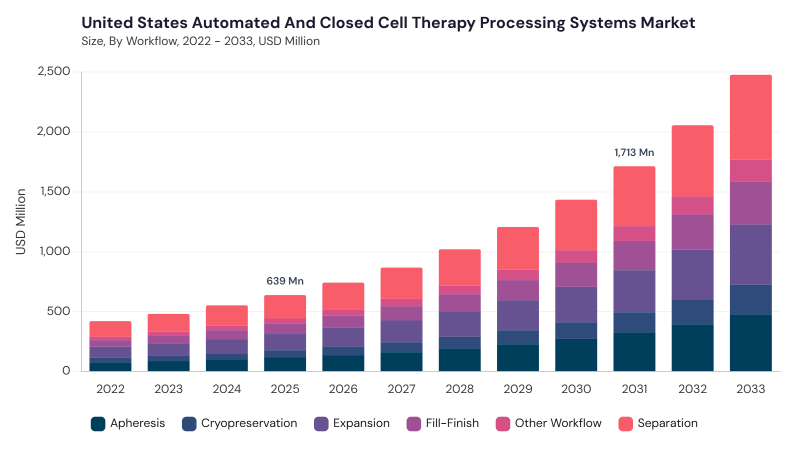
Based on Workflow, the market is segmented into Separation, Expansion, Apheresis, Fill-Finish, Cryopreservation, and Other Workflow. Separation leads the market because cell isolation is a foundational step in producing high-quality therapeutic cell products. Automated closed separation systems help isolate target cells from blood, bone marrow, or other biological materials while reducing contamination risk and improving purity, viability, and consistency. Expansion is an important segment as many therapies require controlled cell growth to achieve clinically relevant doses.
Automated expansion platforms support scalable culture conditions, process monitoring, and reproducible cell proliferation across autologous and allogeneic workflows. Apheresis plays a key role in collecting patient-derived or donor-derived cells for personalized and immune cell therapies. Fill-Finish supports sterile final product preparation, dosing accuracy, and compliance-ready product handling. Cryopreservation is important for long-term storage, transport, and multi-site distribution of viable cell products. Other Workflow includes formulation, washing, buffer exchange, quality control preparation, and supportive processing steps that improve end-to-end manufacturing efficiency.
Free Valuable Insights: The Global Automated And Closed Cell Therapy Processing Systems Market will hit USD 7.0 Billion billion by 2033, at a CAGR of 20.2%
Based on Country, the market is segmented into US, Canada, Mexico, and Rest of North America. The US market dominated the North America Automated And Closed Cell Therapy Processing Systems Market by Country in 2025, and would continue to be a dominant market till 2033; thereby, achieving a market value of USD 2.1 billion by 2032, growing at a CAGR of 18.8 % during the forecast period. The Canada market is expected to witness a CAGR of 22.3% during (2026 - 2033). Additionally, The Mexico market is expected to witness a CAGR of 21.8% during (2026 - 2033).
The US remains the leading country market due to its strong cell and gene therapy pipeline, large biotechnology base, advanced clinical trial ecosystem, established CDMO network, regulatory maturity, and high investment in automated GMP-compliant manufacturing. The country is adopting closed processing platforms for CAR-T therapies, immune cell therapies, stem cell research, commercial manufacturing, decentralized production, and digital process monitoring. Canada contributes through its growing regenerative medicine ecosystem, CAR-T manufacturing capabilities, academic research centers, clinical development programs, and increasing use of modular closed-system technologies. Mexico is gaining traction through expanding biotechnology activity, clinical research development, improving regulatory alignment, and gradual adoption of automated platforms for safer and more consistent cell therapy processing. Rest of North America supports market growth through specialized therapy development, cross-border research collaboration, clinical manufacturing support, and increasing awareness of closed-system automation for advanced therapy production.

By Type
By Scale
By Workflow
By Country
Set to reach USD 2.6 billion by 2033, growing at 19.5% CAGR during 2026-2033.
The US leads with USD 2.1 billion by 2032, growing at 18.8% CAGR during 2026-2033.
Rising demand for stem cell therapy, growing at 20% CAGR during 2026-2033, drives market growth.
Non-stem cell therapy hits USD 1.5 billion by 2032 at 19.1% CAGR during 2026-2033.
The Canada market is expected to witness a 22.3% CAGR during 2026-2033.
Pre-commercial scale reaches USD 1.9 billion by 2032, with a 19.3% CAGR during 2026-2033.
Our team of dedicated experts can provide you with attractive expansion opportunities for your business.




 Unique Offerings