The sample copy of this report is available for access.
The Europe Automated And Closed Cell Therapy Processing Systems Market is expected to reach USD 1.1 billion by 2031, growing at a CAGR of 19.9% during (2026 – 2033).
The Europe Automated And Closed Cell Therapy Processing Systems Market has evolved from manual, open, and labor-intensive cell therapy manufacturing practices into a more advanced, sterile, automated, and compliance-driven processing ecosystem. In the early stage, cell therapy production across Europe depended on manual handling, semi-automated tools, and open processing methods that created challenges related to contamination risk, operator dependency, batch variability, and limited scalability. As cell therapies, regenerative medicine, CAR-T therapies, and advanced therapy medicinal products gained clinical importance, manufacturers increasingly required closed systems that could improve reproducibility, sterility, traceability, and GMP compliance. The market gradually advanced toward integrated platforms combining cell separation, expansion, washing, formulation, fill-finish, and cryopreservation within controlled environments.
The current market is shaped by rising ATMP development, expanding clinical research, stronger regulatory expectations, increasing biopharmaceutical manufacturing investment, and the growing need for scalable and contamination-free cell therapy workflows. European manufacturers, CDMOs, hospitals, academic centers, and biotechnology companies are seeking systems that can reduce manual intervention, improve cell yield and viability, support real-time process monitoring, and enable faster transition from clinical development to commercial manufacturing. Demand is also increasing for modular platforms, single-use systems, AI-enabled process analytics, digital batch records, decentralized manufacturing tools, and flexible systems that can support both autologous and allogeneic therapies.
Based on Type, the market is segmented into Non Stem Cell Therapy and Stem Cell Therapy. The Non Stem Cell Therapy market dominated the Europe Automated And Closed Cell Therapy Processing Systems Market by Type in 2025, and would continue to be a dominant market till 2033; thereby, achieving a market value of USD 636.3 million by 2031, growing at a CAGR of 19.5 % during the forecast period. The Stem Cell Therapy market is expected to witness a CAGR of 20.4% during (2026 - 2033).
Non Stem Cell Therapy holds the leading position due to increasing development of immune cell therapies, CAR-T therapies, TCR-based therapies, NK cell therapies, and other engineered cellular products across Europe. These therapies require automated and closed processing systems for cell isolation, activation, modification, expansion, washing, formulation, and final preparation while maintaining sterility and reproducibility. The segment is supported by growing clinical trial activity, expanding advanced therapy centers, and increasing collaboration between hospitals, biotech companies, and CDMOs. Stem Cell Therapy is also gaining relevance through ongoing regenerative medicine research, tissue engineering, musculoskeletal applications, cardiovascular repair, inflammatory disease studies, and broader stem cell-based therapeutic development. Automated closed systems help improve stem cell culture expansion, differentiation, harvesting, cryopreservation, and product consistency while reducing manual error and contamination exposure.
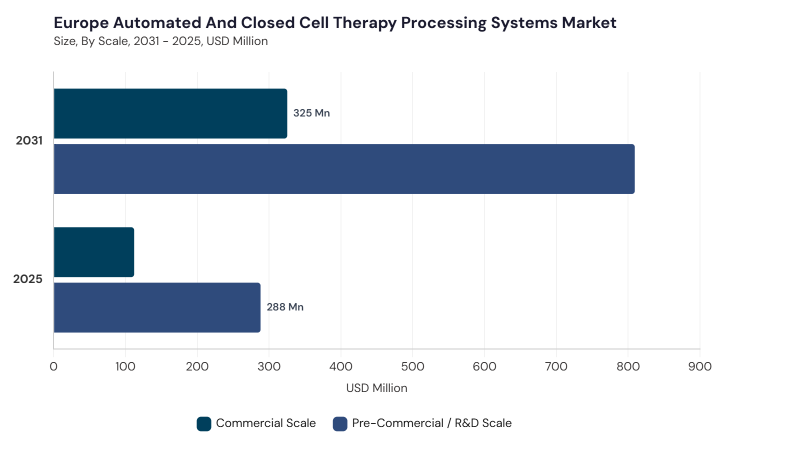
Based on Scale, the market is segmented into Pre-Commercial / R&D Scale and Commercial Scale. The Pre-Commercial / R&D Scale market dominated the Europe Automated And Closed Cell Therapy Processing Systems Market by Scale in 2025, and would continue to be a dominant market till 2033; thereby, achieving a market value of USD 809.2 million by 2031, growing at a CAGR of 19.7 % during the forecast period. The Commercial Scale market is expected to witness a CAGR of 20.4% during (2026 - 2033).
Pre-Commercial / R&D Scale leads the market as Europe has strong cell therapy research activity, clinical-stage programs, academic medical centers, biotechnology startups, and early-stage ATMP development initiatives. At this scale, automated and closed systems are used for protocol development, small-batch production, early clinical trial material preparation, and process optimization across different cell therapy modalities. These systems provide flexibility while supporting sterility, traceability, and reproducibility in experimental and clinical environments. Commercial Scale is gaining importance as more advanced therapies move toward approval, market launch, and wider patient access. Commercial-scale systems emphasize throughput, process standardization, electronic documentation, GMP compliance, automation depth, and reduced labor dependency. As European manufacturers and CDMOs expand capacity for approved and late-stage cell therapies, demand for scalable closed platforms is expected to increase.
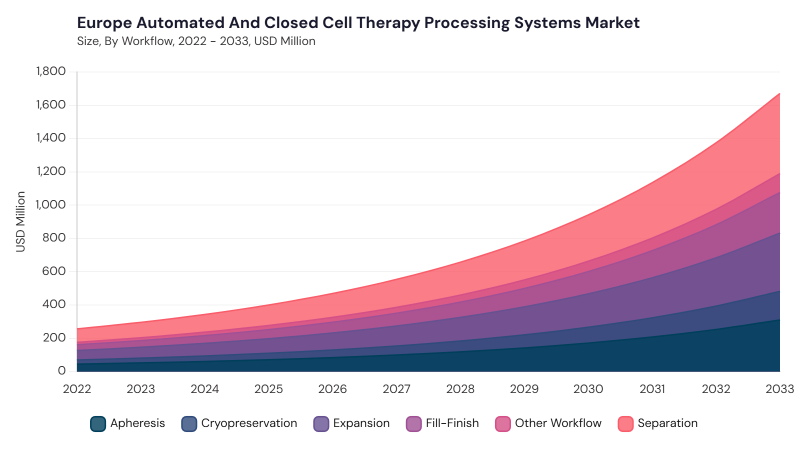
Based on Workflow, the market is segmented into Separation, Expansion, Apheresis, Fill-Finish, Cryopreservation, and Other Workflow. Separation leads the market because isolating high-quality target cells is a critical first step in cell therapy manufacturing. Automated closed separation systems help improve purity, viability, sterility, and process consistency while reducing operator intervention. Expansion is an important segment as many therapies require controlled cell proliferation to achieve clinically useful quantities without compromising potency or identity.
Automated expansion platforms support closed bioreactor-based culture, process monitoring, and scalable production for autologous and allogeneic therapies. Apheresis plays a key role in collecting patient-derived or donor-derived cells for personalized and immune cell therapy workflows. Fill-Finish supports aseptic final product handling, accurate dosing, sterile packaging, and regulatory compliance. Cryopreservation is important for secure storage, transport, and distribution of viable cell products across clinical and commercial networks. Other Workflow includes washing, formulation, buffer exchange, in-process sampling, and quality control preparation that support end-to-end automated manufacturing.
Free Valuable Insights: The Global Automated And Closed Cell Therapy Processing Systems Market will hit USD 7.0 Billion billion by 2033, at a CAGR of 20.2%
Based on Country, the market is segmented into Germany, UK, France, Russia, Spain, Italy, and Rest of Europe. The Germany market dominated the Europe Automated And Closed Cell Therapy Processing Systems Market by Country in 2025, and would continue to be a dominant market till 2033; thereby, achieving a market value of USD 244.9 million by 2031, growing at a CAGR of 18.4 % during the forecast period. The UK market is expected to witness a CAGR of 18.9% during (2026 - 2033). Additionally, The France market is expected to witness a CAGR of 20.7% during (2026 - 2033).
Germany remains the leading country market due to its strong biopharmaceutical manufacturing base, advanced therapy research ecosystem, GMP-focused production environment, and demand for modular and digitally integrated closed processing systems. The UK market is supported by advanced therapy manufacturing initiatives, strong clinical research activity, cell and gene therapy infrastructure, and increasing adoption of modular automation platforms for autologous and allogeneic therapies. France is progressing through regenerative medicine research, clinical trial activity, AI-enabled automation, and strong emphasis on compliance-ready closed processing systems. Russia contributes through gradual adoption of automated processing, robotics-supported workflows, and demand for cost-effective closed systems aligned with GMP standards. Spain is supported by hospital-based manufacturing interest, decentralized cell therapy production, CAR-T development, and demand for compact and flexible systems. Italy benefits from growing cell therapy clinical activity, modular automation adoption, GMP-grade processing needs, and partnerships between research institutions and manufacturing centers.

By Type
By Scale
By Workflow
By Country
Set to reach USD 1.1 billion by 2033, growing at 19.9% CAGR during 2026-2033.
Germany leads with USD 244.9 million by 2031, growing at 18.4% CAGR during the forecast period.
The dominance of non-stem cell therapy, reaching USD 636.3 million by 2031, is a key driver.
Non-stem cell therapy hits USD 636.3 million by 2031, growing at 19.5% CAGR during the forecast period.
The UK market is expected to witness a CAGR of 18.9% during 2026-2033.
Pre-Commercial/R&D Scale reaches USD 809.2 million by 2031, growing at 19.7% CAGR during the forecast period.
Our team of dedicated experts can provide you with attractive expansion opportunities for your business.




 Unique Offerings