The sample copy of this report is available for access.
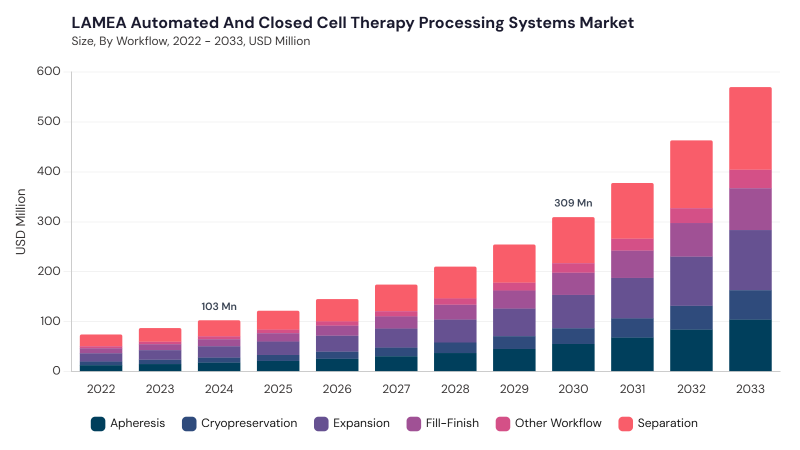
The LAMEA Automated And Closed Cell Therapy Processing Systems Market is expected to reach USD 254.5 million by 2029, growing at a CAGR of 21.6% during (2026 – 2033).
The LAMEA Automated And Closed Cell Therapy Processing Systems Market has evolved from manual, open, and labor-intensive cell therapy processing practices into a more automated, sterile, and compliance-oriented manufacturing ecosystem. In the early stage, cell therapy production across Latin America, the Middle East, and Africa relied heavily on manual handling, open processing steps, and limited infrastructure, which created challenges related to contamination risk, inconsistent cell quality, operator dependency, and limited scalability. As regenerative medicine, immunotherapies, stem cell therapies, and advanced biologic treatments gained attention, manufacturers and research centers increasingly required closed systems that could improve sterility, process control, reproducibility, and regulatory readiness. The market gradually advanced toward integrated automated platforms that support cell separation, expansion, washing, formulation, fill-finish, and preservation within controlled environments.
The current market is shaped by rising interest in regenerative medicine, gradual expansion of cell-based immunotherapy research, growing healthcare investment, increasing regulatory focus on quality control, and demand for scalable systems suited to diverse regional infrastructure conditions. Biotechnology companies, hospitals, academic centers, CDMOs, and specialized healthcare providers are seeking systems that can reduce manual intervention, improve process consistency, support contamination-free workflows, and enable better traceability across cell therapy manufacturing stages. Demand is also increasing for modular platforms, single-use disposable systems, AI-enabled process monitoring, digital workflow control, compact point-of-care processing tools, and flexible systems that can manage different cell types and therapy protocols.
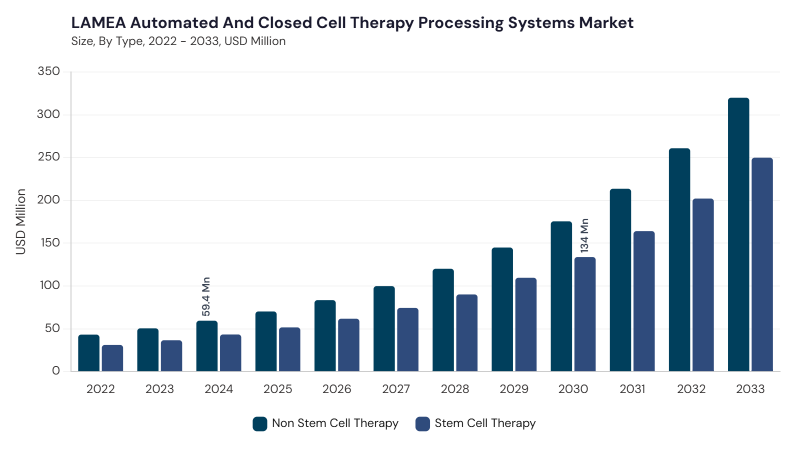
Based on Type, the market is segmented into Non Stem Cell Therapy and Stem Cell Therapy. The Non Stem Cell Therapy market dominated the LAMEA Automated And Closed Cell Therapy Processing Systems Market by Type in 2025, and would continue to be a dominant market till 2033; thereby, achieving a market value of USD 144.9 million by 2029, growing at a CAGR of 21.2 % during the forecast period. The Stem Cell Therapy market is expected to witness a CAGR of 22.1% during (2026 - 2033).
Non Stem Cell Therapy holds the leading position due to rising interest in immune cell therapies, oncology-focused cellular treatments, autologous therapies, and other advanced biologic platforms across selected LAMEA markets. Automated and closed systems help process immune cells under sterile, controlled, and reproducible conditions while reducing contamination risk and improving clinical research reliability. The segment is supported by increasing private healthcare investment, growing cancer treatment needs, and partnerships between regional healthcare providers and global technology companies. Stem Cell Therapy is also gaining relevance due to growing interest in regenerative medicine, orthopedic care, wound healing, chronic disease treatment, and stem cell research. Automated closed systems support stem cell separation, expansion, washing, storage, and controlled processing while improving safety, standardization, and quality control. Although adoption varies widely across the region, demand is expected to grow as healthcare infrastructure, regulatory clarity, and technical expertise continue improving.
Based on Scale, the market is segmented into Pre-Commercial / R&D Scale and Commercial Scale. The Pre-Commercial / R&D Scale market dominated the LAMEA Automated And Closed Cell Therapy Processing Systems Market by Scale in 2025, and would continue to be a dominant market till 2033; thereby, achieving a market value of USD 183.7 million by 2029, growing at a CAGR of 21.4 % during the forecast period. The Commercial Scale market is expected to witness a CAGR of 22.1% during (2026 - 2033).
Pre-Commercial / R&D Scale leads the market as much of the LAMEA cell therapy ecosystem remains concentrated in research, clinical development, pilot production, and early-stage process validation. Academic institutions, research laboratories, biotechnology startups, specialized hospitals, and early clinical programs require flexible automated systems that can support protocol development, small-batch processing, cell isolation, expansion, and cryopreservation under controlled conditions. These systems help reduce manual variability while supporting early compliance with quality and sterility standards. Commercial Scale is gaining importance as selected markets gradually expand cell therapy production capabilities and invest in more structured manufacturing infrastructure. Commercial-scale systems emphasize throughput, reproducibility, GMP alignment, automation depth, traceability, and reduced contamination risk. As advanced therapy commercialization increases across leading LAMEA economies, commercial-scale adoption is expected to progress steadily, supported by partnerships, localized manufacturing, and infrastructure development.
Based on Workflow, the market is segmented into Separation, Expansion, Apheresis, Fill-Finish, Cryopreservation, and Other Workflow. Separation leads the market because isolating high-quality therapeutic cells is a foundational step in cell therapy manufacturing. Automated closed separation systems help improve purity, viability, sterility, and process consistency while reducing operator handling and contamination exposure. Expansion is an important segment as cell therapies often require controlled cell growth to achieve clinically relevant quantities while maintaining product quality and functionality.
Automated expansion platforms support scalable culture conditions, reduced manual interaction, and better reproducibility across research and clinical manufacturing environments. Apheresis plays a developing role in collecting patient-derived or donor-derived cells for personalized therapies and immune cell workflows. Fill-Finish supports sterile final product preparation, formulation, dosing accuracy, and compliance-oriented handling. Cryopreservation is important for storage, transport, cold-chain management, and maintaining viable cell products across geographically dispersed markets. Other Workflow includes washing, formulation adjustment, quality control sampling, cell counting, logistics support, and other ancillary steps that improve end-to-end manufacturing efficiency.
Free Valuable Insights: The Global Automated And Closed Cell Therapy Processing Systems Market will hit USD 7.0 Billion billion by 2033, at a CAGR of 20.2%
Based on Country, the market is segmented into Brazil, Argentina, UAE, Saudi Arabia, South Africa, Nigeria, and Rest of LAMEA. The Brazil market dominated the LAMEA Automated And Closed Cell Therapy Processing Systems Market by Country in 2025, and would continue to be a dominant market till 2033; thereby, achieving a market value of USD 64.8 million by 2029, growing at a CAGR of 20.1 % during the forecast period. The Argentina market is expected to witness a CAGR of 22.5% during (2026 - 2033). Additionally, The UAE market is expected to witness a CAGR of 20.6% during (2026 - 2033).
Brazil remains the leading country market due to its expanding advanced therapy research base, growing interest in CAR-T and stem cell treatments, improving regulatory alignment, and increasing need for scalable closed processing systems. Argentina is progressing through regenerative medicine research, hospital-based cell therapy activity, academic-industry collaboration, and gradual adoption of compact automated systems for controlled processing. The UAE shows strong potential due to advanced healthcare infrastructure, biotechnology investment, personalized medicine initiatives, regulatory focus on quality assurance, and demand for digitally integrated closed processing platforms. Saudi Arabia is advancing through biotechnology localization, healthcare modernization, domestic manufacturing ambitions, and investment in automated systems aligned with national health strategies. South Africa contributes through cell therapy research, transplant-related applications, regulatory quality focus, and demand for modular platforms suited to clinical and research environments. Nigeria is emerging through growing interest in regenerative medicine, clinical research development, healthcare technology partnerships, and demand for cost-effective closed systems adapted to local infrastructure needs.

By Type
By Scale
By Workflow
By Country
Set to reach USD 254.5 million by 2033, growing at 21.6% CAGR during 2026-2033.
Brazil leads with USD 64.8 million by 2029, growing at 20.1% CAGR during 2026-2033.
The Non Stem Cell Therapy segment dominates, reaching USD 144.9 million by 2029 at 21.2% CAGR during 2026-2033.
Pre-Commercial/R&D Scale hits USD 183.7 million by 2029, growing at 21.4% CAGR during 2026-2033.
The UAE market is expected to grow at a CAGR of 20.6% during 2026-2033.
Argentina is expected to witness a CAGR of 22.5% during 2026-2033.
Our team of dedicated experts can provide you with attractive expansion opportunities for your business.




 Unique Offerings