The sample copy of this report is available for access.
“Global Automated And Closed Cell Therapy Processing Systems Market to reach a market value of USD 7,021.64 Million by 2033 growing at a CAGR of 20.2%”
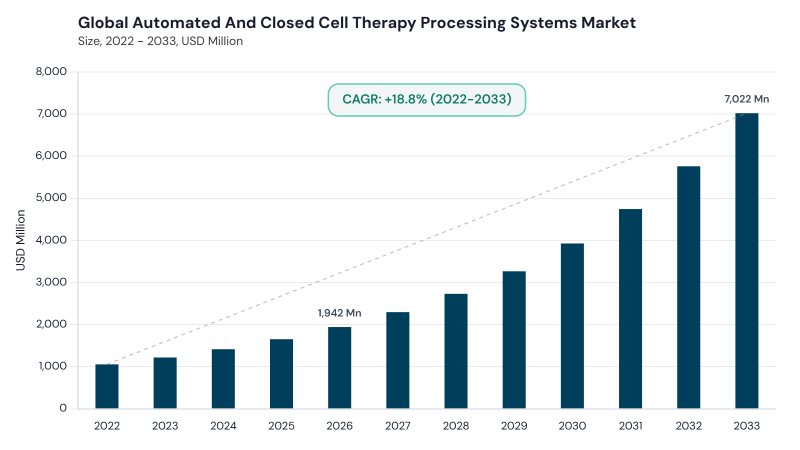
The Global Automated and Closed Cell Therapy Processing Systems Market is expected to reach USD 7.0 Billion by 2033, growing at a CAGR of 20.2% during (2026 – 2033).
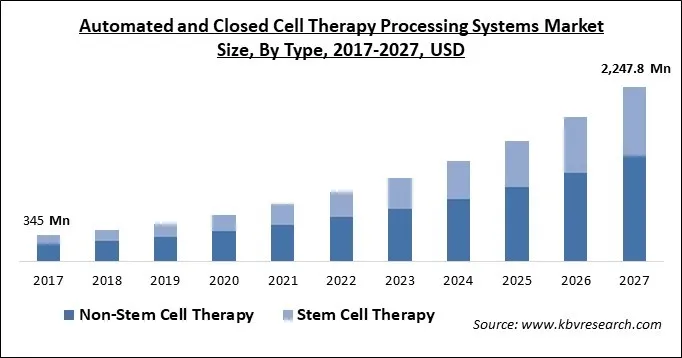
The Automated and Closed Cell Therapy Processing Systems Market is expanding as healthcare organizations, biotechnology companies, pharmaceutical manufacturers, CDMOs, hospitals, and research institutes focus on improving efficiency, scalability, safety, and regulatory compliance in cell therapy manufacturing. Rising advancements in regenerative medicine, stem cell therapies, CAR-T cell therapies, personalized medicine, and advanced therapy medicinal products are increasing demand for automated, closed, contamination-free, and standardized processing systems. The market started with manual, labor-intensive, and open processing methods that created risks related to contamination, reproducibility, scalability, and batch consistency. Over time, it evolved into integrated closed-system platforms supporting multiple processing stages within sterile environments.
The Automated And Closed Cell Therapy Processing Systems Market is witnessing strong expansion as cell therapy developers increasingly shift from manual and semi-automated processes toward closed, automated, and digitally controlled manufacturing platforms. These systems help reduce contamination risk, improve process reproducibility, lower operator dependency, support GMP compliance, and enable better scale-up from clinical trials to commercial production. The market is further supported by increasing cell and gene therapy pipelines, rising commercialization of CAR-T therapies, growing demand for autologous and allogeneic therapies, and the need for cost-efficient, standardized, and scalable manufacturing workflows.
The Automated And Closed Cell Therapy Processing Systems Market is characterized by a moderately consolidated and advanced bioprocessing technology-driven competitive environment. Competition is centered on end-to-end automation, closed-system manufacturing, single-use technologies, process analytics, modularity, regulatory compliance, AI-enabled optimization, and commercial scalability. Global life science and bioprocessing companies compete through broad product portfolios and integrated manufacturing ecosystems, while specialized automation players compete through purpose-built closed platforms, flexible workflows, and advanced digital manufacturing capabilities.
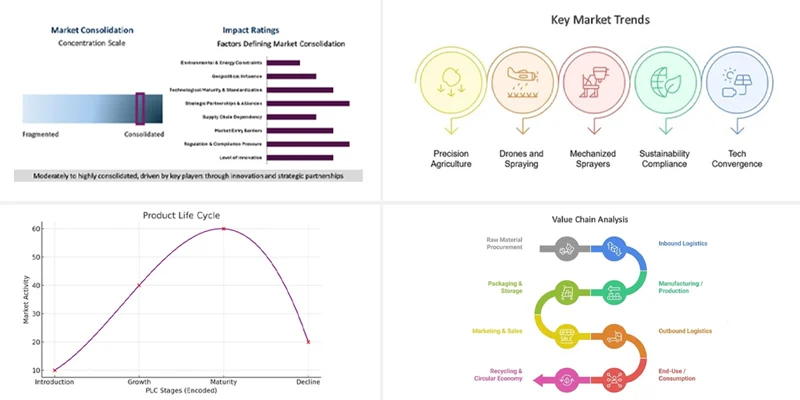

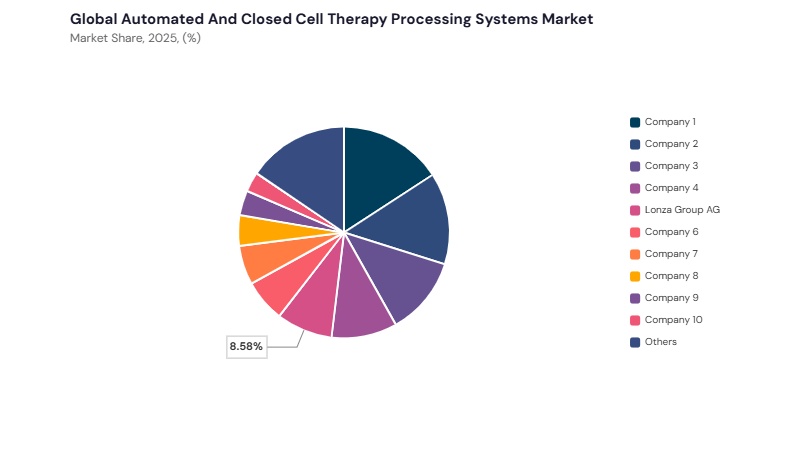
The global Automated And Closed Cell Therapy Processing Systems Market is moderately consolidated, with competition led by life science companies, bioprocess equipment manufacturers, cell therapy automation specialists, and advanced therapy technology providers. Thermo Fisher Scientific Inc. leads the market due to its broad automated cell processing, closed bioprocessing, single-use, analytical, and manufacturing capabilities. Cytiva, Sartorius AG, Miltenyi Biotec, and Lonza Group also hold strong positions through automated processing platforms, closed-system technologies, scalable bioprocessing, and cell therapy manufacturing expertise. Other key players such as Fresenius Kabi, Terumo BCT, Bio-Techne, Cellares, and Merck KGaA strengthen the market through specialized collection, processing, reagents, and automated manufacturing solutions.
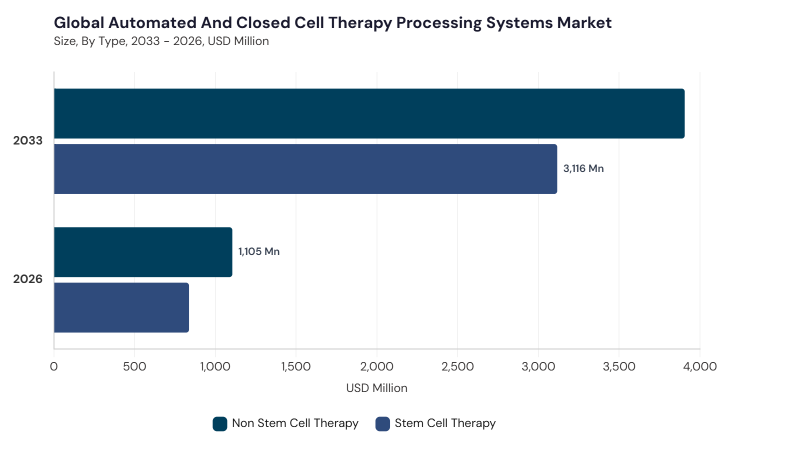
Based on Type, the market is segmented into Non Stem Cell Therapy and Stem Cell Therapy. The Non Stem Cell Therapy market dominated the Global Automated And Closed Cell Therapy Processing Systems Market by Type in 2025, and would continue to be a dominant market till 2033; thereby, achieving a market value of USD 3.9 Billion by 2033, growing at a CAGR of 19.8 % during the forecast period. The Stem Cell Therapy market is expected to witness a CAGR of 20.7% during (2026 - 2033).
Non Stem Cell Therapy leads the market due to the increasing development and commercialization of immune cell therapies, particularly CAR-T, TCR-based therapies, NK cell therapies, and other engineered cell-based treatments. These therapies require complex processing steps such as cell collection, isolation, activation, expansion, genetic modification, washing, concentration, and final formulation, making automated and closed systems highly valuable. Stem Cell Therapy is also gaining strong traction as regenerative medicine, tissue engineering, autoimmune disease research, neurological applications, orthopedic therapies, cardiovascular repair, and wound healing applications continue to expand. Automated closed systems help improve stem cell viability, purity, potency, reproducibility, and regulatory readiness across research, clinical, and commercial settings.
Based on Scale, the market is segmented into Pre-Commercial / R&D Scale and Commercial Scale. The Pre-Commercial / R&D Scale market dominated the Global Automated And Closed Cell Therapy Processing Systems Market by Scale in 2025, and would continue to be a dominant market till 2033; thereby, achieving a market value of USD 5.0 Billion by 2033, growing at a CAGR of 20 % during the forecast period. The Commercial Scale market is expected to witness a CAGR of 20.6% during (2026 - 2033).
Pre-Commercial / R&D Scale dominates the market as academic institutions, biotechnology startups, research organizations, and early-stage cell therapy developers increasingly rely on flexible automated systems for process development, small-batch manufacturing, clinical trial material production, and protocol optimization. These systems support experimentation across diverse cell types and therapy formats while reducing contamination risk and improving process consistency. Commercial Scale is gaining momentum as more cell therapies move through late-stage clinical trials, regulatory approvals, and commercial manufacturing. At this scale, automated and closed systems support higher throughput, reproducible batch production, traceability, reduced manual labor, and GMP-compliant manufacturing for broader clinical distribution.
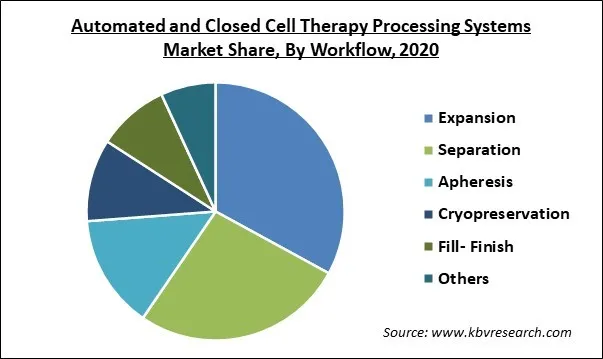
Based on Workflow, the market is segmented into Separation, Expansion, Apheresis, Fill-Finish, Cryopreservation, and Other Workflow. The Separation market dominated the Global Automated And Closed Cell Therapy Processing Systems Market by Workflow in 2025, and would continue to be a dominant market till 2033; thereby, achieving a market value of USD 2.0 Billion by 2033, growing at a CAGR of 19.2 % during the forecast period. The Expansion market is expected to witness a CAGR of 19.5% during (2026 - 2033). Additionally, The Apheresis market is expected to witness highest CAGR of 20.8% during (2026 - 2033).
Separation leads the market due to its critical role in isolating target cells with high purity, viability, and consistency from complex biological samples such as peripheral blood or bone marrow. Expansion is another major workflow as manufacturers require scalable cell proliferation systems to produce clinically relevant doses while maintaining cell quality and phenotype. Apheresis supports the collection of patient-derived or donor-derived cells for autologous and allogeneic therapies. Fill-Finish is gaining importance as automated aseptic filling improves dose accuracy, sterility, and regulatory compliance. Cryopreservation supports long-term storage, shipment, and treatment scheduling, while Other Workflow includes washing, conditioning, formulation, quality control, and other supportive processing steps that improve overall manufacturing efficiency.
Free Valuable Insights: Automated And Closed Cell Therapy Processing Systems Market Size to reach $7.0 Billion by 2033
Region-wise, the Automated And Closed Cell Therapy Processing Systems Market is analyzed across North America, Europe, Asia Pacific, and LAMEA. The North America market dominated the Global Automated And Closed Cell Therapy Processing Systems Market by Region in 2025, and would continue to be a dominant market till 2033; thereby, achieving a market value of USD 3.2 Billion by 2033, growing at a CAGR of 19.5 % during the forecast period. The Europe market is expected to witness a CAGR of 19.9% during (2026 - 2033). Additionally, The Asia Pacific market is expected to witness a CAGR of 21.3% during (2026 - 2033).
North America dominates the market due to strong biopharmaceutical investments, advanced cell therapy manufacturing infrastructure, favorable regulatory support, high clinical trial activity, and increasing commercialization of CAR-T and other advanced therapies. Europe is supported by expanding regenerative medicine research, strong ATMP regulatory frameworks, growing biomanufacturing capacity, and demand for GMP-compliant closed processing technologies. Asia Pacific is witnessing strong growth due to rising biotechnology investments, increasing clinical research, expanding healthcare infrastructure, and growing cell therapy development in China, Japan, South Korea, India, and Singapore. LAMEA holds a smaller but emerging position as investment in advanced therapeutics, clinical research, and automated cell processing gradually increases across Latin America, the Middle East, and Africa.
| Report Attribute | Details |
|---|---|
| Market size value in 2026 | USD 1.9 Billion |
| Market size forecast in 2033 | USD 7.0 Billion |
| Base Year | 2025 |
| Historical Period | 2022 to 2024 |
| Forecast Period | 2026 to 2033 |
| Revenue Growth Rate | CAGR of 20.2% from 2026 to 2033 |
| Number of Pages | 546 |
| Tables | 630 |
| Report Coverage | Market Trends, Revenue Estimation and Forecast, Segmentation Analysis, Regional and Country Breakdown, Competitive Landscape, Market Share Analysis, Company Profiling, Companies Strategic Developments, SWOT Analysis, Product Life Cycle Analysis, Value Chain Analysis, Market Consolidation Analysis, Key Customer Criteria, Pandemic Impact Analysis, and Winning Imperatives |
| Segments Covered | Type, Scale, Workflow, Region |
| Country Scope |
|
| Companies Included | Thermo Fisher Scientific Inc., Cytiva, Sartorius AG, Miltenyi Biotec B.V. & Co. KG, Lonza Group AG, Fresenius Kabi AG, Terumo BCT, Inc., Bio-Techne Corporation, Cellares Corporation, and Merck KGaA |
By Type
By Scale
By Workflow
By Geography
The market size is USD 1.9 billion in 2026.
Non stem cell therapy leads, expected to reach USD 3.9 billion by 2033.
Thermo Fisher Scientific Inc., Cytiva, Sartorius AG, Miltenyi Biotec B.V. & Co. KG, Lonza Group AG.
North America dominates, projected to reach USD 3.2 billion by 2033.
Advancements in automation and digital integration are enhancing market efficiency.
Separation leads, expected to achieve USD 2.0 billion by 2033.
Our team of dedicated experts can provide you with attractive expansion opportunities for your business.








 Unique Offerings