The North America 5G Router Market is expected to reach USD 4.5 billion by 2032, growing at a CAGR of 26.2% during (2026 – 2033).
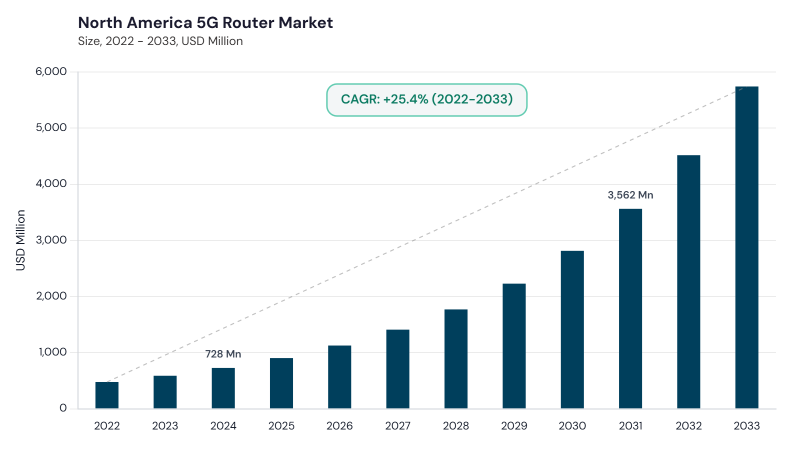
The North America 5G Router Market developed as demand increased for wireless broadband connectivity beyond the speed, latency, and capacity limits of 4G LTE networks. Early market development involved combining 5G radio access technologies with traditional routing functions, mainly for enterprises, smart cities, and early fixed wireless access use cases. Adoption expanded as standalone and non-standalone 5G architectures progressed, spectrum availability improved, and mid-band and millimeter-wave deployments enhanced throughput. The market later diversified into routers supporting fixed wireless access, edge computing, private networks, and IoT-heavy environments.
The North America 5G Router Market is being shaped by private 5G deployments, IoT proliferation, smart city projects, SD-WAN integration, telecom infrastructure investments, and fixed wireless access adoption. Customers are selecting routers based on throughput, latency, signal reliability, security architecture, integration with existing networks, cost structure, modularity, and scalability. Demand is supported by residential broadband replacement, enterprise connectivity, industrial automation, transportation networks, telemedicine, public safety, and temporary connectivity deployments. Vendors are focusing on AI-driven network optimization, network-native security, edge computing compatibility, multi-band support, Wi-Fi integration, and software-defined management.
Based on Connectivity, the market is segmented into Non-Standalone and Standalone. The Non-Standalone market dominated the North America 5G Router Market by Connectivity in 2025, and would continue to be a dominant market till 2033; thereby, achieving a market value of USD 2.9 billion by 2032, growing at a CAGR of 25.7 % during the forecast period. The Standalone market is expected to witness a CAGR of 27.1% during (2026 - 2033).
Non-Standalone leads as telecom operators continue to use existing LTE infrastructure to accelerate 5G deployment, reduce implementation costs, and provide service continuity during the transition to advanced networks. NSA routers support fixed wireless access, residential broadband, enterprise connectivity, and early IoT use cases where immediate coverage and faster rollout are important. Standalone remains significant as investment grows in 5G core networks capable of supporting ultra-low latency, network slicing, private 5G, and mission-critical applications. This segment is increasingly aligned with smart manufacturing, autonomous systems, healthcare telemetry, logistics, and enterprise networks requiring stronger control, security, and real-time responsiveness.
Based on Product Type, the market is segmented into Indoor 5G Routers, Outdoor 5G Routers, and Portable 5G Routers. The Indoor 5G Routers market dominated the North America 5G Router Market by Product Type in 2025, and would continue to be a dominant market till 2033; thereby, achieving a market value of USD 2.3 billion by 2032, growing at a CAGR of 25.8 % during the forecast period. The Outdoor 5G Routers market is expected to witness a CAGR of 26.7% during (2026 - 2033). The Portable 5G Routers market is expected to witness a CAGR of 26.7% during (2026 - 2033).
Indoor 5G Routers lead as homes, offices, small businesses, and commercial spaces require reliable high-speed broadband for streaming, gaming, remote work, smart home devices, cloud applications, and video conferencing. These routers benefit from fixed wireless access adoption and integration with Wi-Fi, mesh networking, and cloud-managed features. Outdoor 5G Routers remain significant because they provide robust connectivity for construction sites, campuses, public infrastructure, transportation hubs, remote facilities, and rural broadband deployments. Portable 5G Routers support remote workers, mobile professionals, emergency response teams, travelers, field operations, and temporary locations requiring secure, compact, battery-powered, and quickly deployable connectivity.
Based on Application, the market is segmented into Residential, Commercial, Industrial, and Other Application. The Residential market dominated the North America 5G Router Market by Application in 2025, and would continue to be a dominant market till 2033; thereby, achieving a market value of USD 1.7 billion by 2032, growing at a CAGR of 25.4 % during the forecast period. The Commercial market is expected to witness a CAGR of 26.4% during (2026 - 2033). Additionally, The Industrial market is expected to witness highest CAGR of 27.1% during (2026 - 2033).
Residential leads as consumers increasingly adopt 5G routers for high-speed home broadband, smart home connectivity, online gaming, video streaming, remote work, and fiber-alternative internet access. Commercial remains significant as offices, retail outlets, hospitality venues, educational institutions, and small businesses require secure wireless connectivity for cloud services, point-of-sale systems, unified communication, and digital operations. Industrial adoption is supported by automation, robotics, smart manufacturing, remote monitoring, and real-time machine communication. Other Application includes public safety, construction sites, outdoor events, rural connectivity projects, emergency response, and specialized networks requiring flexible, resilient, and fast-deployable wireless infrastructure.
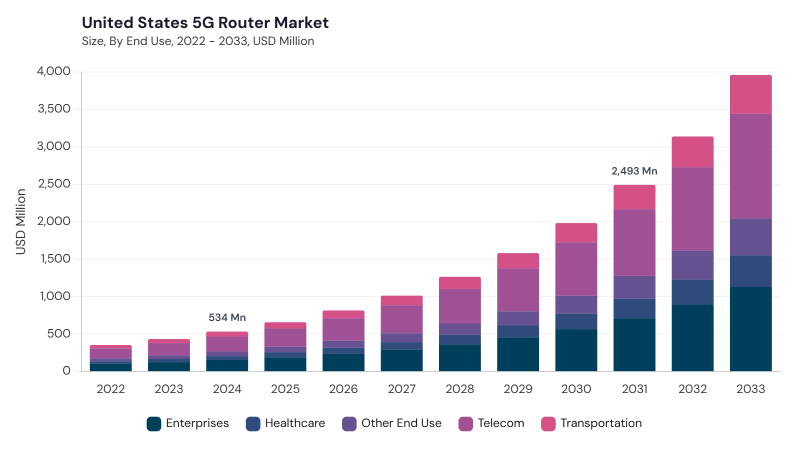
Based on End Use, the market is segmented into Telecom, Enterprises, Transportation, Healthcare, and Other End Use. Telecom leads as communication service providers expand 5G infrastructure, fixed wireless access services, network slicing capabilities, edge gateways, and high-capacity routing systems. Enterprises remain significant as organizations adopt 5G routers for secure WAN connectivity, hybrid work, cloud applications, IoT integration, remote access, and multi-location business operations.
Transportation uses these routers for fleet management, connected vehicles, public transit, smart traffic systems, passenger connectivity, and logistics visibility. Healthcare adoption is supported by telemedicine, connected medical devices, remote patient monitoring, emergency response, and secure data transmission, while Other End Use includes government, education, utilities, public safety, smart buildings, and municipal IoT deployments.
Free Valuable Insights: The Global 5G Router Market will hit USD 19.7 Billion billion by 2033, at a CAGR of 27.0%
Based on Country, the market is segmented into US, Canada, Mexico, and Rest of North America. The US market dominated the North America 5G Router Market by Country in 2025, and would continue to be a dominant market till 2033; thereby, achieving a market value of USD 3.1 billion by 2032, growing at a CAGR of 25.3 % during the forecast period. The Canada market is expected to witness a CAGR of 28% during (2026 - 2033). Additionally, The Mexico market is expected to witness a CAGR of 27.9% during (2026 - 2033).
The US leads due to CBRS-enabled private network growth, broad 5G rollout, IoT expansion, enterprise digitization, Cloud RAN adoption, and demand for routers supporting edge computing and AI-enabled network management. Canada supports market growth through industrial-grade routers, rugged outdoor use, rural connectivity, standalone 5G expansion, edge computing integration, and partnerships between telecom providers and hardware manufacturers. Mexico is advancing through telecom modernization, 5G infrastructure expansion, private networks, smart city development, and demand for cost-effective enterprise and residential routers. Rest of North America benefits from fixed wireless access, localized router configurations, cybersecurity upgrades, edge-enabled devices, and broadband expansion across underserved urban, suburban, and rural markets.

By Connectivity
By Product Type
By Application
By End Use
By Country
Set to reach $4.5 Billion by 2032, growing at 26.2% CAGR during 2026-2033.
The US leads with $3.1 billion by 2032, growing at a 25.3% CAGR during the forecast period.
Rising demand in the Residential sector, reaching $1.7 billion by 2032 at a 25.4% CAGR.
Non-Standalone segment to reach $2.9 billion by 2032, growing at a 25.7% CAGR during the forecast period.
The Canada market is expected to witness a 28% CAGR during 2026-2033.
Indoor 5G Routers to reach $2.3 billion by 2032, growing at a 25.8% CAGR during the forecast period.
Our team of dedicated experts can provide you with attractive expansion opportunities for your business.




 Unique Offerings