“Global 5G Router Market to reach a market value of USD 19,752.96 Million by 2033 growing at a CAGR of 27%”
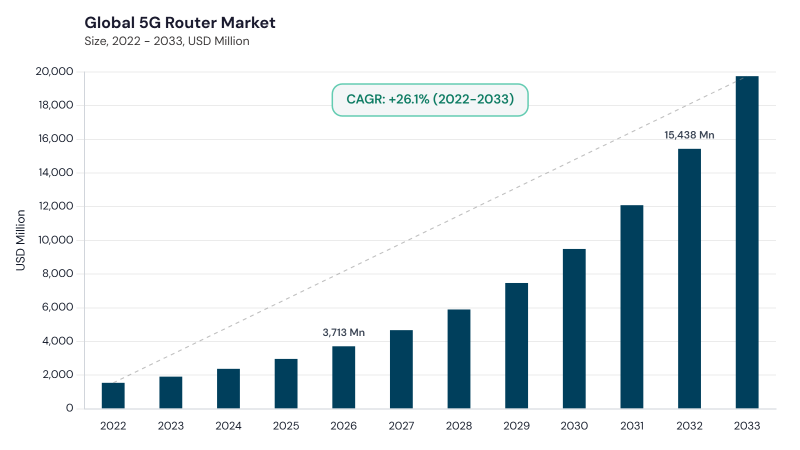
The Global 5G Router Market is expected to reach USD 19.7 billion by 2033, growing at a CAGR of 27% during (2026 - 2033).
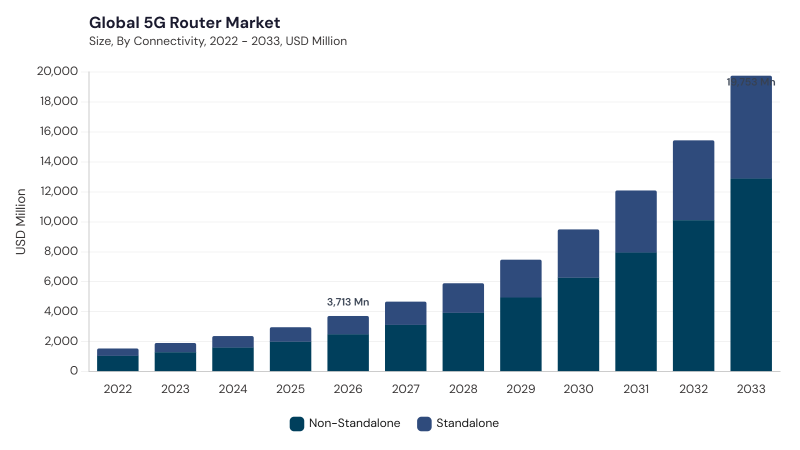
5G router market is shaped by surging demand for low-latency communication, high-speed wireless connectivity, and reliable broadband access across commercial, residential, transportation, industrial, and enterprise environments. Market demand is further surging as users focus on uninterrupted video streaming, faster data transmission, enhanced network performance, flexible deployment, and multi-device connectivity. 5G router market evolved along with the advent of 5G technology, developed to overcome latency, speed, and connectivity limitations of earlier cellular generations. 5G routers developed into key devices for enterprise connectivity, fixed wireless access, mobile broadband, and industrial IoT.
5G router market is expanding as 5G routers become necessary gateways for home broadband replacement, fixed wireless access, private 5G networks, industrial connectivity, enterprise wireless WAN deployment, and transportation systems. Growing IoT adoption, expanding 5G coverage, rising demand for cloud-managed networking, and remote work requirements are strengthening market adoption. Manufacturers are largely focusing on wi-fi integration, advanced antenna systems, remote management, stronger security, edge readiness, and router designs suited for enterprise, residential, and industrial connectivity environments.
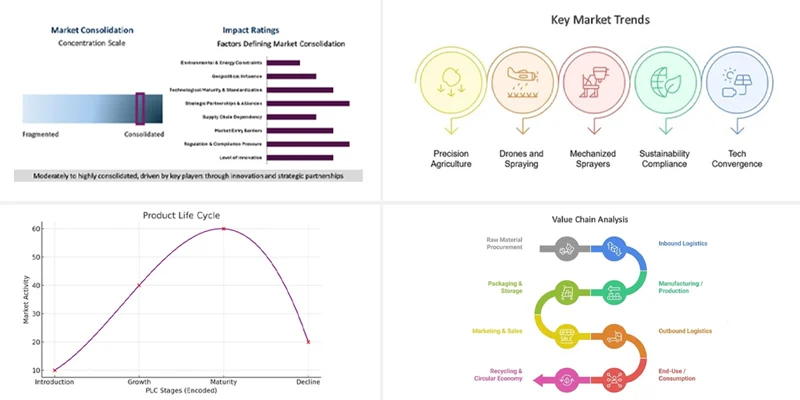
5G router market represents a connectivity-driven and highly consolidated, supported by networking solution providers, telecom equipment manufacturers, industrial networking companies, enterprise wireless WAN specialists, Wi-Fi integration, cloud-managed networking, operator partnerships, ruggedized hardware, and SD-WAN support. Market competition is predicted to rely on Wi-Fi 7 integration, 5G advanced readiness, AI-powered network management, cybersecurity, edge computing, and reliable wireless broadband performance.

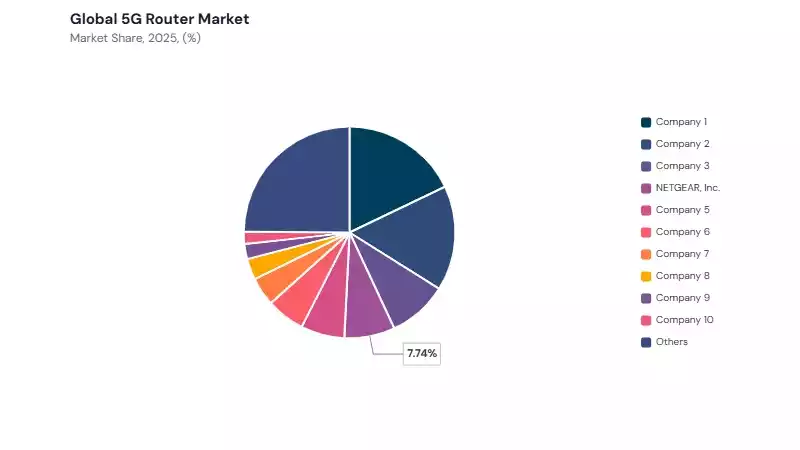
5G router market represents a connectivity-driven competitive landscape shaped by networking solution providers, telecommunications equipment manufacturers, fixed wireless access vendors, and industrial networking companies. ZTE Corporation, and HTE Technologies hold strong position through operator relationships, carrier-grade networking solutions, fixed wireless access gateways, and 5G customer premises equipment. Market players are further positioning themselves ahead in competition through industrial IoT, enterprise wireless WAN, cloud-managed routing, mission-critical networking solutions, and transportation connectivity.
Based on Connectivity, the market is segmented into Non-Standalone and Standalone. The Non-Standalone market dominated the Global 5G Router Market by Connectivity in 2025, and would continue to be a dominant market till 2033; thereby, achieving a market value of USD 12.8 billion by 2033, growing at a CAGR of 26.5 % during the forecast period. The Standalone market is expected to witness a CAGR of 27.9% during (2026 - 2033).
Non-Standalone leads the market as telecom operators use existing LTE infrastructure to enable faster and lower-cost 5G rollout while supporting enhanced mobile broadband and fixed wireless access. Standalone is gaining demand as dedicated 5G core networks expand across enterprise, industrial, and mission-critical environments. These routers enable ultra-low latency, network slicing, private 5G deployment, advanced security, and improved support for industrial automation and edge computing applications.
Based on Product Type, the market is segmented into Indoor 5G Routers, Outdoor 5G Routers, and Portable 5G Routers. The Indoor 5G Routers market dominated the Global 5G Router Market by Product Type in 2025, and would continue to be a dominant market till 2033; thereby, achieving a market value of USD 10.3 billion by 2033, growing at a CAGR of 26.5 % during the forecast period. The Outdoor 5G Routers market is expected to witness a CAGR of 27.5% during (2026 - 2033). The Portable 5G Routers market is expected to witness a CAGR of 27.4% during (2026 - 2033).
Indoor 5G Routers lead due to strong adoption across homes, offices, small businesses, and commercial spaces requiring stable high-speed broadband connectivity. Outdoor 5G Routers support industrial sites, rural broadband, smart city projects, venues, and remote facilities through rugged construction and stronger antenna performance. Portable 5G Routers serve mobile workers, travelers, temporary sites, transportation users, and field operations requiring flexible broadband access.
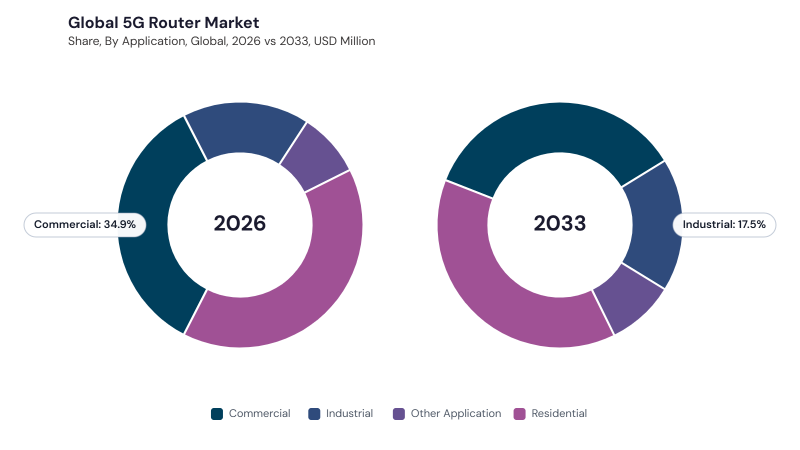
Based on Application, the market is segmented into Residential, Commercial, Industrial, and Other Application. The Residential market dominated the Global 5G Router Market by Application in 2025, and would continue to be a dominant market till 2033; thereby, achieving a market value of USD 7.5 billion by 2033, growing at a CAGR of 26.2 % during the forecast period. The Commercial market is expected to witness a CAGR of 27.2% during (2026 - 2033). Additionally, The Industrial market is expected to witness highest CAGR of 27.8% during (2026 - 2033).
Residential leads the market as 5G routers support home broadband, video streaming, gaming, remote work, online learning, and smart home connectivity. Commercial applications are expanding across offices, retail, hospitality, education, and small businesses requiring secure, scalable wireless networks. Industrial use is increasing through smart manufacturing, automation, private 5G, robotics, monitoring, and predictive maintenance, while Other Application supports public safety, temporary connectivity, smart city, and specialized communication needs.
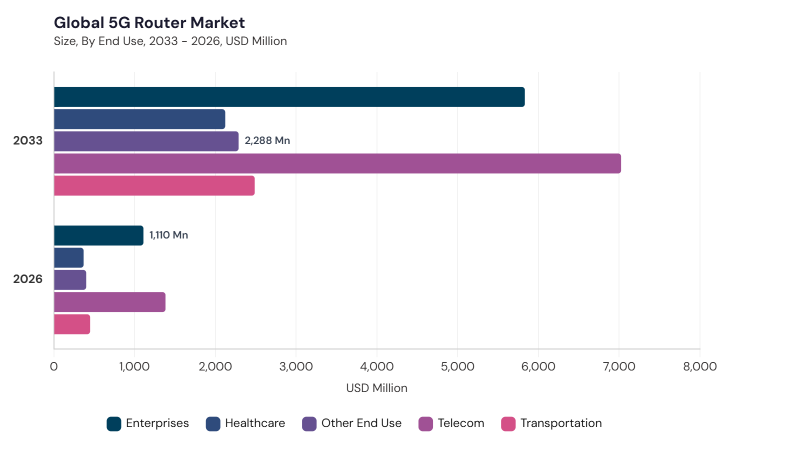
Based on End Use, the market is segmented into Telecom, Enterprises, Transportation, Healthcare, and Other End Use. The Telecom market dominated the Global 5G Router Market by End Use in 2025, and would continue to be a dominant market till 2033; thereby, achieving a market value of USD 7.0 billion by 2033, growing at a CAGR of 26.1 % during the forecast period. The Enterprises market is expected to witness a CAGR of 26.7% during (2026 - 2033). Additionally, The Transportation market is expected to witness highest CAGR of 27.7% during (2026 - 2033).
Telecom leads the market through investments in 5G infrastructure, fixed wireless access, broadband expansion, and next-generation communication services. Enterprises adopt 5G routers for digital transformation, hybrid work, secure wireless WAN, cloud access, and IoT-enabled operations. Transportation uses these routers for fleet management, connected mobility, V2X, passenger connectivity, and real-time data exchange, while Healthcare and Other End Use support telemedicine, connected medical devices, education, government, public safety, and smart infrastructure.
Free Valuable Insights: 5G Router Market Size to reach $19.7 Billion by 2033
Region-wise, the 5G Router Market is analyzed across North America, Europe, Asia Pacific, and LAMEA. In 2025, the Asia Pacific captured the largest share in 5G router market and is anticipated to remain at the same position till 2033, with a market value of USD 7.4 billion, expanding with a CAGR of 27.5% by 2033. Moreover, the North America market is predicted to grow at a CAGR of 26.6% during 2026-2033 and Europe market is anticipated to witness a CAGR of 26.7% in the forecast period.
APAC dominates the market because of rapid 5G infrastructure, fixed wireless access adoption, smart city investment, and strong demand for industrial and residential high-speed connectivity. North America is shaped by enterprise digital transformation, widespread 5G commercialization, and advanced wireless technology investment. Furthermore, Europe is witnessing growth due to elements including digital infrastructure initiatives, Industry 4.0 adoption, and 5G coverage. Also, LAMEA is experiencing expansion through growing broadband connectivity demand and telecom infrastructure investment.
| Report Attribute | Details |
|---|---|
| Market size value in 2026 | USD 3.7 billion |
| Market size forecast in 2033 | USD 19.7 billion |
| Base Year | 2025 |
| Historical Period | 2022 to 2024 |
| Forecast Period | 2026 to 2033 |
| Revenue Growth Rate | CAGR of 27.0% from 2026 to 2033 |
| Number of Pages | 635 |
| Tables | 780 |
| Report Coverage | Market Trends, Revenue Estimation and Forecast, Segmentation Analysis, Regional and Country Breakdown, Competitive Landscape, Market Share Analysis, Company Profiling, Companies Strategic Developments, SWOT Analysis, Product Life Cycle Analysis, Value Chain Analysis, Market Consolidation Analysis, Key Customer Criteria, Pandemic Impact Analysis, and Winning Imperatives |
| Segments Covered | Connectivity, Product Type, Application, End Use, and Geography |
| Country Scope |
|
| Companies Included | Huawei Technologies Co., Ltd.; ZTE Corporation; TP-Link; NETGEAR, Inc.; Ericsson (Cradlepoint); Nokia Corporation; Inseego Corp.; Zyxel Group Corporation; Peplink; Teltonika Networks |
By Connectivity
By Product Type
By Application
By End Use
By Geography
The 5G Router Market is valued at USD 3.7 billion in 2026.
Non-Standalone segment leads, reaching USD 12.8 billion by 2033.
Huawei, ZTE, TP-Link, NETGEAR, Ericsson, Nokia, Inseego, Zyxel, Peplink, Teltonika.
Asia Pacific leads, achieving USD 7.4 billion by 2033.
Industrial automation expansion and IoT integration fueled by 5G connectivity drive growth.
The market is expected to reach USD 19.7 billion by 2033, growing at 27.0% CAGR during 2026-2033.
Our team of dedicated experts can provide you with attractive expansion opportunities for your business.








 Unique Offerings