The LAMEA 5G Router Market is expected to reach USD 676.2 million by 2029, growing at a CAGR of 28.3% during (2026 – 2033).
The LAMEA 5G Router Market evolved from the broader advancement of wireless communication technologies across Latin America, the Middle East, and Africa, where 3G and 4G LTE networks initially supported internet connectivity. Early 5G development was driven by demand for higher bandwidth, lower latency, and more reliable networks across consumer, enterprise, and industrial environments. The market advanced with millimeter wave frequencies, massive MIMO antenna arrays, small cell networks, and the integration of LPWA technologies such as LTE-M and NB-IoT. These developments supported the transition from experimental 5G deployments to commercially viable router solutions.
The LAMEA 5G Router Market is being shaped by 5G infrastructure rollout, industrial automation, IoT integration, digital inclusion initiatives, security-focused network management, and demand for scalable connectivity. Customers are selecting routers based on performance reliability, affordability, interoperability, regulatory compliance, data security, scalability, and customization flexibility. Demand is supported by residential broadband, commercial digitization, telecom modernization, energy and mining connectivity, transportation networks, healthcare systems, education, public safety, and emergency response operations. Vendors are focusing on enhanced antenna technology, software-defined networking, edge computing integration, AI-driven network management, rugged device designs, and localized product configurations.
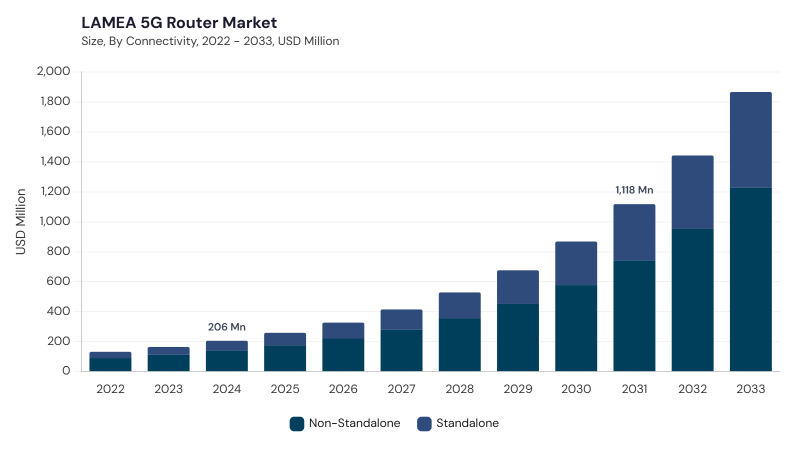
Based on Connectivity, the market is segmented into Non-Standalone and Standalone. The Non-Standalone market dominated the LAMEA 5G Router Market by Connectivity in 2025, and would continue to be a dominant market till 2033; thereby, achieving a market value of USD 451.4 million by 2029, growing at a CAGR of 27.8 % during the forecast period. The Standalone market is expected to witness a CAGR of 29.2% during (2026 - 2033).
Non-Standalone leads as telecom operators use existing 4G LTE infrastructure to commercialize 5G services cost-effectively while improving broadband availability across Latin America, the Middle East, and Africa. NSA routers support residential users, SMEs, and early enterprise deployments that need faster connectivity without full infrastructure replacement. Standalone remains significant as investments grow in digital infrastructure, private 5G networks, smart cities, and industrial connectivity. This segment supports low-latency communication, network slicing, high-capacity services, enterprise IoT, healthcare connectivity, and advanced public sector applications.
Based on Product Type, the market is segmented into Indoor 5G Routers, Outdoor 5G Routers, and Portable 5G Routers. The Indoor 5G Routers market dominated the LAMEA 5G Router Market by Product Type in 2025, and would continue to be a dominant market till 2033; thereby, achieving a market value of USD 363.0 million by 2029, growing at a CAGR of 27.8 % during the forecast period. The Outdoor 5G Routers market is expected to witness a CAGR of 28.8% during (2026 - 2033). The Portable 5G Routers market is expected to witness a CAGR of 28.8% during (2026 - 2033).
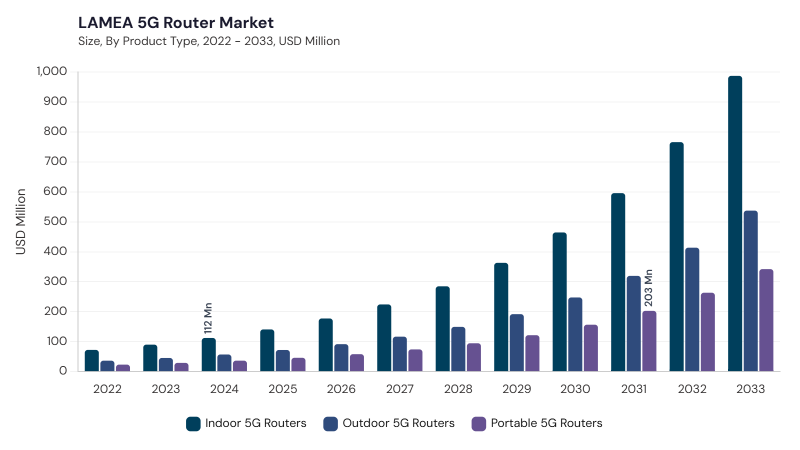
Indoor 5G Routers lead as residential properties, offices, small businesses, and commercial spaces increasingly require dependable wireless broadband for streaming, remote work, online education, smart homes, cloud tools, and daily digital operations. These routers benefit from fixed wireless access expansion in areas where fiber deployment remains limited or costly. Outdoor 5G Routers remain significant for oil and gas facilities, mining sites, construction projects, transportation infrastructure, rural broadband, smart city networks, and remote industrial sites. Portable 5G Routers support mobile workforces, business travelers, field teams, temporary worksites, public events, emergency communication, and flexible connectivity needs.
Based on Application, the market is segmented into Residential, Commercial, Industrial, and Other Application. The Residential market dominated the LAMEA 5G Router Market by Application in 2025, and would continue to be a dominant market till 2033; thereby, achieving a market value of USD 267.3 million by 2029, growing at a CAGR of 27.4 % during the forecast period. The Commercial market is expected to witness a CAGR of 28.4% during (2026 - 2033). Additionally, The Industrial market is expected to witness highest CAGR of 29.1% during (2026 - 2033).
Residential leads as consumers increasingly seek reliable broadband for video streaming, online education, remote working, smart home applications, gaming, and high-speed wireless access where fixed-line infrastructure is limited. Commercial remains significant as retail outlets, hospitality facilities, financial institutions, offices, SMEs, and co-working spaces need secure and uninterrupted connectivity for cloud systems, POS platforms, and digital services. Industrial adoption is supported by manufacturing, energy, mining, logistics, automation, remote monitoring, and Industrial IoT. Other Application includes public sector projects, smart agriculture, educational campuses, transportation hubs, public safety networks, temporary events, and emergency response operations.
Based on End Use, the market is segmented into Telecom, Enterprises, Transportation, Healthcare, and Other End Use. Telecom leads as operators continue investing in 5G network expansion, wireless infrastructure modernization, broadband services, small cell deployments, and scalable network capacity. Enterprises remain significant as organizations adopt 5G routers for cloud platforms, connected workplaces, hybrid work, secure communication, IoT integration, and digital transformation.
Transportation uses these routers across airports, ports, logistics hubs, fleet management systems, intelligent mobility projects, and real-time communication networks. Healthcare adoption is supported by telehealth, connected healthcare facilities, remote diagnostics, digital patient management, and secure high-speed connectivity, while Other End Use includes government, education, utilities, agriculture, energy, and public safety.
Free Valuable Insights: 5G Router Market Size Worth USD 19.7 Billion billion by 2033
Based on Country, the market is segmented into Brazil, Argentina, UAE, Saudi Arabia, South Africa, Nigeria, and Rest of LAMEA. The Brazil market dominated the LAMEA 5G Router Market by Country in 2025, and would continue to be a dominant market till 2033; thereby, achieving a market value of USD 138.7 million by 2029, growing at a CAGR of 26.3 % during the forecast period. The Argentina market is expected to witness a CAGR of 30.1% during (2026 - 2033). Additionally, The UAE market is expected to witness a CAGR of 26.9% during (2026 - 2033).
Brazil leads due to 5G infrastructure rollout, spectrum reforms, private network adoption, smart city projects, industrial IoT, AI-driven network management, and demand for routers supporting enterprise and consumer connectivity. Argentina supports market growth through AI-enabled router management, IoT adoption, network densification, energy-efficient designs, and localized connectivity solutions for urban and rural deployment needs. The UAE contributes through advanced telecom infrastructure, 5G-Advanced adoption, smart city development, enterprise IoT, AI-enabled network management, and strong demand for secure high-performance routers. Saudi Arabia, South Africa, and Nigeria add momentum through digital transformation, Vision-led infrastructure, spectrum reforms, industrial automation, localized innovation, and expanding broadband demand, while Rest of LAMEA benefits from edge computing, energy-efficient devices, public-private partnerships, and digital inclusion initiatives.

By Connectivity
By Product Type
By Application
By End Use
By Country
Set to reach $676.2 Million by 2029, growing at 28.3% CAGR during 2026-2033.
Brazil leads with $138.7 million by 2029, growing at a CAGR of 26.3% during the forecast period.
Rising demand for Non-Standalone routers, reaching $451.4 million by 2029, is a key growth driver.
Indoor 5G Routers will reach $363.0 million by 2029, growing at a CAGR of 27.8% during the forecast period.
Argentina is expected to witness a CAGR of 30.1% during 2026-2033.
The Industrial segment is expected to witness the highest CAGR of 29.1% during 2026-2033.
Our team of dedicated experts can provide you with attractive expansion opportunities for your business.




 Unique Offerings