The sample copy of this report is available for access.
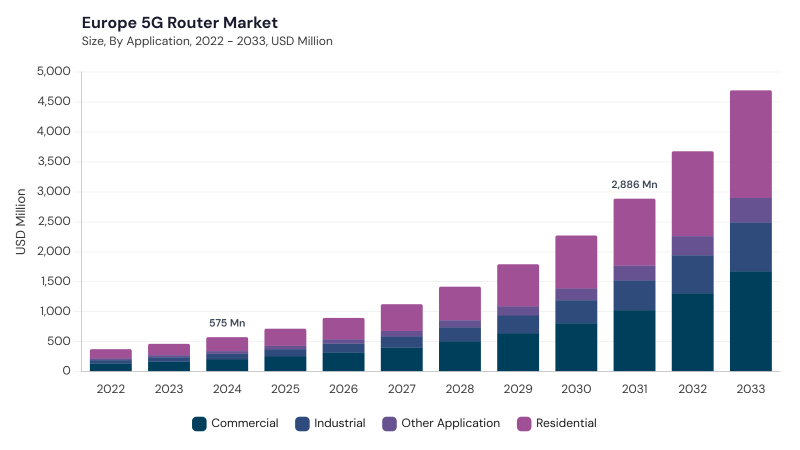
The Europe 5G Router Market is expected to reach USD 2886.1 million by 2031, growing at a CAGR of 26.7% during (2026 – 2033).
The Europe 5G Router Market evolved alongside the broader rollout of 5G technologies across the continent, beginning with 4G LTE enhancement and early wireless broadband experimentation. Initial development focused on combining modem and routing functions to support higher data throughput, improved latency, and stronger connectivity. As 5G New Radio standards, spectrum availability, chipset improvements, and antenna technologies advanced, routers became essential edge devices for consumer, enterprise, and industrial networks. The market later shifted from basic connectivity hardware toward intelligent nodes supporting fixed wireless access, SDN, private networks, and industrial IoT.
The Europe 5G Router Market is being shaped by fixed wireless access adoption, mid-band spectrum utilization, optical communication infrastructure, private 5G networks, industrial automation, and rising demand for secure low-latency connectivity. Customers are selecting routers based on throughput, reliability, interoperability, cost efficiency, data security, regulatory compliance, scalability, and customization flexibility. Demand is supported by residential broadband needs, commercial digitization, Industry 4.0 projects, transportation modernization, healthcare digitalization, and public sector connectivity. Vendors are focusing on SDN support, AI-driven traffic management, edge computing integration, network slicing, energy-efficient designs, rugged hardware, and GDPR-aligned security features.
Based on Connectivity, the market is segmented into Non-Standalone and Standalone. The Non-Standalone market dominated the Europe 5G Router Market by Connectivity in 2025, and would continue to be a dominant market till 2033; thereby, achieving a market value of USD 1899.1 million by 2031, growing at a CAGR of 26.2 % during the forecast period. The Standalone market is expected to witness a CAGR of 27.6% during (2026 - 2033).
Non-Standalone leads as telecom operators continue to use existing LTE infrastructure to accelerate 5G commercialization, optimize capital investment, and expand high-speed wireless services across urban and suburban areas. NSA routers support early fixed wireless access, consumer broadband, enterprise connectivity, and improved capacity while maintaining continuity with existing network assets. Standalone remains significant as independent 5G core networks expand to support ultra-low latency, network slicing, private 5G, and advanced enterprise use cases. This segment is increasingly important for smart manufacturing, logistics, healthcare, smart cities, and industrial networks requiring secure, dedicated, and highly responsive connectivity.
Based on Product Type, the market is segmented into Indoor 5G Routers, Outdoor 5G Routers, and Portable 5G Routers. The Indoor 5G Routers market dominated the Europe 5G Router Market by Product Type in 2025, and would continue to be a dominant market till 2033; thereby, achieving a market value of USD 1527.4 million by 2031, growing at a CAGR of 26.3 % during the forecast period. The Outdoor 5G Routers market is expected to witness a CAGR of 27.2% during (2026 - 2033). The Portable 5G Routers market is expected to witness a CAGR of 27.2% during (2026 - 2033).
Indoor 5G Routers lead as households, small offices, commercial spaces, and enterprise environments increasingly require reliable wireless broadband for remote work, online education, streaming, gaming, smart homes, cloud computing, and digital services. These routers benefit from fixed wireless access adoption, Wi-Fi integration, beamforming, mesh support, and telecom operator service bundles. Outdoor 5G Routers remain significant for transportation infrastructure, rural broadband, smart cities, construction sites, industrial facilities, public Wi-Fi, and harsh-environment deployments. Portable 5G Routers support mobile professionals, business travelers, remote field teams, tourism-driven demand, emergency response, temporary networks, and users requiring secure high-speed connectivity across multiple locations.
Based on Application, the market is segmented into Residential, Commercial, Industrial, and Other Application. The Residential market dominated the Europe 5G Router Market by Application in 2025, and would continue to be a dominant market till 2033; thereby, achieving a market value of USD 1118.8 million by 2031, growing at a CAGR of 25.9 % during the forecast period. The Commercial market is expected to witness a CAGR of 26.9% during (2026 - 2033). Additionally, The Industrial market is expected to witness highest CAGR of 27.5% during (2026 - 2033).
Residential leads as households increasingly adopt 5G routers for high-speed wireless broadband, remote working, online education, connected home ecosystems, video streaming, gaming, and backup connectivity where fixed broadband coverage is limited. Commercial remains significant as offices, retail outlets, hospitality facilities, healthcare sites, and educational institutions require scalable wireless networking for cloud applications, mobility, and secure digital operations. Industrial adoption is supported by smart factories, logistics hubs, energy sites, automation, robotics, predictive maintenance, and real-time monitoring. Other Application includes public administration, smart city infrastructure, agriculture, event management, public safety, temporary networking, and specialized field operations requiring flexible and high-capacity wireless communication.
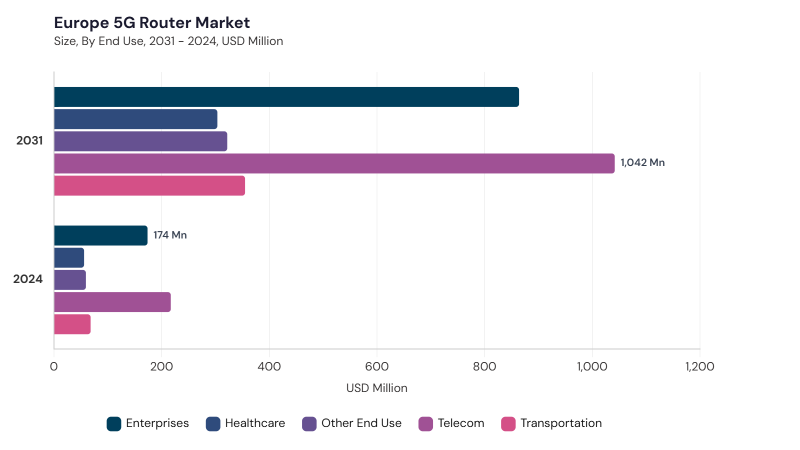
Based on End Use, the market is segmented into Telecom, Enterprises, Transportation, Healthcare, and Other End Use. Telecom leads as service providers continue investing in 5G coverage, fixed wireless access, mobile infrastructure, network slicing, carrier aggregation, virtualized network functions, and edge-enabled routing. Enterprises remain significant as businesses adopt 5G routers for cloud computing, hybrid workplaces, secure wireless access, IoT integration, private networks, and real-time analytics.
Transportation uses these routers for connected rail, public transit, logistics, fleet tracking, smart traffic systems, and vehicle-to-everything communication. Healthcare adoption is supported by telemedicine, remote monitoring, connected medical equipment, AI-based diagnostics, and secure data transfer, while Other End Use includes education, government, utilities, public safety, retail, energy, and smart infrastructure applications.
Free Valuable Insights: The Worldwide 5G Router Market is projected to reach USD 19.7 Billion billion by 2033, at a CAGR of 27.0%
Based on Country, the market is segmented into Germany, UK, France, Russia, Spain, Italy, and Rest of Europe. The Germany market dominated the Europe 5G Router Market by Country in 2025, and would continue to be a dominant market till 2033; thereby, achieving a market value of USD 615.5 million by 2031, growing at a CAGR of 25.1 % during the forecast period. The UK market is expected to witness a CAGR of 25.6% during (2026 - 2033). Additionally, The France market is expected to witness a CAGR of 27.5% during (2026 - 2033).
Germany leads due to strong private 5G campus network adoption, industrial digitalization, IoT convergence, manufacturing automation, and demand for routers supporting low latency, security, and interoperability. The UK supports market growth through portable and home-based router demand, dense urban 5G infrastructure, remote working, and greater emphasis on embedded security features. France contributes through AI-enabled router capabilities, edge computing integration, operator partnerships, IoT ecosystems, and digital transformation initiatives. Russia, Spain, and Italy add momentum through localization, smart infrastructure, industrial IoT, fixed wireless access, cybersecurity, and regulatory-driven deployment strategies, while Rest of Europe benefits from cloud-edge IoT, 5G modernization, private networks, and localized router solutions.

By Connectivity
By Product Type
By Application
By End Use
By Country
Set to reach $2886.1 Million by 2031, growing at 26.7% CAGR during 2026-2033.
Germany leads, achieving $615.5 million by 2031 with a 25.1% CAGR during the forecast period.
Rising adoption in residential applications, reaching $1118.8 million by 2031, is a key growth driver.
Non-Standalone segment will reach $1899.1 million by 2031, growing at a 26.2% CAGR during the forecast period.
The UK market is expected to witness a CAGR of 25.6% during 2026-2033.
Portable 5G Routers are expected to witness a 27.2% CAGR during 2026-2033.
Our team of dedicated experts can provide you with attractive expansion opportunities for your business.




 Unique Offerings