The sample copy of this report is available for access.
The North America 5G Indoor Network Infrastructure Market is expected to reach USD 20.4 billion by 2032, growing at a CAGR of 19.7% during (2026 - 2033).
The North America 5G Indoor Network Infrastructure Market evolved from conventional 4G LTE, Wi-Fi, distributed antenna, and early small-cell solutions toward dedicated 5G architectures capable of supporting dense enterprise and industrial environments. Initial development focused on improving indoor signal quality, bandwidth, and latency, while the maturation of 5G standards enabled broader deployment of private networks, neutral host models, advanced small cells, and fiber-backed systems. The market has since progressed toward software-defined, AI-enabled, and edge-integrated indoor connectivity designed to support automation, smart facilities, enterprise applications, and large-scale IoT environments.
Private 5G networks, neutral host infrastructure, Open RAN, edge computing, AI-driven network optimization, and advanced fiber connectivity are shaping current market development. Enterprises increasingly require secure, low-latency, and high-capacity indoor networks to support robotics, real-time analytics, smart-building systems, connected healthcare, and immersive applications. Neutral host models are improving infrastructure sharing and deployment economics, while Open RAN is encouraging interoperability and vendor flexibility. At the same time, mmWave, network slicing, intelligent automation, and energy-efficient infrastructure are expanding the performance and scalability of indoor 5G environments.
Based on Network Architecture, the market is segmented into Non-standalone and Standalone. The Non-standalone market dominated the North America 5G Indoor Network Infrastructure Market by Network Architecture in 2025, and would continue to be a dominant market till 2033; thereby, achieving a market value of USD 13.4 billion by 2032, growing at a CAGR of 19.4 % during the forecast period. The Standalone market is expected to witness a CAGR of 20.4% during (2026 - 2033).
Non-standalone architecture leverages existing 4G LTE core infrastructure while adding 5G New Radio for improved throughput and capacity, making it suitable for phased indoor upgrades and cost-sensitive deployments. Standalone architecture operates through a native 5G core and enables capabilities such as network slicing, ultra-low latency, dedicated private wireless, and localized service control. Standalone networks are increasingly relevant in manufacturing, healthcare, smart buildings, and enterprise environments requiring customized performance, stronger security, and greater operational independence.
Based on Technology, the market is segmented into Small Cell Systems, Distributed Antenna Systems (DAS), and Open RAN. The Small Cell Systems market dominated the North America 5G Indoor Network Infrastructure Market by Technology in 2025, and would continue to be a dominant market till 2033; thereby, achieving a market value of USD 8.8 billion by 2032, growing at a CAGR of 19.2 % during the forecast period. The Distributed Antenna Systems (DAS) market is expected to witness a CAGR of 19.9% during (2026 - 2033).
Small Cell Systems improve indoor capacity and coverage through compact radio units deployed close to users and connected devices, making them particularly suitable for enterprise campuses, retail environments, factories, and high-density commercial spaces. Distributed Antenna Systems extend consistent cellular coverage across large and complex buildings through centrally managed antenna networks and remain important for airports, hospitals, stadiums, high-rise properties, and other multi-operator venues. Open RAN introduces disaggregated hardware and software, multi-vendor interoperability, cloud-native network functions, and software-driven management, supporting more flexible and customizable indoor 5G architectures.
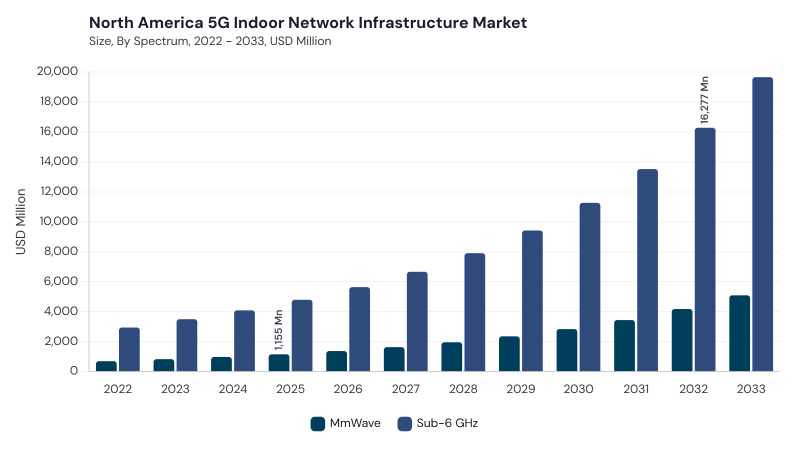
Based on Spectrum, the market is segmented into Sub-6 GHz and MmWave. Sub-6 GHz provides favorable propagation through walls and structural materials, enabling wider indoor coverage with fewer access points and supporting enterprise mobility, IoT, and general mobile broadband applications.
MmWave delivers exceptionally high throughput and concentrated capacity for environments requiring bandwidth-intensive connectivity, including immersive media, advanced enterprise applications, and high-density user zones. Its shorter range and limited penetration require denser infrastructure, beam management, and careful placement, making it particularly suited to targeted indoor hotspots where extremely high performance is prioritized.
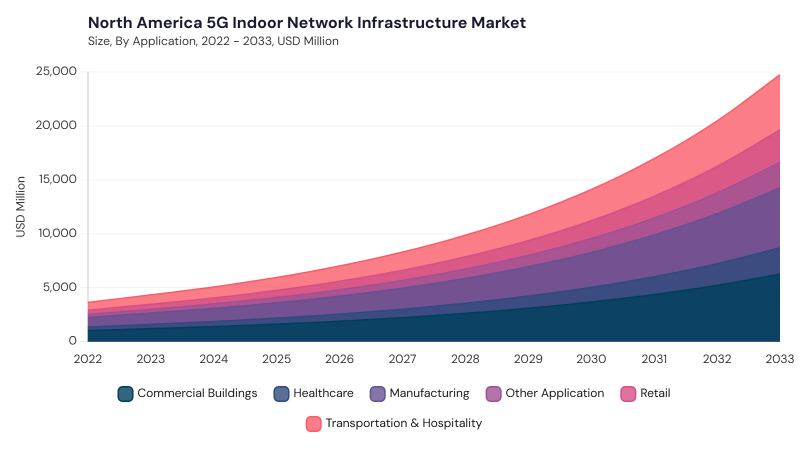
Based on Application, the market is segmented into Commercial Buildings, Manufacturing, Transportation & Hospitality, Retail, Healthcare, and Other Application. Commercial Buildings use indoor 5G to support high-density connectivity, smart-building systems, enterprise applications, cloud access, and hybrid workplace environments. Manufacturing relies on private 5G, automation, robotics, predictive maintenance, industrial IoT, and real-time analytics, while Transportation & Hospitality uses indoor networks across airports, transit facilities, hotels, and convention venues for passenger services, operational connectivity, and high-capacity user access.
Retail applies 5G to digital payments, inventory intelligence, immersive engagement, and omnichannel operations, whereas Healthcare uses it for connected medical equipment, mobile clinical workflows, telemedicine, tracking, and digital care. Other Application includes education campuses, entertainment venues, warehouses, public facilities, government buildings, and other specialized indoor environments.
Free Valuable Insights: The Global 5G Indoor Network Infrastructure Market will hit USD 83.5 Billion billion by 2033, at a CAGR of 20.7%
Based on Country, the market is segmented into US, Canada, Mexico, and Rest of North America. The US market dominated the North America 5G Indoor Network Infrastructure Market by Country in 2025, and would continue to be a dominant market till 2033; thereby, achieving a market value of USD 16.2 billion by 2032, growing at a CAGR of 19 % during the forecast period. The Canada market is expected to witness a CAGR of 23.1% during (2026 - 2033). Additionally, The Mexico market is expected to witness a CAGR of 21.9% during (2026 - 2033).
Across North America, indoor 5G development is being shaped by private networks, network densification, Open RAN, AI-enabled automation, edge computing, spectrum optimization, and enterprise digital transformation. The US emphasizes small-cell densification, network virtualization, Open RAN, private 5G, AI-based management, and energy efficiency, while Canada focuses on private enterprise networks, legacy-system interoperability, edge computing, cloud-native infrastructure, and intelligent network control. Mexico is advancing industrial IoT, smart buildings, modular indoor radio systems, sustainable infrastructure, network slicing, and cost-efficient 5G variants, whereas Rest of North America continues to develop private 5G, neutral host models, Open RAN, mmWave, AI-driven orchestration, and scalable enterprise-oriented indoor connectivity.

By Network Architecture
By Technology
By Spectrum
By Application
By Country
Set to reach $20.4 Billion by 2032, growing at 19.7% CAGR during 2026-2033.
The US leads with a market value of $16.2 billion by 2032, growing at a 19% CAGR during the forecast period.
Rising enterprise cloud adoption and AI-driven workloads are the main catalysts.
Non-standalone segment to achieve $13.4 billion by 2032, with a 19.4% CAGR during the forecast period.
Canada market is expected to witness a CAGR of 23.1% during 2026-2033.
Small Cell Systems to reach $8.8 billion by 2032, growing at a 19.2% CAGR during the forecast period.
Our team of dedicated experts can provide you with attractive expansion opportunities for your business.




 Unique Offerings