The sample copy of this report is available for access.
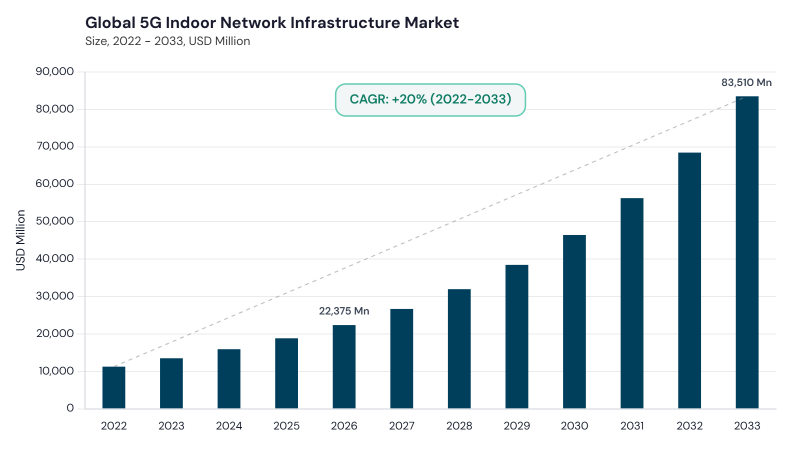
“Global 5G Indoor Network Infrastructure Market to reach a market value of USD 83,509.95 Million by 2033 growing at a CAGR of 20.7%”
The Global 5G Indoor Network Infrastructure Market is expected to reach USD 83.5 billion by 2033, growing at a CAGR of 20.7% during (2026 - 2033).
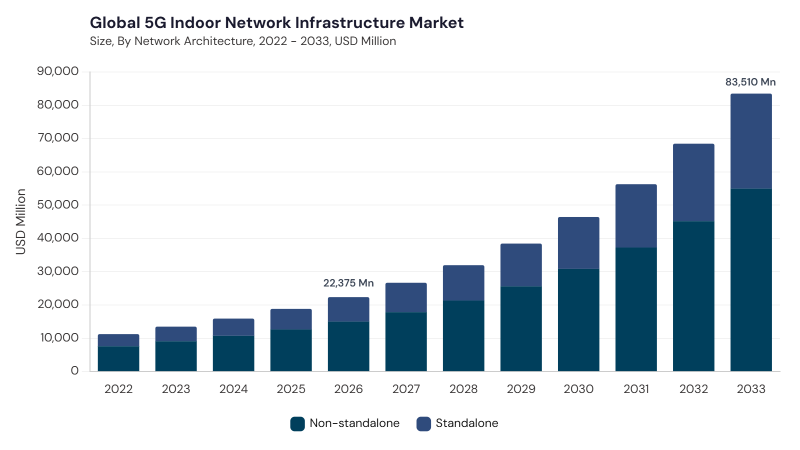
Healthcare providers, manufacturers, commercial facilities, enterprises, transport hubs, and public venues are surging investment in 5G indoor network infrastructure to achieve more reliable, faster, and low-latency wireless connectivity inside complex buildings. Adoption is further supported by smart building systems, private 5G networks, small cells, IoT connectivity, industrial automation, scalable indoor deployment models, and smart network management. 5G indoor network infrastructure market developed from earlier cellular efforts designed to solve indoor coverage gaps caused by poor building penetration, and signal weakening. Initial solutions depend mainly upon distributed antenna systems and small cell for 4G and 3G environments.
5G indoor network infrastructure market is experiencing strong expansion as businesses and venue operators require greater network capacity, seamless indoor coverage, reliable device connectivity, real-time communication, and reliable device connectivity, Indoor environments generate substantial mobile traffic, but outdoor macro networks often face signal penetration challenges inside buildings. In conclusion, adoption of DAS, small cells, Sub-6 GHz systems, Open RAN, edge computing, mmWave zones, and private 5G networks is accelerating across healthcare, commercial, industrial, and transportation spaces.
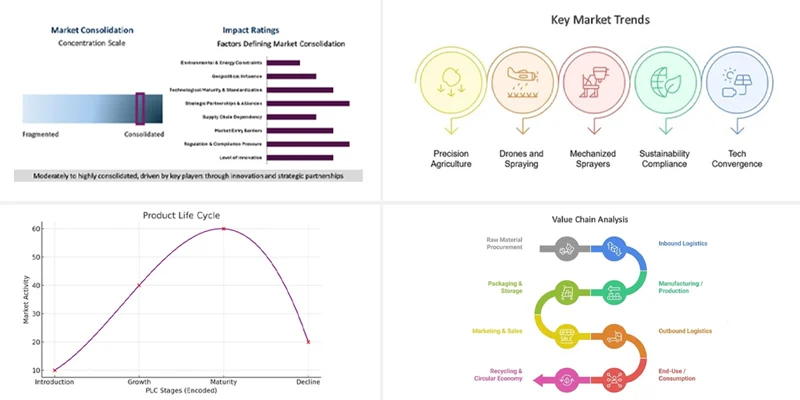
5G indoor network infrastructure market is moderately consolidated and largely innovation-driven, with competition driven by DAS specialists, global RAN vendors, private wireless infrastructure providers, and indoor small cell suppliers. Market players compete through multi-operator support, indoor radio performance, Open RAN readiness, neutral-host models, energy efficiency, 5G-advanced capability, deployment scalability, integration with enterprise IT environments, and AI-enabled network optimization. Market competition relies on digital indoor systems, private 5G expansion, smart network sharing, and edge computing, and cost-effective deployment needs.

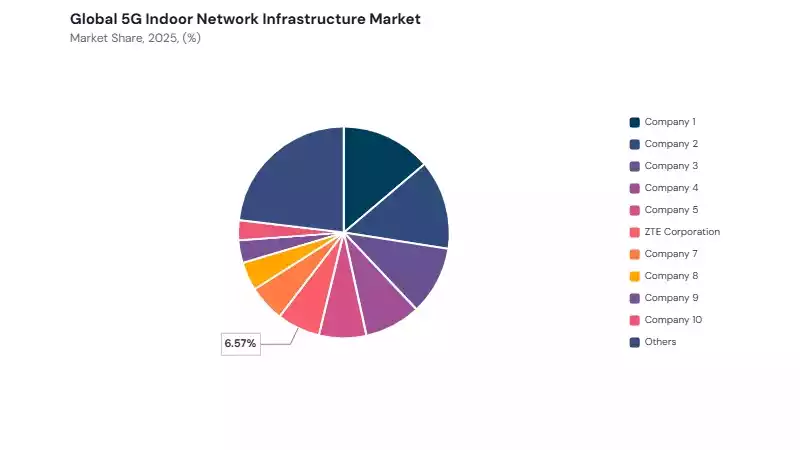
5G indoor network infrastructure market is supported by leading competitive including Huawei Technologies, Ericsson, and Nokia across private 5G, indoor small cells, operator-led indoor deployments, and digital indoor systems. Samsung Electronics, CommScope, and ZTE are some of the market players strengthening the market through digital indoor distribution platforms, mmWave solutions, and DAS. Comba Telecom, Airspan Networks, SOLiD, and JMA Wireless further support across healthcare, enterprise, industrial, large-venue deployments, and transportation.
Based on Network Architecture, the market is segmented into Non-standalone and Standalone. The Non-standalone market dominated the Global 5G Indoor Network Infrastructure Market by Network Architecture in 2025, and would continue to be a dominant market till 2033; thereby, achieving a market value of USD 54.9 billion by 2033, growing at a CAGR of 20.4 % during the forecast period. The Standalone market is expected to witness a CAGR of 21.4% during (2026 - 2033).
Non-standalone leads the market due to its ability to reuse existing LTE core infrastructure, reduce initial deployment costs, and accelerate indoor 5G implementation across enterprise and commercial facilities. It remains suitable for operators and enterprises seeking faster service upgrades without full core-network transformation. Standalone is gaining traction as enterprises increasingly require dedicated 5G cores, ultra-low latency, network slicing, private network control, and mission-critical performance. Its adoption is expected to strengthen as private 5G and industrial automation use cases expand.
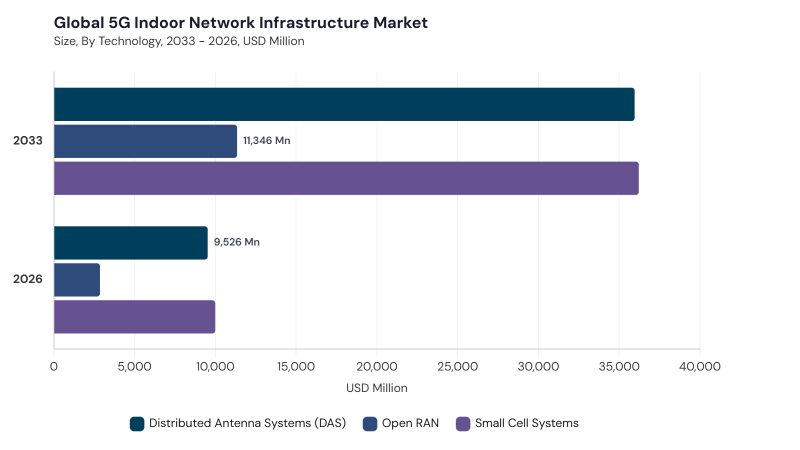
Based on Technology, the market is segmented into Small Cell Systems, Distributed Antenna Systems (DAS), and Open RAN. The Small Cell Systems market dominated the Global 5G Indoor Network Infrastructure Market by Technology in 2025, and would continue to be a dominant market till 2033; thereby, achieving a market value of USD 36.2 billion by 2033, growing at a CAGR of 20.2 % during the forecast period. The Distributed Antenna Systems (DAS) market is expected to witness a CAGR of 20.9% during (2026 - 2033).
Small Cell Systems dominate the market due to compact deployment, localized capacity improvement, lower installation flexibility constraints, and strong suitability for high-density enterprise environments. Distributed Antenna Systems remain important for large buildings, airports, hospitals, stadiums, hotels, and multi-user venues requiring uniform signal distribution and scalable multi-operator connectivity. Open RAN is expanding as enterprises and operators seek interoperable components, vendor diversification, software-driven architectures, and flexible network expansion. Together, these technologies support both coverage-led and capacity-led indoor 5G deployments.
Based on Spectrum, the market is segmented into Sub-6 GHz and MmWave. The Sub-6 GHz market dominated the Global 5G Indoor Network Infrastructure Market by Spectrum in 2025, and would continue to be a dominant market till 2033; thereby, achieving a market value of USD 66.6 billion by 2033, growing at a CAGR of 20.5 % during the forecast period.Additionally, The MmWave market is expected to witness highest CAGR of 21.6% during (2026 - 2033).
Sub-6 GHz dominates the market due to stronger indoor propagation, broader building coverage, practical deployment economics, and established spectrum availability across diverse indoor environments. It supports reliable connectivity across commercial buildings, hospitals, manufacturing sites, and transportation facilities where consistent coverage is essential. MmWave remains a smaller but important segment, supported by extremely high throughput, low-latency connectivity, dense device environments, and hotspot deployments in high-traffic indoor locations. However, shorter transmission range and limited penetration require denser infrastructure planning.
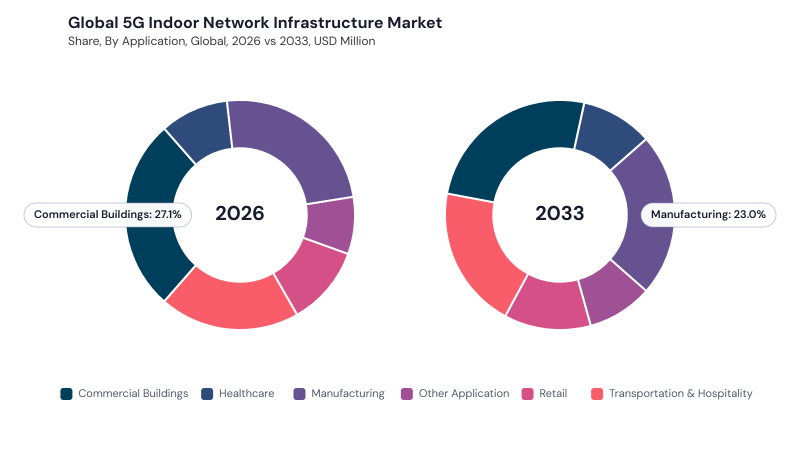
Based on Application, the market is segmented into Commercial Buildings, Manufacturing, Transportation & Hospitality, Retail, Healthcare, and Other Application. The Commercial Buildings market dominated the Global 5G Indoor Network Infrastructure Market by Application in 2025, and would continue to be a dominant market till 2033; thereby, achieving a market value of USD 21.2 billion by 2033, growing at a CAGR of 19.6 % during the forecast period. The Manufacturing market is expected to witness a CAGR of 19.8% during (2026 - 2033). Additionally, The Transportation & Hospitality market is expected to witness highest CAGR of 21% during (2026 - 2033).
Commercial Buildings lead the market due to rising demand for reliable indoor coverage across offices, corporate campuses, smart buildings, and multi-tenant commercial properties. Manufacturing is supported by private 5G networks, robotics, machine connectivity, industrial IoT, and real-time operational systems. Transportation & Hospitality benefits from airports, hotels, transit facilities, and high-density venues requiring uninterrupted connectivity. Retail demand is driven by digital payments, connected stores, analytics, and immersive applications, while Healthcare adoption is supported by connected medical equipment and digital care workflows. Other Application includes education, entertainment, warehouses, and specialized indoor environments.
Free Valuable Insights: 5G Indoor Network Infrastructure Market Size to reach $83.5 Billion by 2033
Region-wise, the 5G Indoor Network Infrastructure Market is analyzed across North America, Europe, Asia Pacific, and LAMEA.
In 2025, the Asia Pacific led the 5G indoor network infrastructure market and is estimated to remain dominant till 2033, by gathering a market value of USD 32.8 billion by 2033, expanding a CAGR of 21.3%. The North America region is predicted to grow at a CAGR of 19.7% during the forecast period. Moreover, the Europe market is estimated to expand at a CAGR of 20.4% during the forecast period.
Asia Pacific led the market because of high-density urban infrastructure, extensive 5G network deployment, rising indoor connectivity demand, and smart manufacturing investment across industrial and commercial facilities. North America region is driven by enterprise modernization, private 5G networks, high-capacity indoor wireless infrastructure investment, and advanced manufacturing. Europe benefits from digital transformation, industrial connectivity initiatives, private enterprise network adoption, and spectrum availability. LAMEA is developing through commercial infrastructure modernization, 5G coverage growth, traditional upgrades, commercial infrastructure modernization, and surging adoption of enterprise indoor connectivity solutions.
| Report Attribute | Details |
|---|---|
| Market size value in 2026 | USD 22.3 billion |
| Market size forecast in 2033 | USD 83.5 billion |
| Base Year | 2025 |
| Historical Period | 2022 to 2024 |
| Forecast Period | 2026 to 2033 |
| Revenue Growth Rate | CAGR of 20.7% from 2026 to 2033 |
| Number of Pages | 683 |
| Tables | 750 |
| Report Coverage | Market Trends, Revenue Estimation and Forecast, Segmentation Analysis, Regional and Country Breakdown, Competitive Landscape, Market Share Analysis, Company Profiling, Companies Strategic Developments, SWOT Analysis, Product Life Cycle Analysis, Value Chain Analysis, Market Consolidation Analysis, Key Customer Criteria, Pandemic Impact Analysis, and Winning Imperatives |
| Segments Covered | Network Architecture, Technology, Spectrum, Application, Region |
| Country Scope |
|
| Companies Included | Ericsson, Huawei Technologies Co., Ltd., Nokia Corporation, Samsung Electronics Co., Ltd., ZTE Corporation, Airspan Networks Holdings LLC, Comba Telecom Systems Holdings Ltd., JMA Wireless, and SOLiD, Inc. |
By Network Architecture
By Technology
By Spectrum
By Application
By Geography
The market is set to reach USD 83.5 billion by 2033, growing at 20.7% CAGR during 2026-2033.
Non-standalone segment leads, projected to hit USD 54.9 billion by 2033.
Ericsson, Huawei Technologies Co., Ltd., Nokia Corporation, and Samsung Electronics Co. are key players.
Small Cell Systems segment leads, expected to reach USD 36.2 billion by 2033.
Asia Pacific leads, anticipated to achieve a market value of USD 32.8 billion by 2033.
Expanding demand for enhanced indoor wireless connectivity in enterprises and public venues drives growth.
Our team of dedicated experts can provide you with attractive expansion opportunities for your business.








 Unique Offerings