The sample copy of this report is available for access.
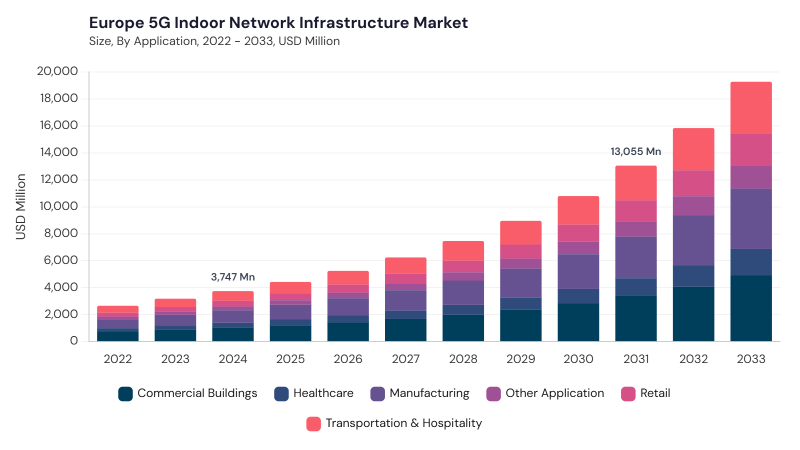
The Europe 5G Indoor Network Infrastructure Market is expected to reach USD 13.0 billion by 2031, growing at a CAGR of 20.4% during (2026 - 2033).
The Europe 5G Indoor Network Infrastructure Market developed from early indoor coverage enhancement efforts that adapted cellular networks to complex buildings and densely occupied venues where outdoor macro networks provided inconsistent service. Small cells, distributed antenna systems, advanced indoor antennas, and mmWave technologies progressively improved capacity and signal quality, while regional investment and spectrum initiatives accelerated commercialization. The market has since moved beyond basic coverage extension toward integrated indoor architectures combining private networks, advanced radio access, cloud-native management, and intelligent orchestration to support smart buildings, industrial automation, enterprise applications, and high-density public environments.
Edge computing, artificial intelligence, sustainability, infrastructure sharing, private 5G, and cloud-native networking are shaping current market development. Enterprises increasingly require low-latency indoor connectivity for robotics, industrial IoT, augmented reality, analytics, and other real-time applications, encouraging closer integration between 5G radio networks and edge resources. Energy-efficient antenna systems and intelligent power management are gaining importance as environmental considerations influence infrastructure design. Multi-operator and neutral-host models are also expanding, while AI-driven optimization, network slicing, Open RAN, and secure private networks are improving flexibility, scalability, and service differentiation across European indoor environments.
Based on Network Architecture, the market is segmented into Non-standalone and Standalone. The Non-standalone market dominated the Europe 5G Indoor Network Infrastructure Market by Network Architecture in 2025, and would continue to be a dominant market till 2033; thereby, achieving a market value of USD 8.6 billion by 2031, growing at a CAGR of 20.1 % during the forecast period. The Standalone market is expected to witness a CAGR of 21.1% during (2026 - 2033).
Non-standalone architecture enables indoor 5G services while retaining existing 4G core infrastructure, supporting faster deployment and more gradual network modernization across offices, commercial sites, and public buildings. Standalone architecture employs a dedicated 5G core and enables network slicing, localized traffic processing, ultra-low-latency communication, customized quality-of-service controls, and private network functionality. Its greater control and flexibility make it particularly relevant for industrial campuses, smart buildings, healthcare facilities, and enterprise environments requiring highly secure and mission-critical connectivity.
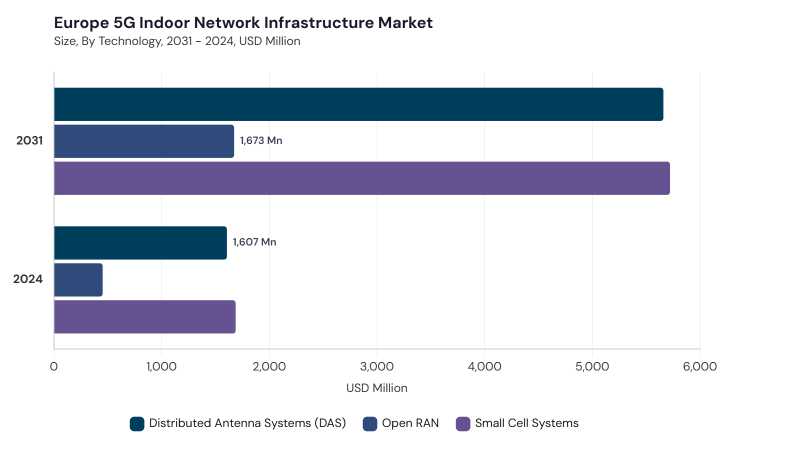
Based on Technology, the market is segmented into Small Cell Systems, Distributed Antenna Systems (DAS), and Open RAN. The Small Cell Systems market dominated the Europe 5G Indoor Network Infrastructure Market by Technology in 2025, and would continue to be a dominant market till 2033; thereby, achieving a market value of USD 5.7 billion by 2031, growing at a CAGR of 19.9 % during the forecast period. The Distributed Antenna Systems (DAS) market is expected to witness a CAGR of 20.6% during (2026 - 2033).
Small Cell Systems provide localized radio coverage and capacity in indoor areas where signal penetration and high device density challenge conventional networks, making them suitable for enterprise buildings, retail sites, and transportation environments. Distributed Antenna Systems distribute signals across larger and structurally complex facilities and remain important for multi-operator coverage in airports, stadiums, hospitals, commercial complexes, and transportation hubs. Open RAN introduces disaggregated and software-driven network components that promote vendor interoperability, virtualization, automation, and flexible procurement, supporting increasingly modular and customizable indoor 5G deployments.
Based on Spectrum, the market is segmented into Sub-6 GHz and MmWave. Sub-6 GHz provides broader indoor coverage and stronger propagation through walls and other building materials, supporting mobile broadband, enterprise applications, IoT devices, and private networks across varied facilities.
MmWave offers substantially higher localized capacity and throughput for dense venues and bandwidth-intensive applications such as immersive media, advanced collaboration, and industrial use cases. Because of its shorter range and weaker penetration, mmWave typically requires denser small-cell deployment, directional antennas, and beamforming, making it most relevant where concentrated performance requirements justify targeted indoor coverage.
Based on Application, the market is segmented into Commercial Buildings, Manufacturing, Transportation & Hospitality, Retail, Healthcare, and Other Application. Commercial Buildings use indoor 5G to support smart-building management, cloud applications, collaboration platforms, connected devices, and high-density workforce connectivity. Manufacturing relies on private networks, industrial IoT, robotics, machine vision, autonomous material handling, and edge-enabled automation, while Transportation & Hospitality uses indoor 5G across airports, railway facilities, hotels, and convention venues for passenger connectivity, operational communication, and smart services.
Retail deploys 5G for connected point-of-sale systems, cashierless technologies, indoor analytics, inventory intelligence, and personalized customer experiences, whereas Healthcare uses it for mobile diagnostic tools, connected clinical devices, equipment tracking, telemedicine, and staff communication. Other Application includes universities, cultural venues, logistics facilities, public buildings, sports complexes, government facilities, and other specialized indoor environments.
Free Valuable Insights: The Worldwide 5G Indoor Network Infrastructure Market is projected to reach USD 83.5 Billion billion by 2033, at a CAGR of 20.7%
Based on Country, the market is segmented into Germany, UK, France, Russia, Spain, Italy, and Rest of Europe. The Germany market dominated the Europe 5G Indoor Network Infrastructure Market by Country in 2025, and would continue to be a dominant market till 2033; thereby, achieving a market value of USD 2.8 billion by 2031, growing at a CAGR of 18.9 % during the forecast period. The UK market is expected to witness a CAGR of 19.3% during (2026 - 2033). Additionally, The France market is expected to witness a CAGR of 21.2% during (2026 - 2033).
Across Europe, indoor 5G development is being shaped by private networks, network densification, AI-driven optimization, Open RAN, edge computing, sustainability, spectrum policy, and localized infrastructure strategies. Germany emphasizes private industrial networks, advanced small cells, network densification, energy-efficient infrastructure, and AI-enabled management, while the UK focuses on 5G-Advanced, private enterprise networks, radiating cable solutions, network slicing, and sustainable deployment. France is advancing localized private networks, AI-supported orchestration, energy-efficient infrastructure, and dedicated indoor connectivity for industrial environments, whereas Russia emphasizes domestically developed equipment, mmWave, FTTA, localized supply chains, and secure network infrastructure. Spain is strengthening AI-assisted RAN, edge computing, shared and private spectrum models, and customized indoor networks, while Italy emphasizes neutral-host models, mmWave, intelligent automation, network slicing, fiber backhaul, and infrastructure sharing. Rest of Europe continues to expand private 5G, Open RAN, edge computing, cloud-native functions, AI-enabled management, and regionally tailored indoor network deployments.

By Network Architecture
By Technology
By Spectrum
By Application
By Country
Set to reach $13.0 Billion by 2031, growing at 20.4% CAGR during 2026-2033.
Germany leads with $2.8 billion by 2031, growing at 18.9% CAGR during the forecast period.
Rising demand for Non-standalone architecture, reaching $8.6 billion by 2031 at 20.1% CAGR.
Small Cell Systems segment to hit $5.7 billion by 2031, growing at 19.9% CAGR during the forecast period.
The UK market is expected to witness a CAGR of 19.3% during 2026-2033.
France is expected to grow at a CAGR of 21.2% during 2026-2033.
Our team of dedicated experts can provide you with attractive expansion opportunities for your business.




 Unique Offerings