The sample copy of this report is available for access.
The LAMEA 5G Indoor Network Infrastructure Market is expected to reach USD 2916.3 million by 2029, growing at a CAGR of 22.2% during (2026 - 2033).
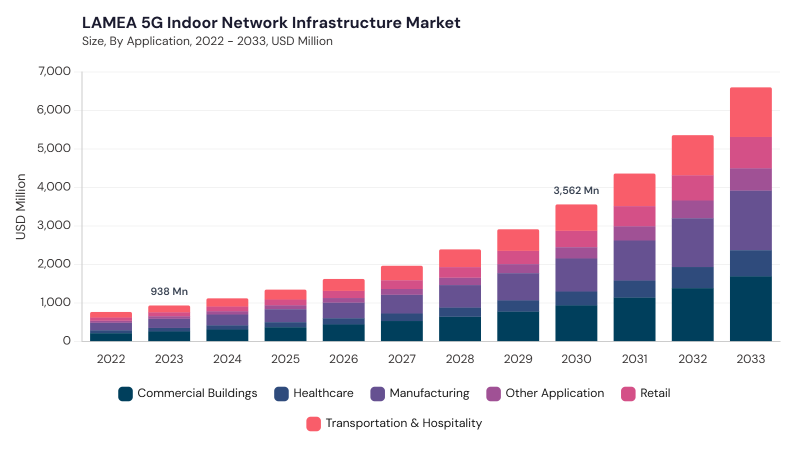
The LAMEA 5G Indoor Network Infrastructure Market evolved from earlier indoor connectivity systems based on 4G and conventional wireless technologies toward more advanced 5G architectures designed to address signal attenuation and coverage limitations within complex buildings. Early deployment relied on distributed antenna systems, small cells, and robust backhaul solutions, while advances in mmWave, Massive MIMO, beamforming, and network densification progressively improved indoor performance. Government digital initiatives and collaboration among operators, infrastructure providers, and technology vendors further accelerated adoption.
Ultra-reliable low-latency communication, edge computing, AI-driven optimization, virtualization, energy-efficient infrastructure, and private network adoption are shaping current market development. Infrastructure providers are increasingly integrating local data processing, predictive maintenance, adaptive resource allocation, intelligent beamforming, and software-defined network management into indoor 5G deployments. Sustainability considerations are encouraging energy-optimized small cells and intelligent power controls, while Open RAN and cloud-native architectures are expanding network flexibility.
Based on Network Architecture, the market is segmented into Non-standalone and Standalone. The Non-standalone market dominated the LAMEA 5G Indoor Network Infrastructure Market by Network Architecture in 2025, and would continue to be a dominant market till 2033; thereby, achieving a market value of USD 1961.8 million by 2029, growing at a CAGR of 21.8 % during the forecast period. The Standalone market is expected to witness a CAGR of 22.9% during (2026 - 2033).
Non-standalone architecture allows operators to enhance indoor connectivity through 5G New Radio while retaining established 4G core infrastructure, reducing transition complexity and supporting phased modernization. It remains relevant across offices, shopping centers, public venues, and enterprise facilities where improved capacity and throughput are required without immediate core replacement. Standalone architecture employs a dedicated 5G core and supports ultra-low latency, network slicing, customized QoS, edge integration, and private cellular environments. These capabilities increase its relevance for smart factories, healthcare facilities, industrial sites, and other mission-critical indoor applications requiring greater network autonomy and control.
Based on Technology, the market is segmented into Small Cell Systems, Distributed Antenna Systems (DAS), and Open RAN. The Small Cell Systems market dominated the LAMEA 5G Indoor Network Infrastructure Market by Technology in 2025, and would continue to be a dominant market till 2033; thereby, achieving a market value of USD 1300.4 million by 2029, growing at a CAGR of 21.6 % during the forecast period. The Distributed Antenna Systems (DAS) market is expected to witness a CAGR of 22.3% during (2026 - 2033).
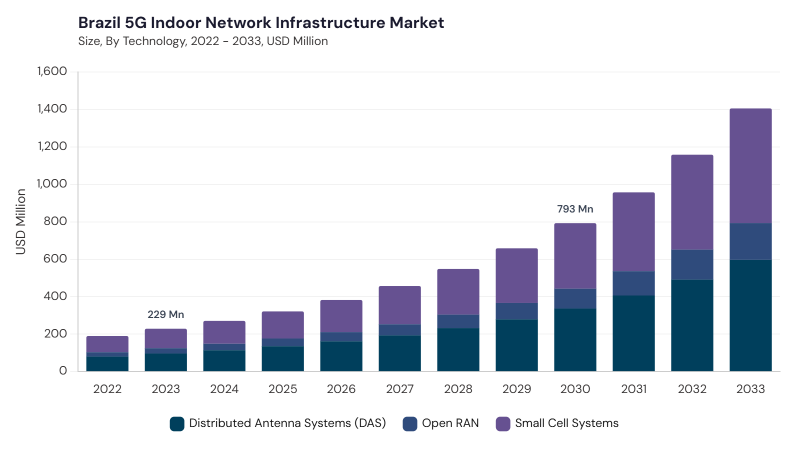
Small Cell Systems deliver localized capacity and low-latency coverage in indoor spaces where outdoor network signals are weakened by structural barriers, making them suitable for offices, retail environments, airports, and enterprise facilities. Distributed Antenna Systems distribute signals across extensive interiors through multiple antenna nodes and remain important for hospitals, stadiums, universities, convention centers, hotels, and other large venues requiring broad and consistent coverage. Open RAN introduces disaggregated hardware and software, multi-vendor interoperability, virtualization, and software-driven control, supporting more flexible, vendor-neutral, and scalable indoor deployments aligned with private network and cloud-native strategies.
Based on Spectrum, the market is segmented into Sub-6 GHz and MmWave. Sub-6 GHz provides a strong balance between coverage, penetration, capacity, and deployment cost, making it suitable for offices, hospitals, shopping centers, institutions, factories, and other environments requiring dependable indoor connectivity. It supports enterprise applications, private networks, enhanced mobile broadband, and IoT ecosystems without requiring extremely dense infrastructure.
MmWave delivers substantially higher localized throughput and very low latency for bandwidth-intensive environments such as airports, stadiums, convention centers, advanced factories, and premium digital venues. Its limited penetration and shorter range require dense small-cell deployment, beamforming, Massive MIMO, and careful network planning, positioning it primarily for high-capacity indoor zones.
Based on Application, the market is segmented into Commercial Buildings, Manufacturing, Transportation & Hospitality, Retail, Healthcare, and Other Application. Commercial Buildings use indoor 5G to support smart-building management, enterprise applications, cloud services, connected security systems, and high-density workforce communication. Manufacturing applies private networks, edge computing, IoT, automation, asset monitoring, and machine-to-machine communication across energy, petrochemical, automotive, mining, and processing facilities.
Transportation & Hospitality relies on 5G within airports, hotels, convention centers, tourism infrastructure, and event venues, while Retail uses it for digital payments, connected store operations, customer analytics, immersive services, and inventory management. Healthcare applies indoor 5G to medical devices, telemedicine, remote monitoring, equipment tracking, and clinical communications. Other Application includes education facilities, logistics hubs, government properties, cultural venues, residential developments, and other emerging digital environments.
Free Valuable Insights: 5G Indoor Network Infrastructure Market Size Worth USD 83.5 Billion billion by 2033
Based on Country, the market is segmented into Brazil, Argentina, UAE, Saudi Arabia, South Africa, Nigeria, and Rest of LAMEA. The Brazil market dominated the LAMEA 5G Indoor Network Infrastructure Market by Country in 2025, and would continue to be a dominant market till 2033; thereby, achieving a market value of USD 658.4 million by 2029, growing at a CAGR of 20.4 % during the forecast period. The Argentina market is expected to witness a CAGR of 24.1% during (2026 - 2033). Additionally, The UAE market is expected to witness a CAGR of 20.8% during (2026 - 2033).
Across LAMEA, indoor 5G development is being shaped by private networks, Open RAN, smart-city investment, network automation, edge computing, sustainability, and localized deployment strategies. Brazil emphasizes Open RAN, private 5G, neutral-host networks, AI-based optimization, and advanced indoor antennas, while Argentina focuses on private enterprise networks, network slicing, dynamic spectrum management, edge computing, and smart-building integration. The UAE is advancing private 5G, Open RAN, edge-enabled infrastructure, AI-driven management, and localized enterprise connectivity, whereas Saudi Arabia emphasizes smart-city projects, IoT, fiber-backed indoor networks, AI optimization, and private wireless systems. South Africa is strengthening FTTA, private 5G, energy-efficient infrastructure, Massive MIMO, and enterprise automation, while Nigeria focuses on hybrid fiber-wireless architectures, scalable small cells, AI-based network management, and sustainable deployment. Rest of LAMEA continues to expand 5G-Advanced, edge computing, software-defined infrastructure, energy-efficient network design, and localized partnerships supporting diverse indoor environments.

By Network Architecture
By Technology
By Spectrum
By Application
By Country
Set to reach $2916.3 Million by 2029, growing at 22.2% CAGR during 2026-2033.
Brazil leads with $658.4 million by 2029, growing at 20.4% CAGR during the forecast period.
Small Cell Systems dominate, reaching $1300.4 million by 2029, growing at 21.6% CAGR during the forecast period.
Non-standalone segment to reach $1961.8 million by 2029, growing at 21.8% CAGR during 2026-2033.
The UAE market is expected to witness a CAGR of 20.8% during 2026-2033.
Distributed Antenna Systems (DAS) to grow at 22.3% CAGR during 2026-2033.
Our team of dedicated experts can provide you with attractive expansion opportunities for your business.




 Unique Offerings