The sample copy of this report is available for access.
“Global Next-generation Sequencing Data Analysis Market to reach a market value of USD 4.66 Billion by 2033 growing at a CAGR of 21.4%”
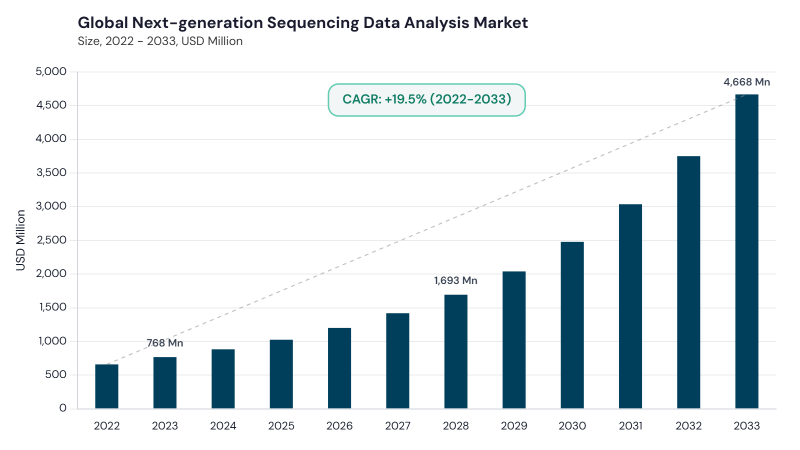
The Global Next-generation Sequencing Data Analysis Market size is expected to reach USD 4.66 billion by 2033, rising at a market growth of 21.4% CAGR during the forecast period.
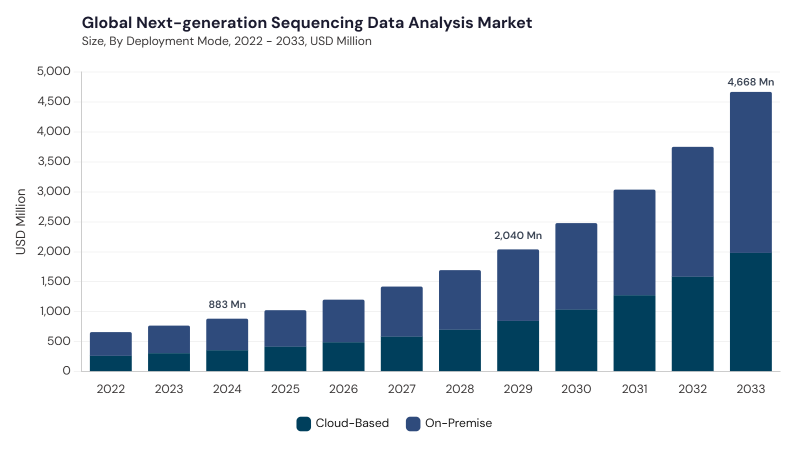
Growth in the market is driven by increasing adoption of precision medicine, rising genomic research activities, and growing integration of artificial intelligence and cloud computing technologies into sequencing analytics workflows. Expanding applications of next-generation sequencing across oncology, rare disease diagnostics, infectious disease surveillance, and personalized therapeutics are accelerating demand for advanced genomic data interpretation platforms globally. Additionally, declining sequencing costs, rapid advancements in sequencing technologies, and increasing demand for high-throughput genomic analysis are further supporting market expansion.
The Global Next-generation Sequencing Data Analysis Market has evolved significantly from conventional bioinformatics interpretation tools into highly sophisticated AI-driven genomic analytics ecosystems. Initially, genomic analysis workflows were largely dependent on manual sequence interpretation, expensive computational infrastructure, and fragmented bioinformatics pipelines, limiting adoption primarily to academic research institutions and specialized laboratories. However, rapid advancements in high-throughput sequencing technologies, automation platforms, and computational analytics have transformed genomic data analysis into a scalable and clinically actionable process. The increasing adoption of precision medicine, oncology profiling, and biomarker discovery applications has accelerated demand for advanced sequencing analytics solutions globally.
Today, artificial intelligence, machine learning, cloud computing, and multi-omics integration technologies are at the core of market expansion. Organizations increasingly deploy AI-powered genomic analytics platforms to automate variant calling, sequence alignment, gene expression analysis, and biomarker identification workflows. In addition, cloud-native infrastructures are improving collaborative research capabilities, data storage scalability, and real-time genomic interpretation efficiency across healthcare institutions, pharmaceutical companies, and research organizations. Increasing integration of sequencing data analysis with clinical diagnostics, drug discovery pipelines, and personalized therapeutics is further strengthening market growth globally.
The major strategies followed by the market participants are Partnerships & Collaborations as the key developmental strategy to keep pace with the changing demands of healthcare and genomic research organizations. For instance, In October, 2024, Illumina, Inc. unveiled the MiSeq i100 Series sequencing systems designed to provide faster and simplified genomic analysis workflows with enhanced operational efficiency. Additionally, In April, 2024, Bio-Rad Laboratories, Inc. collaborated with Oncocyte Corporation to commercialize transplant monitoring solutions utilizing Droplet Digital PCR technology for advanced genomic testing applications.
The COVID-19 pandemic negatively impacted the Next-generation Sequencing Data Analysis Market due to disruptions in laboratory operations, sequencing workflows, and genomic research activities across healthcare and academic institutions. Temporary shutdown of laboratories, workforce limitations, and shortages of sequencing reagents and consumables affected operational capacities and delayed ongoing genomic projects globally. In addition, disruptions in global supply chains negatively impacted sequencing platform deployment and bioinformatics infrastructure expansion. However, the pandemic accelerated long-term investments in pathogen genomics, epidemiological surveillance, cloud-based analytics platforms, and real-time genomic interpretation technologies. Increasing demand for SARS-CoV-2 sequencing and variant tracking significantly strengthened adoption of scalable sequencing data analysis infrastructures globally. Thus, the COVID-19 pandemic had a negative impact on the market.

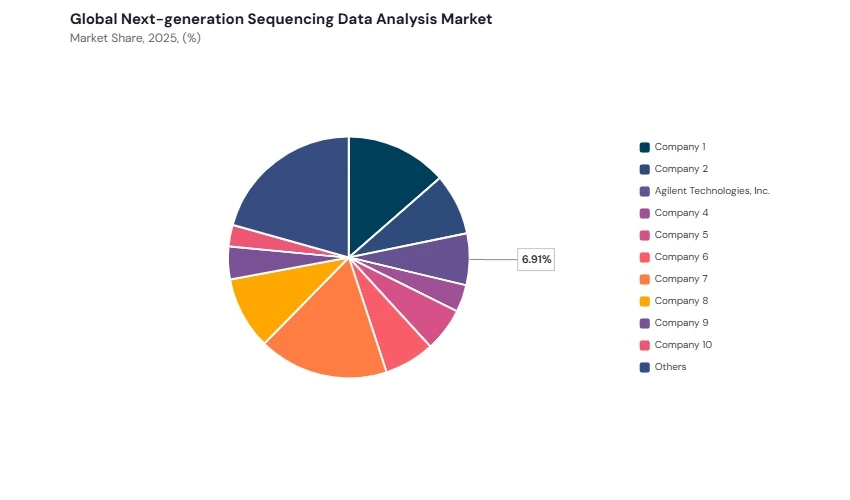
The leading players in the market are competing with diverse innovative offerings to remain competitive in the market. The above illustration shows the percentage of revenue shared by some of the leading companies in the market. The leading players of the market are adopting various strategies in order to cater demand coming from the different industries. The key developmental strategies in the market are Partnerships & Collaborations, Acquisitions, and Product Launches.
On the basis of deployment mode, the Next-generation Sequencing Data Analysis market is classified into On-Premise and Cloud-Based. The On-Premise segment recorded 59.51% revenue share in the market in 2025. Healthcare institutions, pharmaceutical companies, and research organizations increasingly prefer on-premise infrastructures due to enhanced data security, improved regulatory compliance, and greater control over sensitive genomic datasets. The growing importance of genomic privacy and regulatory-grade analytics is further supporting segment growth globally.
Based on component, the Next-generation Sequencing Data Analysis market is classified into Software and Services. The Software segment recorded 57.39% revenue share in the market in 2025. Increasing deployment of AI-enabled bioinformatics platforms, automated genomic interpretation tools, and cloud-integrated analytics systems is supporting segment expansion across research and clinical environments globally.
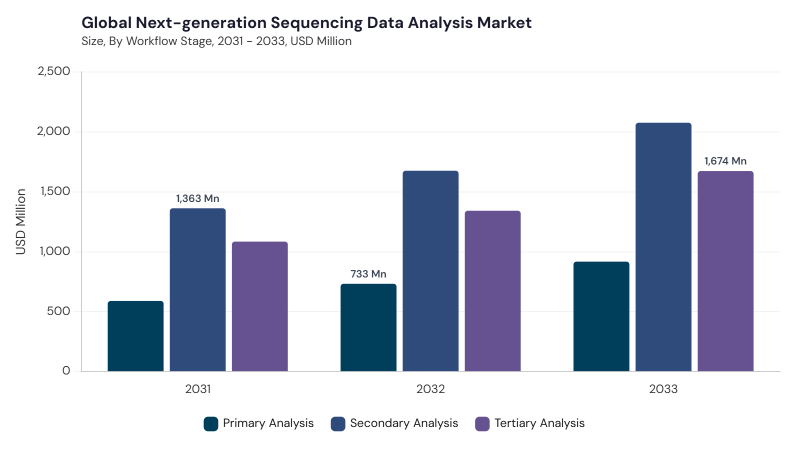
By workflow stage, the Next-generation Sequencing Data Analysis market is divided into Primary Analysis, Secondary Analysis, and Tertiary Analysis. The Secondary Analysis segment recorded 45.93% revenue share in the market in 2025. Secondary analysis workflows play a critical role in sequence alignment, assembly, variant calling, and genomic data processing, making them essential across precision medicine and genomic research applications globally.
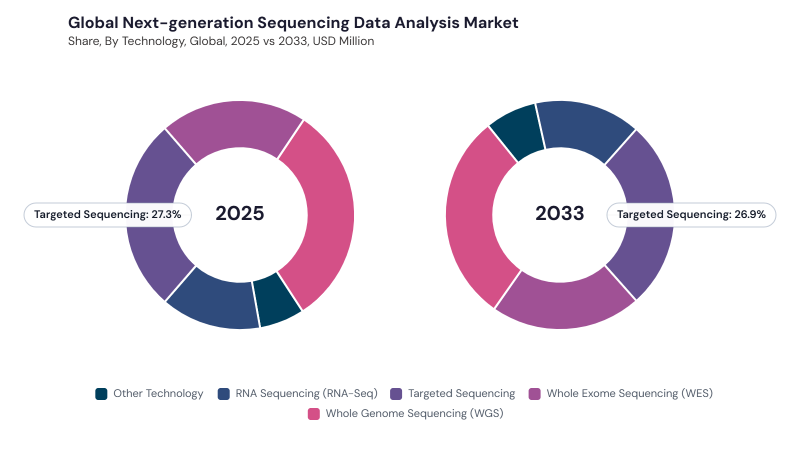
Based on technology, the Next-generation Sequencing Data Analysis market is segmented into Whole Genome Sequencing (WGS), Whole Exome Sequencing (WES), Targeted Sequencing, RNA Sequencing (RNA-Seq), and Others. The Whole Genome Sequencing (WGS) segment recorded 31.41% revenue share in the market in 2025 owing to increasing applications in oncology diagnostics, rare disease detection, and personalized medicine research.
By end user, the Next-generation Sequencing Data Analysis market is categorized into Academic & Research Institutes, Hospitals & Clinics, Pharmaceutical & Biotechnology Companies, CROs, and Others. The Academic & Research Institutes segment recorded 36.72% revenue share in the market in 2025. Rising genomic research activities, increasing funding for precision medicine initiatives, and growing investments in sequencing infrastructure are accelerating adoption across academic and research institutions globally.
Free Valuable Insights: Next-generation Sequencing Data Analysis Market Size to reach $4.66 Billion by 2033
Region-wise, the Next-generation Sequencing Data Analysis Market is analyzed across North America, Europe, Asia Pacific, and LAMEA. The North America segment recorded 48.90% revenue share in the market in 2025. In North America and Europe, genomic research organizations, healthcare institutions, and pharmaceutical companies are increasingly deploying AI-driven sequencing analytics platforms to improve precision medicine capabilities, biomarker discovery, and genomic diagnostics. Strong healthcare infrastructure, advanced sequencing ecosystems, and increasing investments in genomics research are supporting regional market growth.
In Asia Pacific and LAMEA, the Next-generation Sequencing Data Analysis market is witnessing strong growth owing to improving healthcare infrastructure, rising biotechnology investments, and increasing adoption of sequencing technologies across emerging economies. Governments and healthcare organizations across these regions are increasingly investing in genomic research initiatives, precision medicine programs, and cloud-based bioinformatics infrastructures to strengthen healthcare outcomes and disease surveillance capabilities.
The Next-generation Sequencing Data Analysis market is highly competitive and characterized by rapid technological innovation and increasing integration of artificial intelligence, machine learning, and cloud-native bioinformatics platforms. Competition centers on the ability to deliver scalable genomic analytics, automated variant interpretation, high-throughput sequencing workflows, and secure cloud-based genomic infrastructures. Vendors differentiate themselves through AI-enabled analytics capabilities, workflow automation, multi-omics integration, and advanced computational efficiency. Strategic collaborations between sequencing platform providers, pharmaceutical companies, healthcare institutions, and bioinformatics vendors continue to shape competitive positioning globally.
| Report Attribute | Details |
|---|---|
| Market size value in 2026 | USD 1.20 Billion |
| Market size forecast in 2033 | USD 4.66 Billion |
| Base Year | 2025 |
| Historical period | 2022 to 2024 |
| Forecast Period | 2026 to 2033 |
| Revenue Growth Rate | CAGR of 21.4% from 2026 to 2033 |
| Number of Pages | 726 |
| Tables | 930 |
| Report Coverage | Market Trends, Revenue Estimation and Forecast, Segmentation Analysis, Regional and Country Breakdown, Competitive Landscape, Market Share Analysis, Porter’s 5 Forces Analysis, Company Profiling, Companies Strategic Developments, SWOT Analysis, Winning Imperatives |
| Segments Covered | Component, Workflow Stage, Technology, Deployment Mode, End User, Region |
| Country Scope | · North America (US, Canada, Mexico, and Rest of North America) · Europe (Germany, UK, France, Russia, Spain, Italy, and Rest of Europe) · Asia Pacific (Japan, China, India, South Korea, Singapore, Malaysia, and Rest of Asia Pacific) · LAMEA (Brazil, Argentina, UAE, Saudi Arabia, South Africa, Nigeria, and Rest of LAMEA) |
| Companies Included | Illumina, Inc., Thermo Fisher Scientific, Inc., F. Hoffmann-La Roche Ltd., QIAGEN N.V., Agilent Technologies, Inc., Bio-Rad Laboratories, Inc., Revvity, Inc., Pacific Biosciences of California, Inc., Eurofins Genomics, SOPHiA GENETICS |
By Component
By Workflow Stage
By Technology
By Deployment Mode
By End User
By Geography
Valued at USD 1.20 billion in 2026, it will reach USD 4.66 billion by 2033, growing at 21.4% CAGR during 2026-2033.
On-Premise tops the deployment segment, projected to hit $2.69 billion by 2033.
Illumina, Inc., Thermo Fisher Scientific, Inc., and F. Hoffmann-La Roche Ltd. hold the dominant positions.
North America leads at $2.22 billion by 2033; Europe grows at 20.9% CAGR during 2026-2033.
Decreasing genome sequencing costs, AI integration in data interpretation, and expanding precision medicine applications fuel growth.
Whole Genome Sequencing (WGS) leads technology adoption, reaching $1.38 billion by 2033.
Our team of dedicated experts can provide you with attractive expansion opportunities for your business.






 Unique Offerings