The sample copy of this report is available for access.
The Europe Next-generation Sequencing Data Analysis Market is expected to reach $727.82 million by 2031, growing at a CAGR of 20.9% during the forecast period (2026-2033).
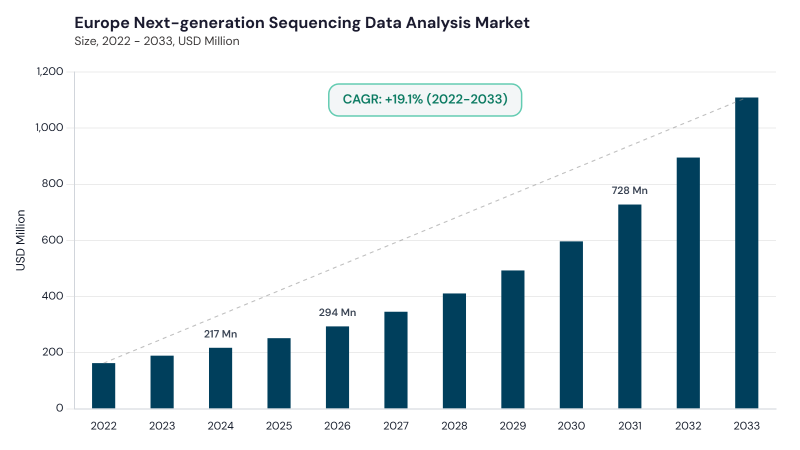
The Germany market dominated the Europe Next-generation Sequencing Data Analysis Market by Country in 2025 and would continue to be a dominant market till 2033. The UK market is expected to witness substantial growth during the forecast period. Additionally, the France market is expected to witness a CAGR of 22.8% during (2026 - 2033). The Rest of Europe market is expected to witness strong growth due to increasing adoption of genomic medicine and precision healthcare initiatives across emerging European economies.
The Europe Next-generation Sequencing (NGS) Data Analysis Market has evolved significantly since the early 2000s with the emergence of high-throughput sequencing technologies that transformed genomic research and clinical diagnostics. Initially, sequencing data analysis was limited by high sequencing costs, computational constraints, and relatively simple bioinformatics pipelines. However, continuous advancements in sequencing platforms such as Illumina and Oxford Nanopore, along with developments in cloud computing, artificial intelligence (AI), and machine learning (ML), have significantly improved genomic data interpretation capabilities. The introduction of advanced analytics tools, automated workflows, and multi-omics integration has accelerated the adoption of next-generation sequencing data analysis solutions across Europe’s healthcare, pharmaceutical, biotechnology, and academic research sectors.
The market is primarily driven by the growing adoption of precision medicine, rising demand for molecular diagnostics, increasing genomic research activities, and expansion of sequencing infrastructure across Europe. Healthcare providers, pharmaceutical companies, and research organizations are increasingly utilizing advanced NGS analytics solutions to support oncology diagnostics, biomarker discovery, infectious disease monitoring, rare disease identification, and personalized treatment planning. Additionally, strong government support, increasing funding for genomic initiatives, and implementation of advanced regulatory frameworks such as GDPR, MDR, and IVDR are further shaping the regional market landscape.
Based on Deployment Mode, the market is segmented into On-Premise and Cloud-Based. The On-Premise market dominated the Europe Next-generation Sequencing Data Analysis Market by Deployment Mode in 2025 and would continue to be a dominant market till 2033, thereby achieving a market value of $639.4 million by 2033, growing at a CAGR of 20.4% during the forecast period. The Cloud-Based market is expected to witness a CAGR of 21.6% during (2026 - 2033).
The dominance of the on-premise segment is attributed to stringent European data protection regulations and increasing concerns regarding the security and privacy of sensitive genomic information. Healthcare organizations and research institutions prefer on-premise infrastructure to maintain control over genomic datasets and ensure compliance with GDPR requirements. However, cloud-based deployment is witnessing strong growth due to its scalability, collaborative capabilities, and cost efficiency for large-scale genomic research projects.
Based on Component, the market is segmented into Software and Services. The Software market dominated the Europe Next-generation Sequencing Data Analysis Market by Component in 2025 and would continue to be a dominant market till 2033, thereby achieving a market value of $621.3 million by 2033. The Services market is expected to witness significant growth throughout the forecast period.
The software segment plays a critical role in transforming massive volumes of raw genomic sequencing data into actionable clinical and research insights. Increasing demand for advanced bioinformatics platforms, AI-powered analytics tools, automated workflows, and integrated multi-omics solutions continues to support the growth of this segment. Additionally, service providers offering outsourced sequencing analysis, consulting, cloud computation, and reporting services are witnessing increasing demand from biotechnology companies, clinical laboratories, and academic institutions lacking in-house bioinformatics expertise.
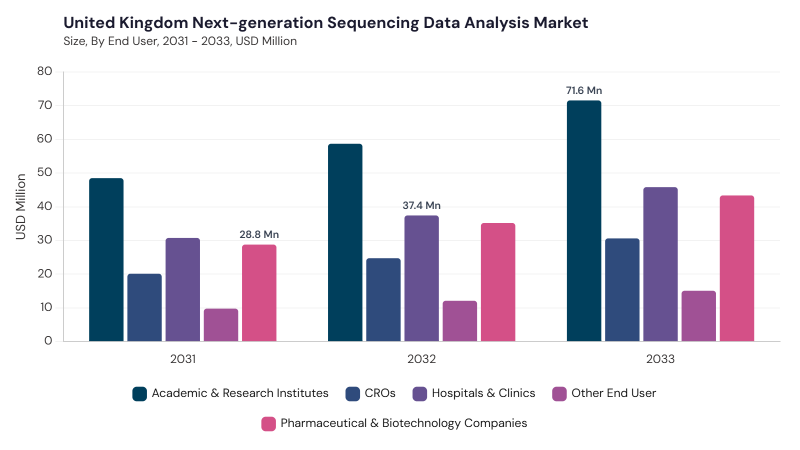
Based on Workflow Stage, the market is segmented into Primary Analysis, Secondary Analysis, and Tertiary Analysis. The Secondary Analysis market dominated the Europe Next-generation Sequencing Data Analysis Market by Workflow Stage in 2025. This segment continues to lead due to its essential role in alignment, assembly, and variant detection processes that transform raw sequencing data into interpretable genomic information. The Tertiary Analysis market recorded a significant revenue share owing to increasing demand for biological interpretation, variant annotation, and precision medicine applications. The Primary Analysis segment also witnessed notable growth due to increasing sequencing throughput and adoption of automated genomic workflows.
Based on Technology, the market is segmented into Whole Genome Sequencing (WGS), Targeted Sequencing, Whole Exome Sequencing (WES), RNA Sequencing (RNA-Seq), and Other Technology. The Whole Genome Sequencing (WGS) market dominated the Europe Next-generation Sequencing Data Analysis Market by Technology in 2025 and would continue to be a dominant market till 2033, thereby achieving a market value of $327.4 million by 2033, growing at a CAGR of 19.9% during the forecast period. The Targeted Sequencing market is expected to witness a CAGR of 20.7% during (2026 - 2033). Additionally, the Whole Exome Sequencing (WES) market is expected to witness the highest CAGR of 21.3% during (2026 - 2033).
The growth of the WGS segment is driven by its ability to comprehensively analyze entire genomes, supporting advanced research in disease mechanisms, population genomics, oncology, and personalized medicine. Targeted sequencing continues to gain traction due to its cost efficiency and focused genomic analysis capabilities for clinical diagnostics and biomarker identification. Meanwhile, RNA Sequencing (RNA-Seq) is increasingly being adopted for transcriptomics and gene expression studies, particularly in oncology and drug discovery applications.
Based on End User, the market is segmented into Academic & Research Institutes, Hospitals & Clinics, Pharmaceutical & Biotechnology Companies, CROs, and Other End User. The Academic & Research Institutes market dominated the Europe Next-generation Sequencing Data Analysis Market by End User in 2025. The dominance of this segment is driven by strong genomic research capabilities, increasing funding for sequencing projects, and rising focus on precision medicine initiatives across Europe. The Hospitals & Clinics segment recorded a significant revenue share due to increasing integration of genomic diagnostics into clinical decision-making and treatment planning. Pharmaceutical & Biotechnology Companies are increasingly leveraging sequencing data analysis for biomarker discovery, clinical trials, and drug development activities.
Free Valuable Insights: The Worldwide Next-generation Sequencing Data Analysis Market is projected to reach USD 4.66 Billion billion by 2033, at a CAGR of 21.4%
Germany continues to dominate the Europe Next-generation Sequencing Data Analysis Market owing to its advanced healthcare infrastructure, strong biotechnology ecosystem, and increasing investments in genomic research and precision medicine initiatives. The UK market is witnessing strong growth due to increasing adoption of AI-driven genomic analytics and rising clinical applications of NGS technologies. France is expected to witness robust expansion supported by government genomics programs and increasing oncology-focused research initiatives. Italy and Spain are also increasingly adopting sequencing technologies for molecular diagnostics and personalized treatment planning. Meanwhile, the Rest of Europe region is experiencing significant growth due to expanding healthcare digitalization, increasing genomic research collaborations, and growing investments in bioinformatics infrastructure.

By Component
By Workflow Stage
By Deployment Mode
By Technology
By End User
By Country
Market will reach $727.82 million by 2031, growing at 20.9% CAGR during the forecast period.
Germany dominated the Europe market in 2025 and continues as the leading country.
Increasing genomic research activities and growing adoption of precision medicine fuel regional expansion.
On-premise deployment led the Europe NGS data analysis market and maintains its dominant position.
France market will witness 22.8% CAGR during 2026-2033, showing strong regional growth.
Software dominated the Europe NGS data analysis market by component segment.
Our team of dedicated experts can provide you with attractive expansion opportunities for your business.




 Unique Offerings