The sample copy of this report is available for access.
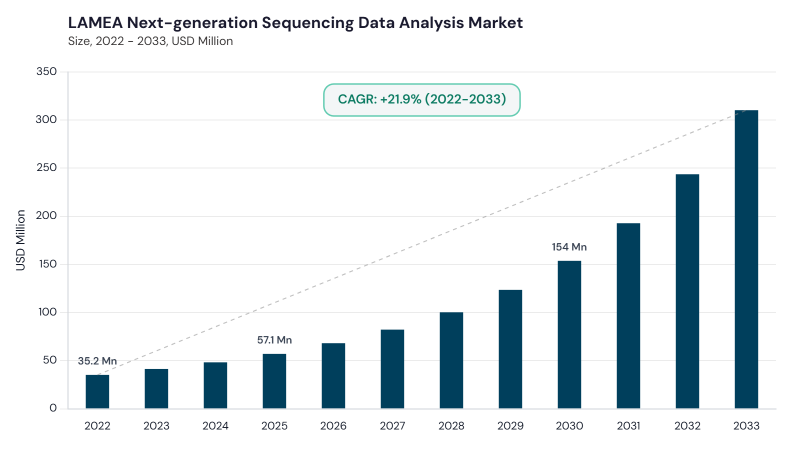
The LAMEA Next-generation Sequencing Data Analysis Market is expected to reach $100.31 million by 2033, growing at a CAGR of 24.2% during the forecast period (2026-2033).
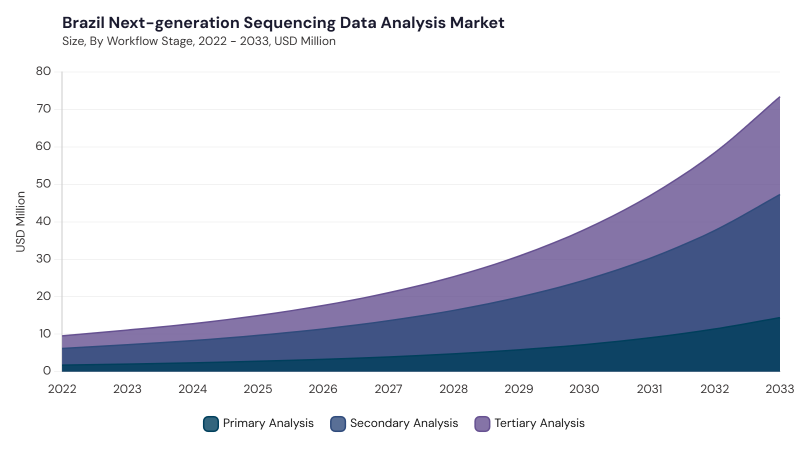
The Brazil market dominated the LAMEA Next-generation Sequencing Data Analysis Market by Country in 2025 and would continue to be a dominant market till 2033; thereby, achieving a market value of $73.42 million by 2033. The UAE market is expected to witness a CAGR of 23.5% during (2026 - 2033). Additionally, the Saudi Arabia market is expected to witness a CAGR of 24.1% during (2026 - 2033). The Brazil and UAE markets led the LAMEA Next-generation Sequencing Data Analysis Market by Country with a market share of 26.2% and 11.6% respectively in 2025. The South Africa market is expected to witness a CAGR of 24.9% throughout the forecast period.
The LAMEA Next-generation Sequencing (NGS) Data Analysis Market is steadily expanding due to growing adoption of genomic technologies across Latin America, the Middle East, and Africa. Increasing utilization of sequencing technologies in precision medicine, oncology diagnostics, infectious disease monitoring, and agricultural genomics is creating significant opportunities for bioinformatics and genomic data analysis platforms across the region. Healthcare modernization initiatives, rising investments in biotechnology research, and growing collaborations between international genomic organizations and regional healthcare institutions are accelerating the implementation of next-generation sequencing workflows in several LAMEA countries.
The market is also benefiting from increasing awareness regarding personalized medicine and genetic testing, particularly in countries such as Brazil, UAE, Saudi Arabia, and South Africa. Governments and private healthcare organizations are increasingly investing in advanced genomic research infrastructure to support early disease diagnosis, population genomics studies, and precision therapeutics development. Additionally, improvements in cloud computing, AI-driven analytics, and high-performance bioinformatics software are enhancing the efficiency and accessibility of genomic data interpretation across research laboratories and clinical settings throughout the region.
Based on Deployment Mode, the market is segmented into On-Premise and Cloud-Based. The On-Premise market dominated the LAMEA Next-generation Sequencing Data Analysis Market by Deployment Mode in 2025 and would continue to be a dominant market till 2033; thereby, achieving a market value of $180.73 million by 2033, growing at a CAGR of 23.6% during the forecast period. The Cloud-Based market is expected to witness a CAGR of 25.0% during (2026 - 2033).
The dominance of the on-premise segment is primarily attributed to data privacy concerns, regulatory compliance requirements, and the preference among research institutions and healthcare organizations for maintaining greater control over sensitive genomic datasets. However, cloud-based deployment is gaining traction rapidly due to increasing demand for scalable storage solutions, lower infrastructure costs, improved collaboration capabilities, and real-time access to large genomic datasets across distributed research ecosystems.
Based on Component, the market is segmented into Software and Services. The Software market dominated the LAMEA Next-generation Sequencing Data Analysis Market by Component in 2025 and would continue to be a dominant market till 2033; thereby, achieving a market value of $173.81 million by 2033, growing at a CAGR of 23.0% during the forecast period. The Services market is expected to witness a CAGR of 25.7% during (2026 - 2033).
The software segment is experiencing strong growth due to rising adoption of advanced genomic interpretation tools, AI-powered analytics platforms, and automated bioinformatics pipelines across research and clinical environments. At the same time, the services segment is expanding significantly as organizations increasingly rely on outsourced bioinformatics expertise, consulting services, cloud-based genomic analytics, and managed sequencing support services to address shortages of skilled genomic professionals across several LAMEA countries.
Based on Workflow Stage, the market is segmented into Primary Analysis, Secondary Analysis, and Tertiary Analysis. The Secondary Analysis market dominated the LAMEA Next-generation Sequencing Data Analysis Market by Workflow Stage in 2025 and would continue to be a dominant market till 2033; thereby, achieving a market value of $136.79 million by 2033, growing at a CAGR of 23.0% during the forecast period. The Primary Analysis market is expected to witness a CAGR of 25.4% during (2026 - 2033). Additionally, the Tertiary Analysis market is expected to witness robust growth throughout the forecast period.
The dominance of secondary analysis is supported by growing demand for sequence alignment, variant calling, genomic assembly, and data processing solutions necessary to transform raw sequencing data into clinically and biologically meaningful insights. Meanwhile, tertiary analysis is gaining momentum due to increasing demand for variant interpretation, clinical reporting, biomarker discovery, and precision medicine applications across oncology and rare disease research.
Based on Technology, the market is segmented into Whole Genome Sequencing (WGS), Whole Exome Sequencing (WES), Targeted Sequencing, RNA Sequencing (RNA-Seq), and Other Technology. The Whole Genome Sequencing (WGS) market dominated the LAMEA Next-generation Sequencing Data Analysis Market by Technology in 2025 and would continue to be a dominant market till 2033; thereby, achieving a market value of $90.55 million by 2033, growing at a CAGR of 22.5% during the forecast period. The Whole Exome Sequencing (WES) market is expected to witness a CAGR of 24.8% during (2026 - 2033). Additionally, the Targeted Sequencing market is expected to witness strong demand throughout the forecast period at a CAGR of 24.0%.
The WGS segment continues to dominate due to its broad application scope in population genomics, infectious disease surveillance, oncology research, and precision medicine initiatives. Meanwhile, WES and targeted sequencing technologies are gaining increased adoption due to their cost-effectiveness, high diagnostic accuracy, and suitability for focused genomic investigations in clinical and translational research environments.
Based on End User, the market is segmented into Academic & Research Institutes, Hospitals & Clinics, Pharmaceutical & Biotechnology Companies, CROs, and Other End User. The Academic & Research Institutes market dominated the LAMEA Next-generation Sequencing Data Analysis Market by End User in 2025 and would continue to be a dominant market till 2033; thereby, achieving a market value of $108.48 million by 2033. The Hospitals & Clinics market is expected to witness substantial growth throughout the forecast period owing to increasing integration of genomic testing into clinical diagnostics and personalized treatment planning. Additionally, the Pharmaceutical & Biotechnology Companies market is experiencing growing demand for sequencing analytics platforms to support drug discovery, biomarker research, and precision therapeutics development.
The strong presence of government-funded research programs, increasing genomic collaborations with international organizations, and rising investment in biotechnology innovation hubs are contributing significantly to the dominance of academic and research institutions across the LAMEA region.
Free Valuable Insights: Next-generation Sequencing Data Analysis Market Size Worth USD 4.66 Billion billion by 2033
Brazil continues to dominate the LAMEA Next-generation Sequencing Data Analysis Market due to increasing investments in biotechnology research, expansion of genomic medicine initiatives, and growing adoption of sequencing technologies across academic and healthcare institutions. The country is witnessing strong development in cancer genomics research, infectious disease surveillance programs, and precision healthcare applications, which continue to strengthen market growth.
The UAE and Saudi Arabia are emerging as key Middle Eastern markets driven by healthcare modernization programs, national genomics initiatives, and increasing deployment of AI-enabled healthcare technologies. Meanwhile, South Africa is witnessing increasing adoption of sequencing technologies in infectious disease research, agricultural genomics, and public health surveillance programs. Other countries across Latin America, the Middle East, and Africa are gradually increasing investments in precision medicine infrastructure, cloud-based healthcare analytics, and genomic research capabilities to support long-term healthcare transformation initiatives.

By Component
By Workflow Stage
By Deployment Mode
By Technology
By End User
By Country
Market will reach $100.31 million by 2033, growing at 24.2% CAGR during the forecast period.
Brazil dominates with 26.2% market share in 2025 and $73.42 million projected by 2033.
Expanding genomics research initiatives and increasing adoption of precision medicine across emerging economies fuel growth.
On-premise deployment leads the regional market, preferred over cloud-based solutions in 2025.
UAE market shows strong expansion at 23.5% CAGR during 2026-2033, despite 11.6% market share in 2025.
Software segment dominates over services in the regional NGS data analysis market.
Our team of dedicated experts can provide you with attractive expansion opportunities for your business.




 Unique Offerings