The sample copy of this report is available for access.
The Asia Pacific Next-generation Sequencing Data Analysis Market attained a market size of $233.84 million in 2025 and is expected to reach $1,032.87 million by 2033, growing at a CAGR of 20.4% during the forecast period (2026-2033).
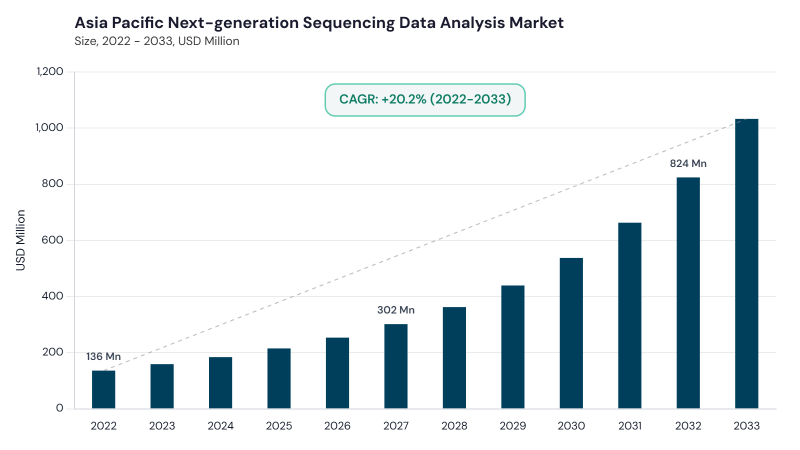
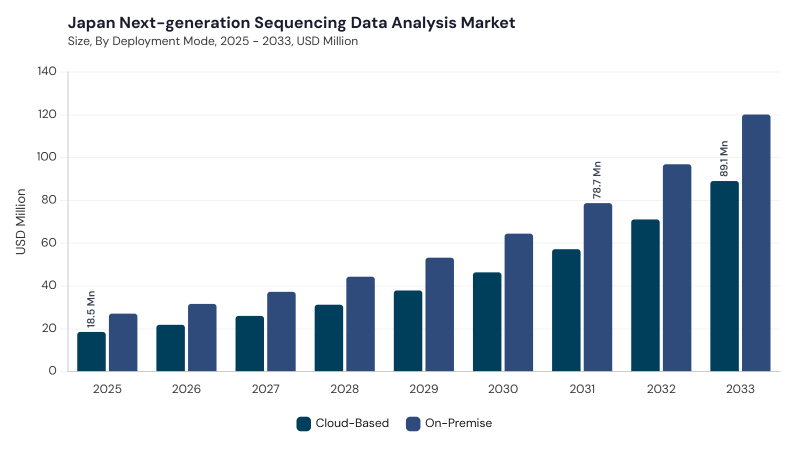
The China market dominated the Asia Pacific Next-generation Sequencing Data Analysis Market by Country in 2025 and would continue to be a dominant market till 2033; thereby, achieving a market value of $338.37 million by 2033. The Japan market is expected to witness a CAGR of 18.9% during (2026 - 2033). Additionally, the India market is expected to witness a CAGR of 22.3% during (2026 - 2033). The China and Japan markets led the Asia Pacific Next-generation Sequencing Data Analysis Market by Country with a market share of 35.8% and 18.1% in 2025. The Singapore market is expected to witness a CAGR of 21.9% throughout the forecast period.
The Asia Pacific Next-generation Sequencing (NGS) Data Analysis Market has emerged as one of the fastest-growing regional markets due to rapid advancements in genomic research, increasing healthcare digitization, and expanding precision medicine initiatives across major economies such as China, Japan, India, South Korea, Singapore, and Australia. The market initially developed through academic and biotechnology research applications, but over the last decade, the integration of sequencing technologies into clinical diagnostics, oncology, reproductive health, and infectious disease surveillance has accelerated regional adoption. Increasing affordability of sequencing technologies, coupled with improvements in computational biology, cloud computing, and artificial intelligence (AI)-driven analytics, has significantly enhanced the scalability and accessibility of genomic data analysis solutions throughout Asia Pacific.
The market is witnessing strong momentum due to increasing government funding for genomics projects, rising investments in biotechnology infrastructure, and growing utilization of precision medicine approaches across healthcare systems. Pharmaceutical companies, research institutions, and healthcare providers are increasingly deploying advanced bioinformatics platforms to process and interpret large-scale sequencing datasets for disease diagnosis, biomarker discovery, and therapeutic development. Furthermore, the growing prevalence of cancer and rare genetic disorders, increasing awareness regarding personalized medicine, and expansion of genomic research collaborations are further supporting market growth across the region. Technological advancements in AI-enabled genomic interpretation, automated sequencing workflows, and cloud-native analytics platforms are also accelerating innovation and commercialization activities throughout Asia Pacific.
Based on Deployment Mode, the market is segmented into On-Premise and Cloud-Based. The On-Premise market dominated the Asia Pacific Next-generation Sequencing Data Analysis Market by Deployment Mode in 2025 and would continue to be a dominant market till 2033; thereby, achieving a market value of $592.63 million by 2033, growing at a CAGR of 19.8% during the forecast period. The Cloud-Based market is expected to witness a CAGR of 21.3% during (2026 - 2033).
The dominance of the on-premise segment is attributed to increasing concerns regarding genomic data privacy, security management, and regulatory compliance across healthcare institutions and research organizations. However, cloud-based deployment is witnessing rapid growth due to increasing demand for scalable storage infrastructure, collaborative analytics capabilities, lower computational costs, and real-time genomic data sharing across research ecosystems.
Based on Component, the market is segmented into Software and Services. The Software market dominated the Asia Pacific Next-generation Sequencing Data Analysis Market by Component in 2025 and would continue to be a dominant market till 2033; thereby, achieving a market value of $573.96 million by 2033, growing at a CAGR of 20.0% during the forecast period. The Services market is expected to witness substantial growth at a CAGR of 20.9% during (2026 - 2033).
The software segment is experiencing strong demand due to increasing adoption of AI-powered bioinformatics platforms, genomic interpretation tools, and automated analytics workflows across healthcare and life sciences organizations. In addition, managed sequencing analytics services, consulting, cloud computation, and outsourced bioinformatics support are gaining traction among biotechnology firms, clinical laboratories, and research institutes lacking advanced in-house analytical capabilities.
Based on Workflow Stage, the market is segmented into Primary Analysis, Secondary Analysis, and Tertiary Analysis. The Secondary Analysis market dominated the Asia Pacific Next-generation Sequencing Data Analysis Market by Workflow Stage in 2025 and would continue to be a dominant market till 2033; thereby, achieving a market value of $458.41 million by 2033, growing at a CAGR of 19.7% during the forecast period. The Primary Analysis market is expected to witness a CAGR of 21.1% during (2026 - 2033). Additionally, the Tertiary Analysis market is expected to witness strong growth throughout the forecast period due to increasing demand for biological interpretation, variant annotation, and clinical reporting solutions.
The dominance of secondary analysis is primarily driven by rising demand for sequence alignment, assembly, variant calling, and genomic data processing solutions required to convert raw sequencing outputs into actionable biological insights. Meanwhile, tertiary analysis is gaining momentum due to increasing utilization of AI-assisted clinical interpretation and precision medicine applications.
Based on Technology, the market is segmented into Whole Genome Sequencing (WGS), Whole Exome Sequencing (WES), Targeted Sequencing, RNA Sequencing (RNA-Seq), and Other Technology. The Whole Genome Sequencing (WGS) market dominated the Asia Pacific Next-generation Sequencing Data Analysis Market by Technology in 2025 and would continue to be a dominant market till 2033; thereby, achieving a market value of $304.58 million by 2033, growing at a CAGR of 19.3% during the forecast period. The Targeted Sequencing market is expected to witness a CAGR of 20.5% during (2026 - 2033). Additionally, the Whole Exome Sequencing (WES) market is expected to witness the highest CAGR of 21.0% during (2026 - 2033).
The WGS segment continues to gain prominence due to its ability to deliver comprehensive genomic insights across oncology, rare disease diagnostics, population genomics, and infectious disease research applications. Targeted sequencing is increasingly being adopted for focused genomic investigations, precision oncology, and biomarker identification owing to its cost efficiency and clinical utility.
Based on End User, the market is segmented into Academic & Research Institutes, Hospitals & Clinics, Pharmaceutical & Biotechnology Companies, CROs, and Other End User. The Academic & Research Institutes market dominated the Asia Pacific Next-generation Sequencing Data Analysis Market by End User in 2025 and would continue to be a dominant market till 2033; thereby, achieving a market value of $361.67 million by 2033. The Hospitals & Clinics market is expected to witness considerable growth throughout the forecast period owing to increasing integration of genomic diagnostics into routine clinical workflows and personalized treatment approaches. Additionally, the Pharmaceutical & Biotechnology Companies market is witnessing strong demand for sequencing analytics solutions to support biomarker discovery, drug development, and companion diagnostics research activities.
The increasing number of genomics research collaborations, growing government funding for sequencing projects, and rising utilization of genomic medicine in healthcare systems are significantly contributing to the dominance of the academic and research segment across Asia Pacific.
Free Valuable Insights: Next-generation Sequencing Data Analysis Market is Predicted to reach USD 4.66 Billion billion by 2033, at a CAGR of 21.4%
China continues to dominate the Asia Pacific Next-generation Sequencing Data Analysis Market owing to extensive investments in biotechnology infrastructure, strong government support for genomic medicine initiatives, and increasing adoption of AI-driven sequencing analytics solutions across hospitals and research institutions. The country is witnessing rapid expansion of precision medicine programs, oncology genomics projects, and cloud-enabled genomic data platforms, which continue to strengthen the market landscape.
Japan is also emerging as a technologically advanced market driven by increasing deployment of sequencing technologies in oncology, rare disease diagnostics, and pharmaceutical research. India is witnessing the fastest growth across the region due to expanding healthcare digitization, rising biotechnology investments, and growing adoption of precision diagnostics and personalized medicine solutions. Meanwhile, Singapore, South Korea, Malaysia, and the Rest of Asia Pacific region are increasingly investing in genomic research infrastructure, AI-powered healthcare analytics, and collaborative sequencing ecosystems to accelerate healthcare innovation and clinical genomics adoption.

By Component
By Workflow Stage
By Deployment Mode
By Technology
By End User
By Country
Market attained $233.84 million in 2025 and will reach $1,032.87 million by 2033.
China dominates with 35.8% market share in 2025 and will reach $338.37 million by 2033.
India shows highest growth at 22.3% CAGR during 2026-2033. Japan follows at 18.9% CAGR during the same period.
On-premise deployment leads the regional market over cloud-based solutions.
Japan holds 18.1% market share in 2025, ranking second after China.
Our team of dedicated experts can provide you with attractive expansion opportunities for your business.




 Unique Offerings