The sample copy of this report is available for access.
“Global Laser Printer Market to reach a market value of USD 14913.20 Million by 2033 growing at a CAGR of %”
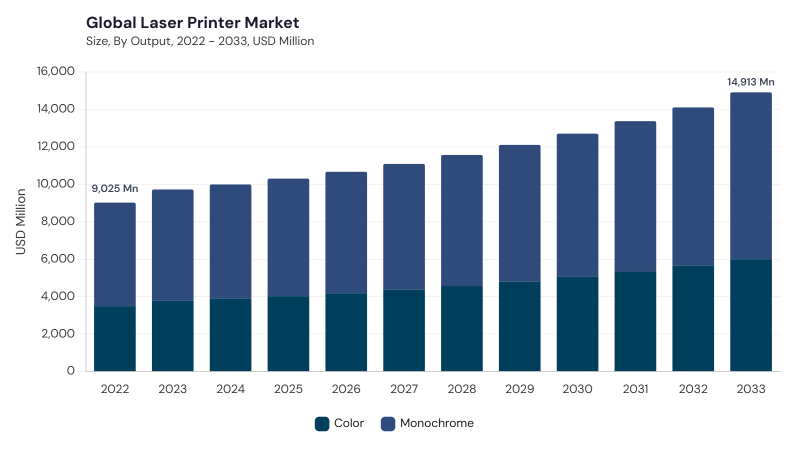
The Global Laser Printer Market is expected to reach USD 14.9 billion by 2033, growing at a CAGR of 4.9% during (2026 – 2033).
Laser printer adoption is increasing as offices, educational institutions, government organizations, healthcare facilities, retail environments, commercial printers, and home-office users require fast, reliable, high-volume, and sharp document output. Demand is reinforced by lower cost per page, durable print engines, secure enterprise printing, wireless and cloud connectivity, and multifunction devices that combine printing, scanning, copying, and document-management capabilities. Manufacturers are improving energy efficiency, toner management, compact designs, security features, and connectivity to meet changing business and institutional needs.
Rising need for efficient document processing, secure output, and dependable high-volume printing is sustaining demand across business, institutional, healthcare, education, and government environments. Multifunction adoption is expanding as organizations consolidate printing, scanning, copying, and digital document workflows into single systems to reduce equipment footprint and improve productivity. Wireless, cloud, and mobile printing are strengthening the relevance of laser printers in hybrid and distributed workplaces. At the same time, sustainability expectations are pushing manufacturers toward lower power consumption, recyclable components, efficient toner systems, and greener product lifecycles. Continued reliance on hard-copy documentation in regulated, administrative, educational, and enterprise settings supports market resilience despite wider digitalization.
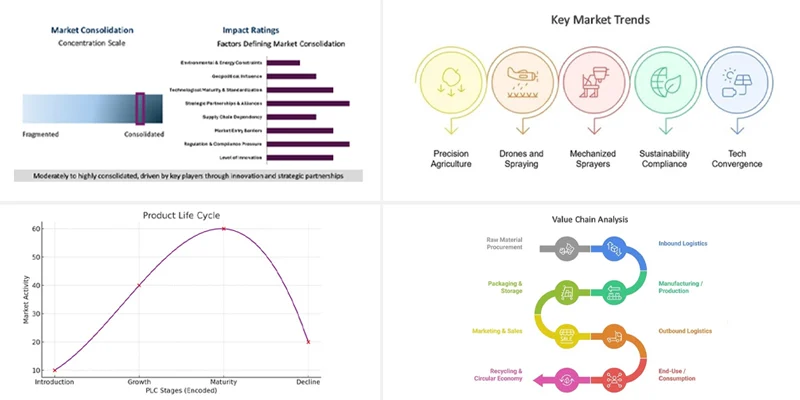
The competitive environment is moderately consolidated, with established global printer manufacturers competing through product reliability, print quality, multifunction capabilities, security, connectivity, energy efficiency, consumables economics, and managed print services. Large companies use broad portfolios, global distribution, installed device bases, and recurring toner and service revenue to maintain strong positions. Regional and specialized manufacturers compete through cost-effective models, localized service networks, compact devices, and price-sensitive offerings. Competition is increasingly shifting from basic hardware performance toward secure endpoints, cloud integration, remote fleet management, document workflow software, sustainability credentials, and lifecycle service models.

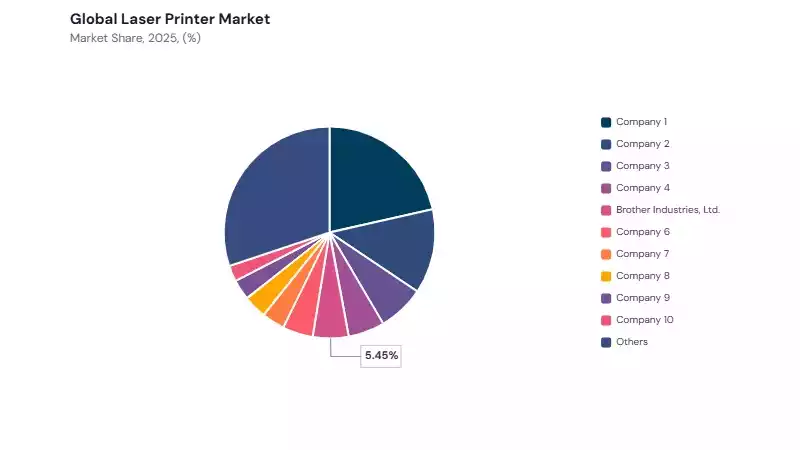
The Laser Printer Market is moderately concentrated, with leading global printing companies benefiting from broad device portfolios, large installed bases, recurring consumables demand, and enterprise relationships. HP, Canon, Xerox, Ricoh, Brother, Kyocera, Konica Minolta, Pantum, FUJIFILM Business Innovation, and Sharp compete across office, enterprise, SMB, and institutional printing environments. Market share is influenced by product reliability, toner economics, service coverage, security features, multifunction integration, and channel strength. Managed print services, cloud-enabled workflows, and cybersecurity capabilities are becoming stronger differentiators as printers become connected enterprise endpoints. Regional and price-focused vendors continue to preserve competitive diversity, especially in cost-sensitive and emerging markets.
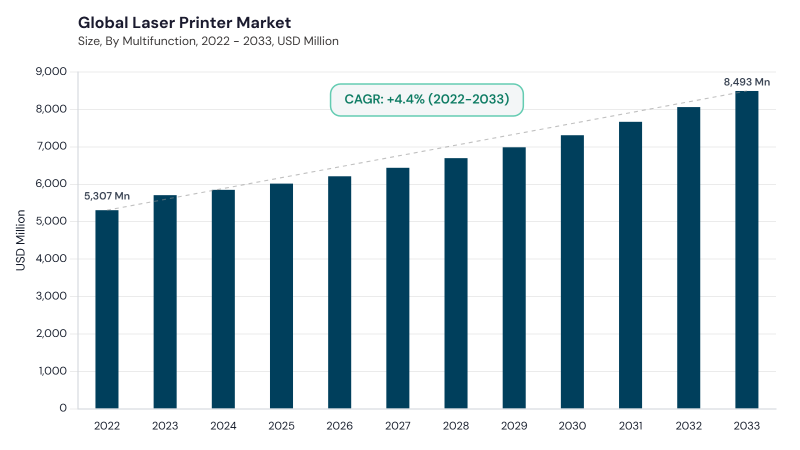
Based on printer type, the market is segmented into Multifunction and Single-function. The Multifunction market dominated the Global Laser Printer Market by Printer Type in 2025, and would continue to be a dominant market till 2033; thereby, achieving a market value of USD 8.4 billion by 2033, growing at a CAGR of 4.6 % during the forecast period. The Single-function market is expected to witness a CAGR of 5.4% during (2026 - 2033).
Multifunction laser printers combine printing, scanning, copying, and sometimes faxing into one device, making them suitable for enterprises, institutions, and offices seeking integrated document workflows. These devices support space optimization, centralized administration, digital document handling, and improved productivity across departments. Single-function laser printers remain important where users need focused, fast, and reliable print output without additional features. They are preferred in small offices, retail environments, print-for-pay settings, and high-volume text-heavy workflows. Together, both subsegments address different customer priorities, with multifunction devices supporting consolidation and single-function models supporting simplicity and cost efficiency.
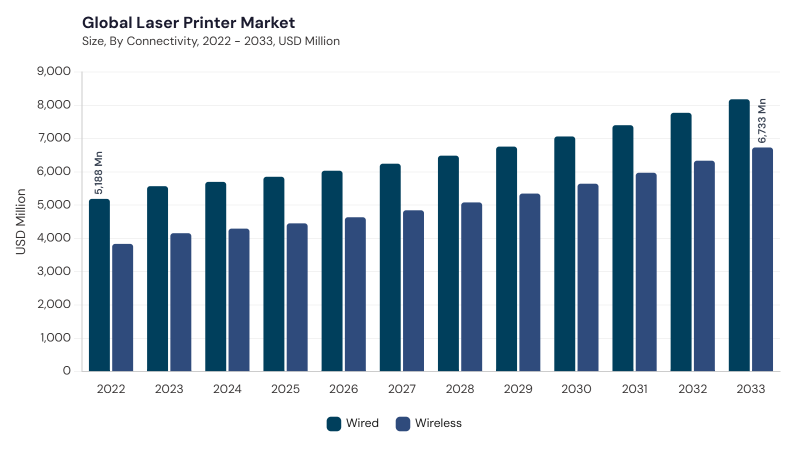
Based on connectivity, the market is segmented into Wired and Wireless. The Wired market dominated the Global Laser Printer Market by Connectivity in 2025, and would continue to be a dominant market till 2033; thereby, achieving a market value of USD 8.1 billion by 2033, growing at a CAGR of 4.4 % during the forecast period. The Wireless market is expected to witness a CAGR of 5.5% during (2026 - 2033).
Wired laser printers remain important in enterprise, government, legal, healthcare, and education settings where stable connections, secure transmission, centralized management, and uninterrupted high-volume printing are critical. Ethernet and USB-based deployments support controlled print environments and reduce exposure to wireless interference. Wireless laser printers are gaining relevance as workplaces adopt mobile devices, flexible office layouts, cloud workflows, and hybrid work models. Wi-Fi, Bluetooth, and cloud printing capabilities allow users to print from laptops, smartphones, and tablets without physical cabling. Both connectivity types remain relevant, with wired models serving security and reliability needs while wireless models support mobility and flexible deployment.
Based on output, the market is segmented into Monochrome and Color. The Monochrome market dominated the Global Laser Printer Market by Output in 2025, and would continue to be a dominant market till 2033; thereby, achieving a market value of USD 8.9 billion by 2033, growing at a CAGR of 4.6 % during the forecast period. The Color market is expected to witness a CAGR of 5.3% during (2026 - 2033).
Monochrome laser printers are widely used for text-heavy printing across offices, government departments, educational institutions, healthcare facilities, and enterprise environments where speed, clarity, and cost efficiency are important. These devices support invoices, reports, memos, administrative forms, and other black-and-white documents at scale. Color laser printers address demand for presentations, marketing material, educational content, graphics, brochures, and visually rich business documents. Improvements in toner quality, print resolution, and operating efficiency are expanding color adoption across professional and institutional settings. The two subsegments serve distinct use cases, with monochrome focused on economical document output and color focused on visual communication.
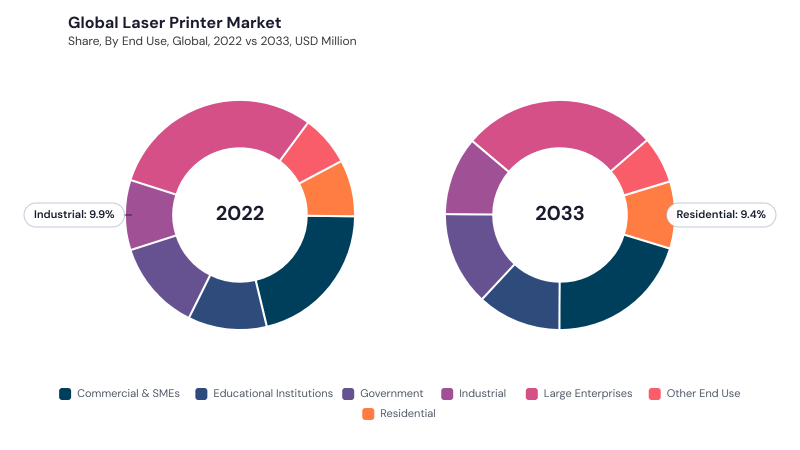
Based on end use, the market is segmented into Large Enterprises, Commercial & SMEs, Government, Educational Institutions, Industrial, Residential, and Other End Use. The Large Enterprises market dominated the Global Laser Printer Market by End Use in 2025, and would continue to be a dominant market till 2033; thereby, achieving a market value of USD 4.1 billion by 2033, growing at a CAGR of 4 % during the forecast period. The Commercial & SMEs market is expected to witness a CAGR of 4.5% during (2026 - 2033). Additionally, The Government market is expected to witness highest CAGR of 5.3% during (2026 - 2033).
Large enterprises require scalable print fleets, secure authentication, centralized device management, and multifunction systems for high-volume workflows. Commercial & SMEs prioritize affordable, compact, and dependable printers that support daily business documents, invoices, and customer-facing operations. Government and educational institutions rely on reliable document output for administration, compliance, records, learning material, and institutional communication. Industrial users require durable systems for operational documents, labels, manuals, and production records, while residential users benefit from home-office and personal printing needs. Other End Use covers specialized commercial and institutional requirements requiring reliable print performance.
Free Valuable Insights: Laser Printer Market Size to reach $14.9 Billion by 2033
Region-wise, the Laser Printer Market is analyzed across North America, Europe, Asia Pacific, and LAMEA. The Asia Pacific market dominated the Global Laser Printer Market by Region in 2025, and would continue to be a dominant market till 2033; thereby, achieving a market value of USD 5.7 billion by 2033, growing at a CAGR of 5.3 % during the forecast period. The North America market is expected to witness a CAGR of 4.3% during (2026 - 2033). Additionally, The Europe market is expected to witness a CAGR of 4.7% during (2026 - 2033).
Asia Pacific holds the leading position, supported by expanding business activity, education infrastructure, commercial printing needs, SME growth, and continued investment in office technology. North America shows strong adoption of multifunction, secure, network-connected, and managed printing solutions across enterprise and institutional environments. Europe benefits from workplace modernization, document workflow optimization, security compliance, and demand for energy-efficient office equipment. LAMEA demand is supported by expanding commercial activity, modernization of office infrastructure, public-sector digitization, and rising use of network-enabled printing systems across developing business environments.
| Report Attribute | Details |
|---|---|
| Market size value in 2026 | USD 10.6 billion |
| Market size forecast in 2033 | USD 14.9 billion |
| Base Year | 2025 |
| Historical Period | 2022 to 2024 |
| Forecast Period | 2026 to 2033 |
| Revenue Growth Rate | CAGR of 4.9% from 2026 to 2033 |
| Number of Pages | XX |
| Tables | XX |
| Report Coverage | Market Trends, Revenue Estimation and Forecast, Segmentation Analysis, Regional and Country Breakdown, Competitive Landscape, Market Share Analysis, Company Profiling, Companies Strategic Developments, SWOT Analysis, Product Life Cycle Analysis, Value Chain Analysis, Market Consolidation Analysis, Key Customer Criteria, Pandemic Impact Analysis, and Winning Imperatives |
| Segments Covered | Printer Type, Connectivity, Output, End Use, and Geography |
| Country Scope |
|
| Companies Included | HP Inc.; Canon Inc.; Xerox; Ricoh Company, Ltd.; Brother Industries; Kyocera Document Solutions; Konica Minolta; Pantum; FUJIFILM Business Innovation Corp.; Sharp Corporation |
By Printer Type
By Connectivity
By Output
By End Use
By Geography
The market is valued at USD 10.6 billion in 2026, projected to reach USD 14.9 billion by 2033.
Multifunction printers lead, projected to hit USD 8.4 billion by 2033.
HP Inc., Canon Inc., Xerox, Ricoh, Brother, Kyocera, Konica Minolta, Pantum, FUJIFILM, and Sharp dominate the market.
Wired printers dominate, expected to reach USD 8.1 billion by 2033.
Asia Pacific leads, projected to reach USD 5.7 billion by 2033.
Monochrome printers lead, expected to reach USD 8.9 billion by 2033.
Our team of dedicated experts can provide you with attractive expansion opportunities for your business.






 Unique Offerings
