The sample copy of this report is available for access.
The Europe Laser Printer Market is expected to reach USD 3246.0 million by 2031, growing at a CAGR of 4.7% during (2026 - 2033).
The Europe Laser Printer Market originated in the late twentieth century as laser printing emerged as a faster and higher-quality alternative to traditional printing methods. Early adoption was concentrated in large corporate and publishing environments due to high costs and technical complexity, while later improvements in print speed, resolution, affordability, and hardware miniaturization expanded usage across SMEs and individual consumers. The market has since matured through color laser printing, multifunction devices, networked systems, wireless connectivity, cloud printing, and energy-efficient designs.
Current market growth is shaped by sustainability, IoT and AI integration, cloud-based printing, and demand for connected office workflows. European buyers are prioritizing energy-efficient printers, reduced emissions, recyclable components, secure cloud compatibility, predictive maintenance, and smart device management. Multifunction laser printers, wireless access, mobile printing, managed print services, and sector-specific printing solutions are also gaining relevance as organizations balance print quality, cost efficiency, regulatory compliance, and hybrid workplace requirements.
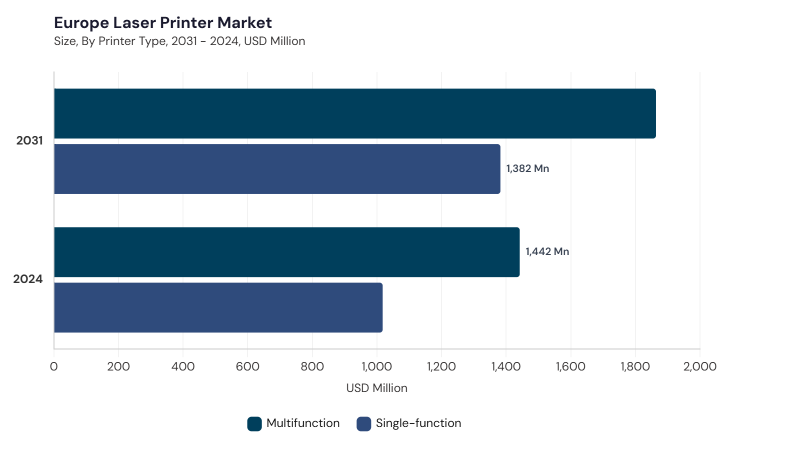
Based on Printer Type, the market is segmented into Multifunction and Single-function. The Multifunction market dominated the Europe Laser Printer Market by Printer Type in 2025, and would continue to be a dominant market till 2033; thereby, achieving a market value of USD 1863.8 million by 2031, growing at a CAGR of 4.3 % during the forecast period. The Single-function market is expected to witness a CAGR of 5.1% during (2026 - 2033).
Multifunction laser printers remain widely adopted across corporate workplaces, government departments, healthcare institutions, educational facilities, banking organizations, and professional service environments because they consolidate several document functions into one device. Their adoption is supported by cloud integration, secure user authentication, confidential print release, encrypted data transmission, mobile connectivity, centralized administration, and sustainability-focused features. Single-function printers maintain a promising presence where dedicated printing capacity, straightforward operation, lower acquisition cost, predictable output, and consistent document printing remain important for small businesses, retail establishments, administrative offices, warehouses, home offices, and specialized departments.
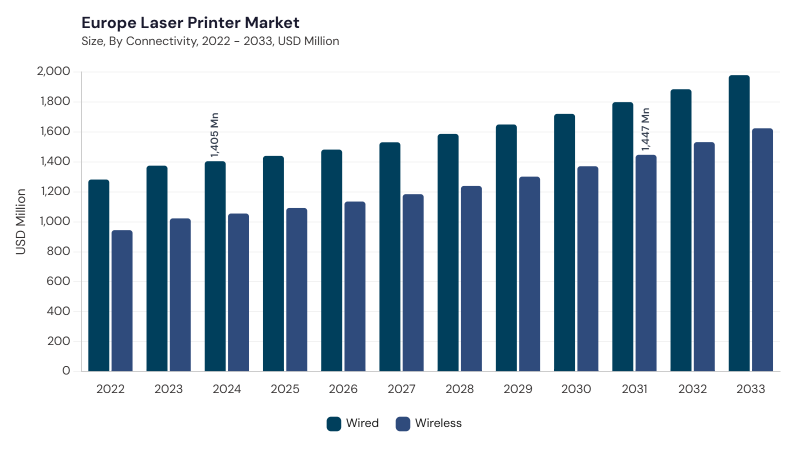
Based on Connectivity, the market is segmented into Wired and Wireless. The Wired market dominated the Europe Laser Printer Market by Connectivity in 2025, and would continue to be a dominant market till 2033; thereby, achieving a market value of USD 1798.9 million by 2031, growing at a CAGR of 4.2 % during the forecast period. The Wireless market is expected to witness a CAGR of 5.3% during (2026 - 2033).
Wired laser printers remain important in large offices, government institutions, regulated industries, and mission-critical environments where stable data transfer, controlled access, high-volume reliability, and secure network integration are required. USB, Ethernet, and other direct connections support predictable performance and lower interference risk. Wireless connectivity holds a promising role as flexible office layouts, hybrid work, mobile devices, shared workspaces, BYOD practices, Wi-Fi, Bluetooth, NFC, cloud printing, and mobile print apps increase demand for cable-free access and easier device placement.
Based on Output, the market is segmented into Monochrome and Color. Monochrome laser printers remain central for high-volume text printing in law firms, finance, government, education, administration, and routine business workflows where speed, sharp text, reliability, and lower running cost are key priorities.
Their adoption is supported by duplexing, network connectivity, energy efficiency, and toner cost optimization. Color laser printers maintain a promising presence in marketing, education, creative services, corporate communications, presentations, brochures, color-coded reports, and branded documents where visual quality, color accuracy, and professional in-house output are important.
Based on End Use, the market is segmented into Large Enterprises, Commercial & SMEs, Government, Educational Institutions, Industrial, Residential, and Other End Use. Large Enterprises rely on laser printers for secure high-volume printing, centralized print management, departmental workflows, document confidentiality, cloud-enabled devices, and remote monitoring. Commercial & SMEs adopt compact and cost-efficient printers for invoicing, billing, marketing collateral, and daily business documentation.
Government users prioritize secure print release, audit trails, public records, official forms, and durable devices. Educational Institutions use laser printers for academic materials, examinations, institutional records, and campus administration. Industrial users require printers for production documentation, compliance records, logistics paperwork, labeling, and technical information. Residential adoption is supported by home offices, hybrid work, compact models, wireless access, and low-to-moderate document workloads, while Other End Use includes healthcare, legal, hospitality, nonprofit, and specialized professional settings.
Free Valuable Insights: The Worldwide Laser Printer Market is projected to reach USD 14.9 Billion billion by 2033, at a CAGR of 4.9%
Based on Country, the market is segmented into Germany, UK, France, Russia, Spain, Italy, and Rest of Europe. The Germany market dominated the Europe Laser Printer Market by Country in 2025, and would continue to be a dominant market till 2033; thereby, achieving a market value of USD 582.6 million by 2031, growing at a CAGR of 3.1 % during the forecast period. The UK market is expected to witness a CAGR of 3.5% during (2026 - 2033). Additionally, The France market is expected to witness a CAGR of 5.4% during (2026 - 2033).
Germany is supported by sustainability-focused devices, multifunction printing, cloud integration, remote management, and cost-optimized models, while the UK is shaped by eco-friendly printers, smart connectivity, IoT features, cloud print management, and AI-driven diagnostics. France reflects sustainable printer design, wireless and cloud-based capabilities, compact SME-focused devices, and multifunction adoption, whereas Russia emphasizes energy-efficient devices, networked infrastructure, mid-range affordability, and localized support. Spain is advancing through eco-conscious printing, wireless and cloud-enabled multifunction devices, AI-enabled maintenance, and managed print services; Italy is driven by energy-efficient printers, wireless and cloud compatibility, high-volume multifunction devices, and IoT-enabled print management; and Rest of Europe is supported by sustainable laser printers, cloud-connected devices, IoT-enabled monitoring, secure printing, and localized product portfolios.

By Printer Type
By Connectivity
By Output
By End Use
By Country
Set to reach $3246.0 Million by 2031, growing at 4.7% CAGR during 2026-2033.
Germany leads with $582.6 million by 2031, growing at a CAGR of 3.1% during the forecast period.
The Multifunction segment dominates, reaching $1863.8 million by 2031, growing at a CAGR of 4.3%.
The Wireless market is expected to witness a CAGR of 5.3% during 2026-2033.
The UK market is expected to witness a CAGR of 3.5% during 2026-2033.
The France market is expected to witness a CAGR of 5.4% during 2026-2033.
Our team of dedicated experts can provide you with attractive expansion opportunities for your business.




 Unique Offerings
