The sample copy of this report is available for access.
The Asia Pacific Laser Printer Market is expected to reach USD 4.8 billion by 2030, growing at a CAGR of 5.3% during (2026 - 2033).
The Asia Pacific Laser Printer Market originated in the latter part of the 20th century as laser printing emerged as a high-speed and high-resolution alternative to impact and inkjet printers. Early adoption was concentrated among large enterprises and commercial users due to the higher cost of monochrome laser devices, while later improvements in photoreceptor materials, toner formulations, laser scanning mechanisms, color output, network connectivity, and energy efficiency expanded usage across businesses and households. The market has since matured through multifunctional devices, cloud connectivity, office automation, and sustainability-focused product development.
Current market growth is shaped by green printing, hybrid work, multifunction devices, regional cost competition, and smart printer integration. Buyers are increasingly favoring energy-efficient printers, eco-friendly consumables, wireless connectivity, remote management, secure printing, and cloud-compatible devices. At the same time, local manufacturers in China and India are strengthening price competition, encouraging wider availability of entry-level models for budget-conscious users and advanced enterprise solutions for high-volume printing environments.
Based on Printer Type, the market is segmented into Multifunction and Single-function. The Multifunction market dominated the Asia Pacific Laser Printer Market by Printer Type in 2025, and would continue to be a dominant market till 2033; thereby, achieving a market value of USD 2.7 billion by 2030, growing at a CAGR of 5 % during the forecast period. The Single-function market is expected to witness a CAGR of 5.8% during (2026 - 2033).
Multifunction laser printers remain widely adopted because they consolidate printing, copying, scanning, and faxing into one device, improving workspace efficiency and document workflow management. Their adoption is supported by cloud integration, mobile printing, wireless connectivity, secure printing, user authentication, and energy-efficient operations. Single-function printers maintain a promising presence in high-throughput business settings where dedicated printing, operational simplicity, predictable performance, print speed, and output reliability remain important for large offices, commercial establishments, financial institutions, educational facilities, retail, logistics, and specialized printing environments.
Based on Connectivity, the market is segmented into Wired and Wireless. The Wired market dominated the Asia Pacific Laser Printer Market by Connectivity in 2025, and would continue to be a dominant market till 2033; thereby, achieving a market value of USD 2.7 billion by 2030, growing at a CAGR of 4.8 % during the forecast period. The Wireless market is expected to witness a CAGR of 5.9% during (2026 - 2033).
Wired laser printers remain important across large enterprises, government agencies, educational institutions, banks, insurance companies, and other document-intensive environments where secure connectivity, stable performance, low latency, and reliable high-volume printing are priorities. Wireless connectivity holds a promising position as smartphone penetration, Wi-Fi infrastructure, hybrid work, mobile printing, cloud workflows, BYOD practices, and flexible office layouts increase the need for cable-free printing from multiple devices.
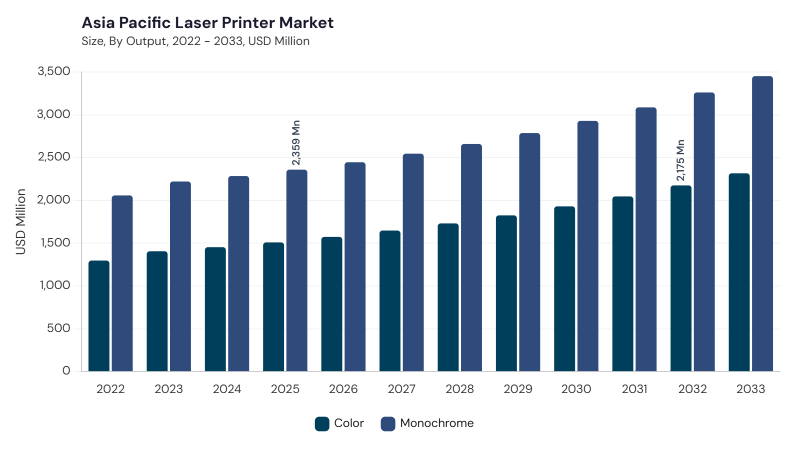
Based on Output, the market is segmented into Monochrome and Color. Monochrome laser printers remain central for contracts, reports, administrative paperwork, academic documents, office records, and other high-volume text-based printing where speed, lower operating cost, and durability are key priorities.
Their adoption is supported by toner efficiency, energy-saving features, affordability, and suitability for document-heavy workflows. Color laser printers maintain a promising role in marketing, design, education, retail, training materials, sales collateral, graphics-rich reports, branded documentation, and other applications requiring visual clarity, color consistency, and professional in-house output.
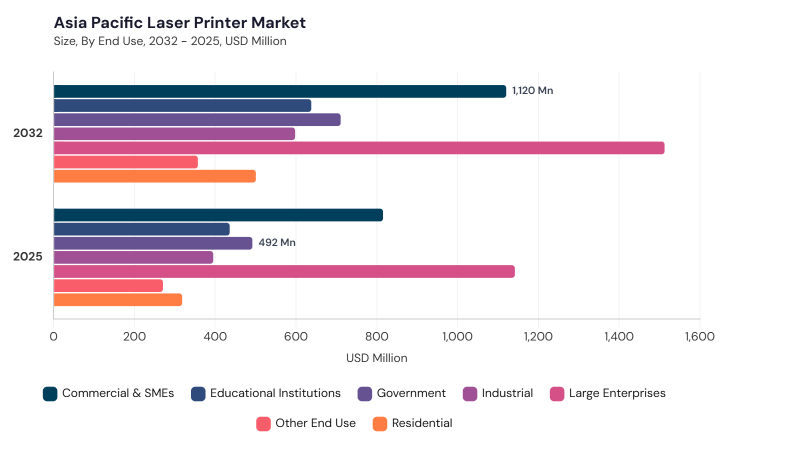
Based on End Use, the market is segmented into Large Enterprises, Commercial & SMEs, Government, Educational Institutions, Industrial, Residential, and Other End Use. Large Enterprises rely on laser printers for secure high-volume printing, multifunction workflows, centralized fleets, remote device management, and network integration. Commercial & SMEs use laser printers for invoices, contracts, reports, marketing collateral, and compact office workflows with manageable operating costs. Government users require secure documentation, official forms, certificates, records, and public-sector workflows.
Educational Institutions depend on printers for teaching materials, examinations, research documents, assignments, and administrative records. Industrial users apply laser printers for shipping labels, quality-control reports, product specifications, inventory records, and compliance paperwork. Residential demand is supported by remote work, home businesses, study needs, compact devices, and wireless access, while Other End Use includes healthcare, banking, hospitality, legal services, creative agencies, and professional environments requiring specialized document output.
Free Valuable Insights: Laser Printer Market is Predicted to reach USD 14.9 Billion billion by 2033, at a CAGR of 4.9%
Based on Country, the market is segmented into China, Japan, India, South Korea, Singapore, Malaysia, and Rest of Asia Pacific. The China market dominated the Asia Pacific Laser Printer Market by Country in 2025, and would continue to be a dominant market till 2033; thereby, achieving a market value of USD 1.7 billion by 2030, growing at a CAGR of 3.9 % during the forecast period. The Japan market is expected to witness a CAGR of 4.5% during (2026 - 2033). Additionally, The India market is expected to witness a CAGR of 6% during (2026 - 2033).
China is shaped by multifunction laser printers, wireless and cloud printing, sustainability, e-commerce distribution, and domestic manufacturing, while Japan reflects smart office infrastructure, cloud printing, compact multifunction devices, and eco-conscious printer design. India is driven by SME adoption, multifunction devices, sustainability, wireless connectivity, cloud integration, and localized service networks. South Korea is supported by IoT-enabled printers, remote management, green devices, multifunctionality, and secure printing, whereas Singapore is influenced by smart connected printers, cloud integration, sustainability, high-speed color printing, and strong service expectations. Malaysia is progressing through energy-efficient printers, cloud-based workflows, localized service support, multifunction adoption, and IoT-enabled print management, while Rest of Asia Pacific is shaped by sustainable devices, wireless and cloud printing, localized support networks, smart sensors, predictive maintenance, and region-specific service models.

By Printer Type
By Connectivity
By Output
By End Use
By Country
Set to reach $4.8 Billion by 2030, growing at 5.3% CAGR during 2026-2033.
China leads with $1.7 billion by 2030, growing at a 3.9% CAGR during 2026-2033.
Rising demand for multifunction printers, reaching $2.7 billion by 2030 at 5% CAGR during 2026-2033.
Wireless segment to grow at a 5.9% CAGR during 2026-2033.
India market to witness a 6% CAGR during 2026-2033.
Single-function market expected to grow at a 5.8% CAGR during 2026-2033.
Our team of dedicated experts can provide you with attractive expansion opportunities for your business.




 Unique Offerings
