The sample copy of this report is available for access.
The LAMEA Laser Printer Market is expected to reach USD 920.3 million by 2029, growing at a CAGR of 6.2% during (2026 - 2033).
The LAMEA Laser Printer Market originated with the broader introduction of laser printing technology in the late 20th century, supported by demand for faster and higher-quality document output beyond traditional inkjet printers. Early adoption across the region was slower due to infrastructure and economic constraints, but demand from finance, telecommunications, government, and enterprise users gradually increased the use of reliable document-management solutions. The market has since progressed from bulky monochrome machines to compact, multifunction, color-capable, network-connected, and cloud-ready devices aligned with evolving office ecosystems.
Current market growth is shaped by sustainable printing, hybrid work, wireless connectivity, multifunction adoption, AI, and IoT-enabled device management. Businesses are increasingly prioritizing energy-efficient devices, reduced consumable waste, mobile printing, compact home-office printers, predictive maintenance, automated supply replenishment, and stronger security features. Localized service networks, partnerships with distributors, cost-competitive models, and region-specific product adaptation are also becoming important as vendors address diverse infrastructure readiness and price sensitivity across Latin America, the Middle East, and Africa.
Based on Printer Type, the market is segmented into Multifunction and Single-function. The Multifunction market dominated the LAMEA Laser Printer Market by Printer Type in 2025, and would continue to be a dominant market till 2033; thereby, achieving a market value of USD 536.5 million by 2029, growing at a CAGR of 5.8 % during the forecast period. The Single-function market is expected to witness a CAGR of 6.6% during (2026 - 2033).
Multifunction laser printers remain widely adopted because they consolidate printing, scanning, copying, and faxing into one device, helping organizations improve workflow efficiency, save office space, and reduce operational complexity. Their adoption is supported by wireless connectivity, duplex printing, cloud integration, secure printing, automatic document feeders, and broader digital document workflows. Single-function printers maintain a promising presence where users require dedicated, dependable, high-speed, and cost-efficient printing for text-heavy documents, official records, reports, legal paperwork, administrative materials, and high-volume routine printing.
Based on Connectivity, the market is segmented into Wired and Wireless. The Wired market dominated the LAMEA Laser Printer Market by Connectivity in 2025, and would continue to be a dominant market till 2033; thereby, achieving a market value of USD 519.0 million by 2029, growing at a CAGR of 5.7 % during the forecast period. The Wireless market is expected to witness a CAGR of 6.8% during (2026 - 2033).
Wired laser printers remain important across corporate offices, government institutions, educational facilities, banking, and public administration where consistent data transfer, network reliability, high-volume performance, and security are priorities. Ethernet, USB, and other wired connections continue to support stable printing in structured office environments. Wireless connectivity holds a promising role as improving broadband availability, mobile-device use, BYOD practices, Wi-Fi, Bluetooth, cloud printing, and decentralized work environments increase demand for flexible printing from smartphones, laptops, tablets, and shared office devices.
Based on Output, the market is segmented into Monochrome and Color. Monochrome laser printers remain central for government offices, educational institutions, SMEs, public administration, legal documentation, financial paperwork, and other high-volume text-based workflows where affordability, speed, clarity, and lower consumable costs are important.
Their adoption is supported by energy efficiency, faster print speeds, cloud workflow integration, and reliable output quality. Color laser printers maintain a promising presence across enterprises, education, retail, marketing, design, and professional services where presentations, promotional materials, instructional content, branding documents, and visually detailed business communication require higher-quality color output.
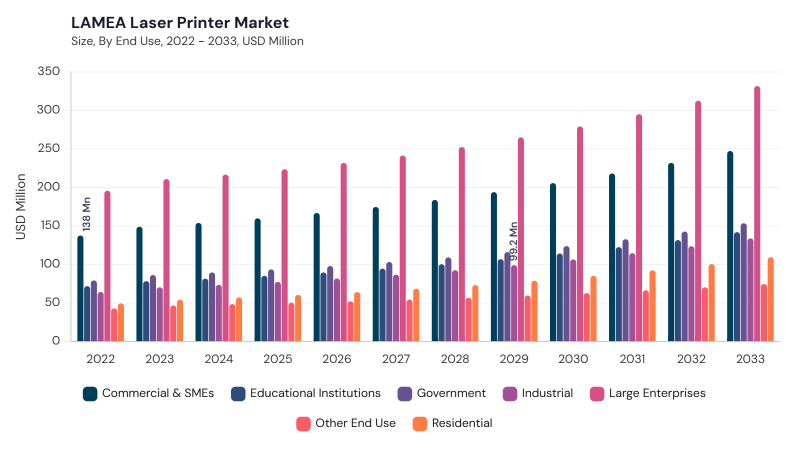
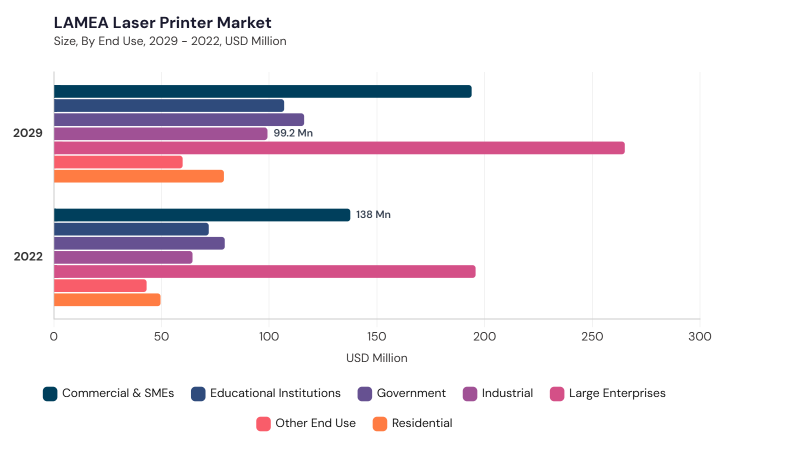
Based on End Use, the market is segmented into Large Enterprises, Commercial & SMEs, Government, Educational Institutions, Industrial, Residential, and Other End Use. Large Enterprises rely on laser printers for secure high-volume printing, centralized fleet control, multifunction workflows, document confidentiality, and network integration. Commercial & SMEs use laser printers for invoices, reports, contracts, marketing materials, and day-to-day administrative printing with manageable operating costs. Government adoption is supported by citizen-service documents, municipal records, public administration, and secure documentation.
Educational Institutions require printers for examinations, learning materials, research documents, and administrative forms. Industrial users apply laser printers for work orders, compliance records, shipping documents, labels, technical records, and logistics paperwork. Residential demand is supported by remote work, home offices, household education, compact devices, and wireless printing, while Other End Use includes healthcare, financial services, hospitality, legal offices, nonprofits, and other specialized establishments.
Free Valuable Insights: Laser Printer Market Size Worth USD 14.9 Billion billion by 2033
Based on Country, the market is segmented into Brazil, Argentina, UAE, Saudi Arabia, South Africa, Nigeria, and Rest of LAMEA. The Brazil market dominated the LAMEA Laser Printer Market by Country in 2025, and would continue to be a dominant market till 2033; thereby, achieving a market value of USD 258.2 million by 2029, growing at a CAGR of 5 % during the forecast period. The Argentina market is expected to witness a CAGR of 8.3% during (2026 - 2033). Additionally, The UAE market is expected to witness a CAGR of 5% during (2026 - 2033).
Brazil is supported by sustainable devices, smart connectivity, multifunction adoption, localized supply chains, and improved after-sales services, while Argentina is shaped by multifunction printers, cloud-enabled devices, wireless connectivity, eco-friendly models, and localized support. The UAE reflects wireless and cloud printing, sustainability-focused devices, digital workflow integration, multifunction adoption, and strong service infrastructure, whereas Saudi Arabia is driven by color laser printing, cloud connectivity, secure mobile printing, sustainability, and smart office digitization. South Africa is advancing through energy-efficient printers, smart connectivity, multifunction devices, cloud compatibility, and sector-specific solutions; Nigeria is supported by cost-efficient devices, multifunction adoption, wireless printing, cloud printing, and localized service networks; and Rest of LAMEA is shaped by multifunction and cloud-integrated printers, sustainable consumables, managed print services, subscription models, and localized distributor partnerships.

By Printer Type
By Connectivity
By Output
By End Use
By Country
Set to reach $920.3 Million by 2029, growing at 6.2% CAGR during 2026-2033.
Brazil leads with $258.2 million by 2029, growing at a 5% CAGR during 2026-2033.
The multifunction segment will reach $536.5 million by 2029, growing at a 5.8% CAGR during 2026-2033.
Wired connectivity will reach $519.0 million by 2029, with a 5.7% CAGR during 2026-2033.
Argentina is expected to witness an 8.3% CAGR during 2026-2033.
Wireless connectivity is expected to grow at a 6.8% CAGR during 2026-2033.
Our team of dedicated experts can provide you with attractive expansion opportunities for your business.




 Unique Offerings
