The sample copy of this report is available for access.
The LAMEA Spirometer Market is expected to reach USD 77.6 million by 2029, growing at a CAGR of 10% during (2026 - 2033).
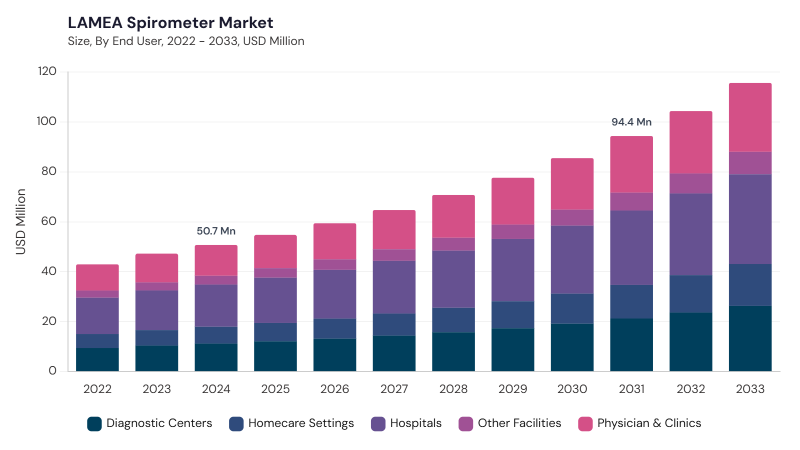
The LAMEA Spirometer Market evolved from cumbersome mechanical pulmonary testing systems used mainly in selected clinical institutions into compact, digital, and increasingly connected respiratory diagnostic solutions. Improvements in sensor accuracy, microelectromechanical systems, miniaturization, and device affordability broadened adoption across hospitals, clinics, and community healthcare environments. Rising awareness of asthma, COPD, and other respiratory conditions further strengthened spirometry's clinical importance. The market now combines portable diagnostic systems, improved calibration, digital connectivity, and telemedicine compatibility to extend pulmonary assessment across diverse healthcare settings.
Portable spirometers, digital connectivity, remote monitoring, regulatory modernization, and broader community-based testing are shaping current market development. Bluetooth and smartphone integration enable respiratory data sharing and longitudinal monitoring, while compact and battery-operated devices support testing in rural and resource-constrained environments. Increasing attention to occupational respiratory risks and pediatric lung-function assessment is widening spirometry applications beyond conventional pulmonology. At the same time, manufacturers are balancing clinical accuracy, affordability, durability, interoperability, and simplified operation to address highly varied healthcare capabilities across LAMEA.
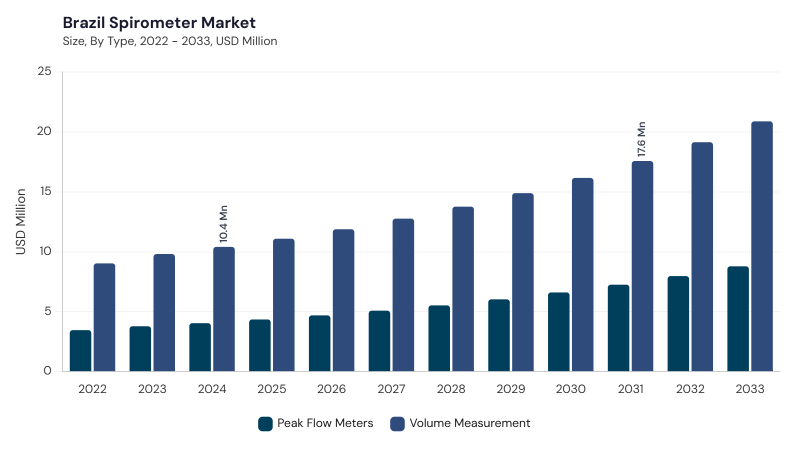
Based on Type, the market is segmented into Volume Measurement and Peak Flow Meters. The Volume Measurement market dominated the LAMEA Spirometer Market by Type in 2025, and would continue to be a dominant market till 2033; thereby, achieving a market value of USD 55.5 million by 2029, growing at a CAGR of 9.7 % during the forecast period. The Peak Flow Meters market is expected to witness a CAGR of 10.7% during (2026 - 2033).
Volume Measurement spirometers support comprehensive lung-function assessment by measuring airflow and respiratory volumes used in diagnosis and monitoring of COPD, asthma, interstitial lung diseases, and other pulmonary disorders. Their application remains concentrated in hospitals, pulmonary laboratories, and specialized respiratory centers where diagnostic accuracy is essential. Peak Flow Meters provide simpler and more affordable assessment of peak expiratory flow, supporting asthma monitoring, primary care, community programs, and home use. Their portability, ease of operation, and emerging digital connectivity make them particularly useful where comprehensive pulmonary laboratories are unavailable.
Based on Product Type, the market is segmented into Devices, Accessories & Consumables, and Software. The Devices market dominated the LAMEA Spirometer Market by Product Type in 2025, and would continue to be a dominant market till 2033; thereby, achieving a market value of USD 44.1 million by 2029, growing at a CAGR of 9.6 % during the forecast period. The Accessories & Consumables market is expected to witness a CAGR of 10.2% during (2026 - 2033). The Software market is expected to witness a CAGR of 11.1% during (2026 - 2033).
Devices include advanced clinical systems as well as portable and handheld spirometers used across hospitals, clinics, occupational health programs, mobile screening initiatives, and underserved communities. Accessories & Consumables include filters, mouthpieces, nose clips, breathing tubes, sensors, calibration materials, and other recurring components needed for safe and standardized testing. Software supports automated respiratory calculations, interpretation, reporting, patient-data storage, remote transmission, and integration with digital health systems. Software adoption is developing progressively as telemedicine, cloud platforms, and healthcare IT infrastructure expand across selected LAMEA markets.
Based on Application, the market is segmented into Chronic Obstructive Pulmonary Disorder (COPD), Asthma, and Other Application. COPD applications rely on spirometry for diagnostic confirmation, assessment of airflow obstruction, monitoring of disease progression, and treatment management across hospitals and outpatient facilities.
Asthma applications use spirometry to assess reversible airflow limitation, evaluate symptoms, monitor disease control, and support pediatric and adult respiratory care. Other Application includes interstitial lung diseases, occupational lung conditions, preoperative respiratory evaluation, pulmonary rehabilitation, workplace exposure monitoring, and assessment of other respiratory impairments requiring objective lung-function measurement.
Based on End User, the market is segmented into Hospitals, Physician & Clinics, Diagnostic Centers, Homecare Settings, and Other Facilities. Hospitals use spirometry for comprehensive diagnosis, chronic respiratory monitoring, emergency evaluation, and specialized pulmonary care, increasingly supported by connected digital systems. Physician & Clinics rely on compact and affordable devices for outpatient screening and routine disease management, while Diagnostic Centers provide focused pulmonary testing and referral-based examinations using high-precision systems.
Homecare Settings are developing through portable devices, smartphone connectivity, and telehealth-enabled monitoring. Other Facilities include occupational health providers, rehabilitation centers, community programs, academic institutions, and research settings requiring specialized respiratory assessment.
Free Valuable Insights: Spirometer Market Size Worth USD 1511.6 Million billion by 2033
Based on Country, the market is segmented into Brazil, Argentina, UAE, Saudi Arabia, South Africa, Nigeria, and Rest of LAMEA. The Brazil market dominated the LAMEA Spirometer Market by Country in 2025, and would continue to be a dominant market till 2033; thereby, achieving a market value of USD 20.9 million by 2029, growing at a CAGR of 8.7 % during the forecast period. The Argentina market is expected to witness a CAGR of 11.2% during (2026 - 2033). Additionally, The UAE market is expected to witness a CAGR of 8.9% during (2026 - 2033).
Across LAMEA, spirometer adoption is being influenced by digital health, portable diagnostics, regulatory modernization, respiratory disease awareness, and localized healthcare development. Brazil emphasizes connected devices, AI-enabled analysis, public respiratory initiatives, and portable testing, while Argentina is advancing cloud connectivity, personalized diagnostics, faster product access, and localized digital ecosystems. The UAE focuses on AI-enabled spirometry, miniaturization, interoperability, and remote monitoring, whereas Saudi Arabia is progressing through smart spirometers, telehealth, cloud integration, and government-backed healthcare digitalization. South Africa emphasizes portable testing, automated quality controls, rural access, and locally adapted devices, while Nigeria is expanding IoT-enabled spirometry, compact devices, training programs, and remote monitoring. Rest of LAMEA continues to develop portable systems, mobile-health integration, localized distribution, and affordable connected respiratory diagnostics.

By Type
By Product Type
By Application
By End User
By Country
Set to reach $77.6 Million by 2029, growing at 10% CAGR during 2026-2033.
Brazil leads with $20.9 million by 2029, growing at 8.7% CAGR during the forecast period.
Volume Measurement segment dominates, reaching $55.5 million by 2029 at 9.7% CAGR during 2026-2033.
Devices segment reaches $44.1 million by 2029, growing at 9.6% CAGR during the forecast period.
The UAE market is expected to witness a CAGR of 8.9% during 2026-2033.
Peak Flow Meters segment is expected to witness a CAGR of 10.7% during 2026-2033.
Our team of dedicated experts can provide you with attractive expansion opportunities for your business.




 Unique Offerings