The sample copy of this report is available for access.
The Europe Spirometer Market is expected to reach USD 362.3 million by 2031, growing at a CAGR of 7.2% during (2026 - 2033).
The Europe Spirometer Market evolved from bulky mechanical and analog pulmonary testing systems into compact, digital, and increasingly connected respiratory diagnostic solutions. Early adoption centered on hospital and specialist pulmonary environments, while improvements in sensors, microelectronics, software, and standardized testing protocols enhanced accuracy and clinical acceptance. The emergence of portable handheld spirometers expanded testing into outpatient, community, and homecare environments. The market now combines digital connectivity, advanced analytics, user-friendly interfaces, and patient-centric monitoring to support broader respiratory disease diagnosis and management.
Portable spirometry, digital health integration, artificial intelligence, remote monitoring, and patient engagement are reshaping market development. Manufacturers are introducing compact, wireless-enabled devices that connect with electronic health records, cloud platforms, telemedicine systems, and broader digital respiratory care ecosystems. AI-assisted interpretation and advanced analytics are improving test assessment and supporting more consistent clinical decision-making, while gamification and interactive features encourage patient adherence. Regulatory emphasis on accuracy, interoperability, data security, and standardized testing is further influencing product development across European healthcare systems.
Based on Type, the market is segmented into Volume Measurement and Peak Flow Meters. The Volume Measurement market dominated the Europe Spirometer Market by Type in 2025, and would continue to be a dominant market till 2033; thereby, achieving a market value of USD 255.3 million by 2031, growing at a CAGR of 6.9 % during the forecast period. The Peak Flow Meters market is expected to witness a CAGR of 7.9% during (2026 - 2033).
Volume Measurement spirometers provide detailed lung-volume and airflow assessment used in hospitals, pulmonary clinics, and specialized diagnostic settings for COPD, asthma, restrictive disorders, and longitudinal monitoring. Their development increasingly incorporates precise sensors, digital records, cloud connectivity, and portable configurations. Peak Flow Meters provide rapid and affordable measurement of peak expiratory flow, supporting asthma self-monitoring, community care, and routine outpatient assessment. Their portability, ease of operation, and increasing smartphone connectivity make them well suited to decentralized respiratory management and home use.
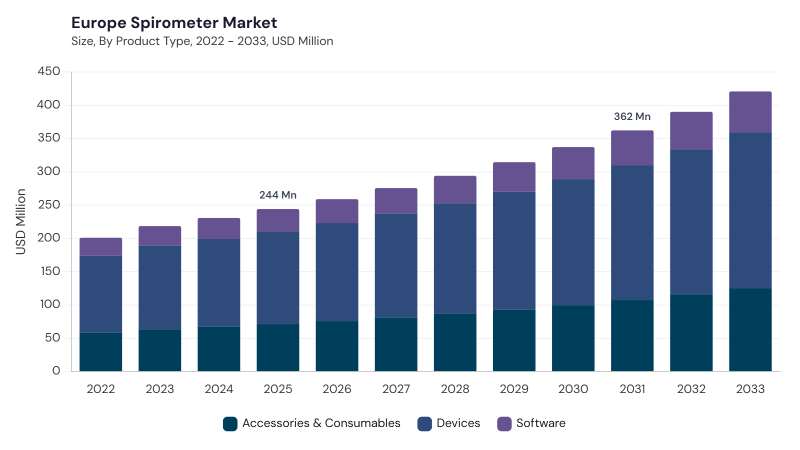
Based on Product Type, the market is segmented into Devices, Accessories & Consumables, and Software. The Devices market dominated the Europe Spirometer Market by Product Type in 2025, and would continue to be a dominant market till 2033; thereby, achieving a market value of USD 202.7 million by 2031, growing at a CAGR of 6.8 % during the forecast period. The Accessories & Consumables market is expected to witness a CAGR of 7.4% during (2026 - 2033). The Software market is expected to witness a CAGR of 8% during (2026 - 2033).
Devices include conventional clinical systems, portable spirometers, and handheld platforms used across hospitals, respiratory centers, physician practices, occupational health programs, and community settings. Accessories & Consumables include mouthpieces, respiratory filters, nose clips, tubing, adapters, calibration components, and other patient-contact supplies required for standardized and hygienic testing. Software supports flow-volume visualization, automated calculation, quality checks, interpretation, reporting, longitudinal tracking, cloud connectivity, and digital integration. Increasing use of AI-assisted analysis and healthcare digitalization is strengthening software's role in connected spirometry platforms.
Based on Application, the market is segmented into Chronic Obstructive Pulmonary Disorder (COPD), Asthma, and Other Application. COPD applications rely on spirometry for diagnosis, disease assessment, treatment monitoring, outpatient follow-up, and pulmonary rehabilitation, with portable and connected devices increasingly supporting remote management.
Asthma applications use spirometry to evaluate airflow variability, bronchodilator response, treatment effectiveness, and disease control across primary care and specialist settings. Other Application includes restrictive lung diseases, postoperative assessment, occupational respiratory screening, pulmonary rehabilitation, clinical research, and other situations where objective lung-function measurement supports diagnosis, monitoring, or risk evaluation.
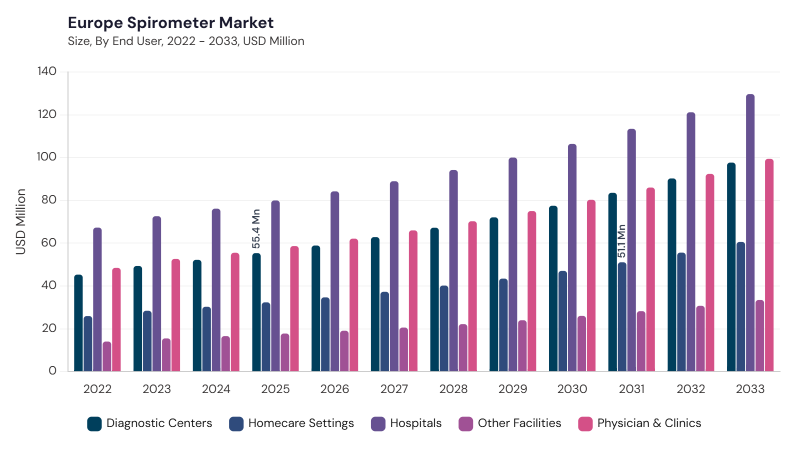
Based on End User, the market is segmented into Hospitals, Physician & Clinics, Diagnostic Centers, Homecare Settings, and Other Facilities. Hospitals use spirometry across pulmonology, surgical, inpatient, outpatient, and chronic respiratory care pathways where measurement accuracy, interoperability, and advanced testing capabilities are important.
Physician & Clinics increasingly use compact systems for respiratory screening and ongoing disease management, while Diagnostic Centers require standardized and reproducible testing supported by advanced data-management tools. Homecare Settings are expanding through portable devices, telehealth, wireless connectivity, and patient-centered monitoring. Other Facilities include rehabilitation centers, occupational health units, research institutions, nursing environments, and other specialized settings requiring targeted pulmonary assessment.
Free Valuable Insights: The Worldwide Spirometer Market is projected to reach USD 1511.6 Million billion by 2033, at a CAGR of 7.9%
Based on Country, the market is segmented into Germany, UK, France, Russia, Spain, Italy, and Rest of Europe. The Germany market dominated the Europe Spirometer Market by Country in 2025, and would continue to be a dominant market till 2033; thereby, achieving a market value of USD 75.4 million by 2031, growing at a CAGR of 5.8 % during the forecast period. The UK market is expected to witness a CAGR of 6.2% during (2026 - 2033). Additionally, The France market is expected to witness a CAGR of 7.9% during (2026 - 2033).
Across Europe, spirometer adoption is being influenced by digital health integration, portable diagnostics, remote monitoring, AI-assisted analysis, and regulatory standardization. Germany emphasizes multifunctional devices, EHR integration, AI interpretation, and localized digital health solutions, while the UK is advancing AI-supported diagnostics, home spirometry, cloud connectivity, and remote respiratory management. France focuses on smart sensors, telemedicine, postoperative monitoring, and patient-centric digital platforms, whereas Russia is progressing through portable devices, AI-supported interpretation, telehealth, and stronger standardization. Spain is strengthening remote monitoring, AI-enabled analysis, standardized testing, and connected devices, while Italy emphasizes mobile integration, cloud analytics, localized solutions, and precision diagnostics. Rest of Europe continues to expand IoT-enabled spirometry, patient-operated devices, AI-supported assessment, and digital interoperability.

By Type
By Product Type
By Application
By End User
By Country
Set to reach $362.3 Million by 2031, growing at 7.2% CAGR during 2026-2033.
Germany leads with $75.4 million by 2031, growing at a 5.8% CAGR during 2026-2033.
Volume Measurement segment hits $255.3 million by 2031, growing at a 6.9% CAGR during 2026-2033.
Devices segment reaches $202.7 million by 2031, growing at a 6.8% CAGR during 2026-2033.
The UK market is expected to witness a 6.2% CAGR during 2026-2033.
Software segment is expected to witness an 8% CAGR during 2026-2033.
Our team of dedicated experts can provide you with attractive expansion opportunities for your business.




 Unique Offerings