The sample copy of this report is available for access.
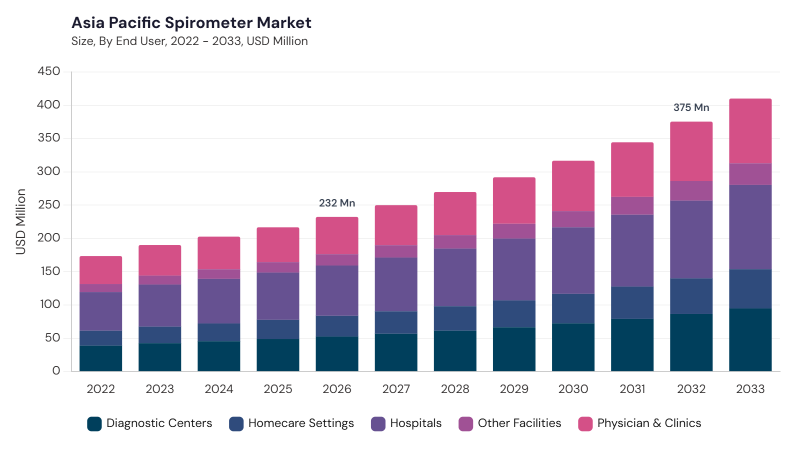
The Asia Pacific Spirometer Market is expected to reach USD 316.7 million by 2030, growing at a CAGR of 8.5% during (2026 - 2033).
The Asia Pacific Spirometer Market evolved from conventional mechanical and laboratory-based pulmonary testing systems into portable, digital, and increasingly connected respiratory diagnostic solutions. Early use was concentrated in hospitals for asthma, COPD, and other respiratory conditions, while advances in sensors, miniaturization, and software expanded adoption into outpatient clinics and remote healthcare settings. Handheld devices, Bluetooth connectivity, mobile applications, and telehealth integration further improved accessibility. The market now reflects a transition toward patient-centered respiratory monitoring supported by digital data exchange and broader preventive healthcare adoption.
Digital health integration, remote monitoring, artificial intelligence, preventive screening, and regulatory harmonization are shaping current market development. Connected spirometers increasingly support cloud-based data management, mobile health platforms, telemedicine, and longitudinal respiratory monitoring. AI-assisted interpretation is improving analytical capabilities while reducing dependence on specialist expertise, and portable devices are extending testing into rural and underserved environments. At the same time, growing respiratory disease awareness and efforts to standardize device quality are encouraging manufacturers to balance accuracy, durability, usability, affordability, and regional compliance.
Based on Type, the market is segmented into Volume Measurement and Peak Flow Meters. The Volume Measurement market dominated the Asia Pacific Spirometer Market by Type in 2025, and would continue to be a dominant market till 2033; thereby, achieving a market value of USD 223.8 million by 2030, growing at a CAGR of 8.2 % during the forecast period. The Peak Flow Meters market is expected to witness a CAGR of 9.1% during (2026 - 2033).
Volume Measurement spirometers support comprehensive evaluation of lung volumes and airflow for COPD, asthma, restrictive disorders, and other pulmonary conditions across hospitals, respiratory clinics, and research settings. Their evolution increasingly incorporates portable configurations, digital connectivity, and integration with healthcare information systems. Peak Flow Meters provide simple and economical measurement of peak expiratory flow, making them suitable for asthma monitoring, primary care, community programs, and home use. Their portability, affordability, ease of operation, and growing mobile connectivity support repeated self-monitoring and decentralized respiratory management.
Based on Product Type, the market is segmented into Devices, Accessories & Consumables, and Software. The Devices market dominated the Asia Pacific Spirometer Market by Product Type in 2025, and would continue to be a dominant market till 2033; thereby, achieving a market value of USD 177.8 million by 2030, growing at a CAGR of 8.1 % during the forecast period. The Accessories & Consumables market is expected to witness a CAGR of 8.7% during (2026 - 2033). The Software market is expected to witness a CAGR of 9.4% during (2026 - 2033).
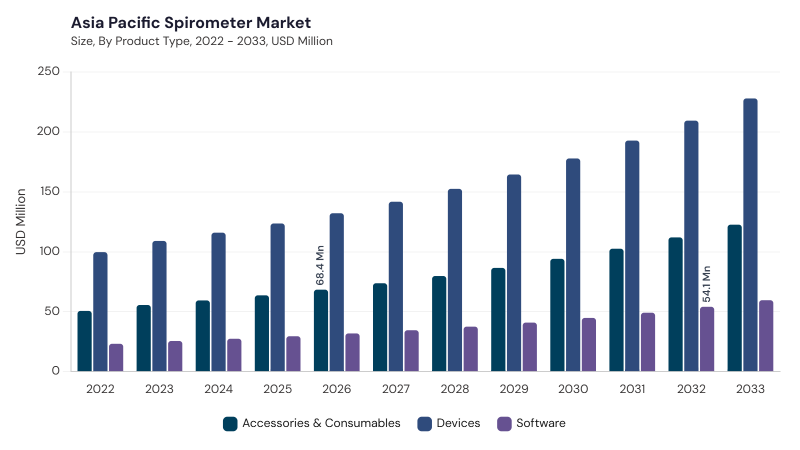
Devices include clinical-grade, portable, handheld, and digitally connected spirometry systems deployed across hospitals, diagnostic laboratories, clinics, community programs, and homecare environments. Accessories & Consumables include mouthpieces, filters, nose clips, tubing, adapters, flow sensors, calibration components, and sanitary supplies required for repeated testing. Software supports automated parameter calculation, interpretation, patient documentation, reporting, cloud connectivity, remote review, and longitudinal monitoring. Expanding telemedicine, smartphone adoption, and healthcare digitalization are strengthening the role of software within connected respiratory diagnostic ecosystems.
Based on Application, the market is segmented into Chronic Obstructive Pulmonary Disorder (COPD), Asthma, and Other Application. COPD applications use spirometry for diagnosis, assessment of airflow limitation, monitoring disease progression, and guiding treatment across hospitals and outpatient settings.
Asthma applications support diagnosis, evaluation of airway variability, treatment response, and repeated monitoring across pediatric and adult populations, with portable devices increasingly improving accessibility. Other Application includes tuberculosis-related pulmonary follow-up, interstitial and restrictive lung disorders, occupational respiratory examinations, preoperative assessment, post-treatment evaluation, and other specialized uses requiring objective lung-function measurement.
Based on End User, the market is segmented into Hospitals, Physician & Clinics, Diagnostic Centers, Homecare Settings, and Other Facilities. Hospitals use spirometry for comprehensive pulmonary testing, chronic respiratory disease management, preoperative assessment, and specialist care while increasingly integrating results with digital records. Physician & Clinics utilize compact systems for screening and routine monitoring, while Diagnostic Centers emphasize high-precision respiratory testing, standardized protocols, and detailed reporting.
Homecare Settings are expanding through smartphone-linked devices, telehealth, and remote supervision that support regular lung-function monitoring. Other Facilities include occupational health units, rehabilitation centers, elder-care establishments, research institutions, and academic medical programs requiring targeted respiratory assessment.
Free Valuable Insights: Spirometer Market is Predicted to reach USD 1511.6 Million billion by 2033, at a CAGR of 7.9%
Based on Country, the market is segmented into China, Japan, India, South Korea, Singapore, Malaysia, and Rest of Asia Pacific. The China market dominated the Asia Pacific Spirometer Market by Country in 2025, and would continue to be a dominant market till 2033; thereby, achieving a market value of USD 90.1 million by 2030, growing at a CAGR of 6.6 % during the forecast period. The Japan market is expected to witness a CAGR of 7.8% during (2026 - 2033). Additionally, The India market is expected to witness a CAGR of 9.1% during (2026 - 2033).
Across Asia Pacific, spirometer adoption is being shaped by digital healthcare, portable diagnostics, respiratory screening, AI-enabled interpretation, and regulatory modernization. China is advancing connected spirometry, AI-assisted analysis, community screening, and domestic innovation, while Japan emphasizes IoMT integration, patient engagement, portable devices, and localized clinical design. India focuses on automated quality control, telemedicine-enabled testing, affordability, and decentralized respiratory care, whereas South Korea is progressing through AI-supported diagnostics, home monitoring, advanced sensors, and stronger reimbursement support. Singapore emphasizes interoperability, standardized testing, digital connectivity, and community-based use, while Malaysia combines connected devices, regulatory compliance, localized adoption, and early respiratory diagnosis. Rest of Asia Pacific continues to expand affordable portable systems, regional manufacturing, telehealth integration, and connected respiratory monitoring.

By Type
By Product Type
By Application
By End User
By Country
Set to reach $316.7 Million by 2030, growing at 8.5% CAGR during 2026-2033.
China leads with a market value of $90.1 million by 2030, growing at a 6.6% CAGR during 2026-2033.
Volume Measurement segment dominates, reaching $223.8 million by 2030 at an 8.2% CAGR during 2026-2033.
Devices segment to reach $177.8 million by 2030, growing at an 8.1% CAGR during 2026-2033.
The Japan market is expected to witness a 7.8% CAGR during 2026-2033.
Software segment to grow at a 9.4% CAGR during 2026-2033.
Our team of dedicated experts can provide you with attractive expansion opportunities for your business.




 Unique Offerings