The sample copy of this report is available for access.
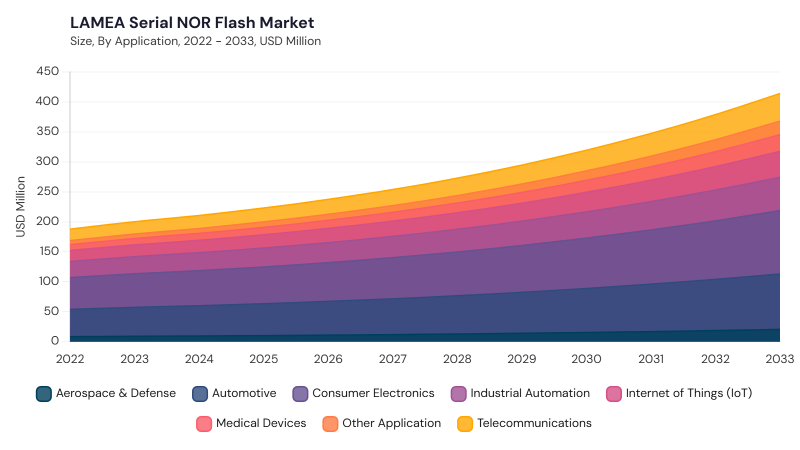
The LAMEA Serial NOR Flash Market is expected to reach USD 294.6 million by 2029, growing at a CAGR of 8.3% during (2026 - 2033).
The LAMEA Serial NOR Flash Market originated as a specialized segment within the broader non-volatile memory industry, serving applications requiring reliable data storage, fast random read capabilities, and durable retention. Early development across Latin America, the Middle East, and Africa focused on automotive, telecommunications, and consumer electronics applications requiring stable boot and code storage, while growth was initially limited by import dependency and restricted local manufacturing capability. Over time, scaled lithography, higher bit densities, the migration from parallel to serial NOR architecture, smaller package sizes, improved power efficiency, and localized distribution networks shifted the market toward wider use in IoT devices, automotive control units, and industrial equipment.
Current market growth is shaped by automotive electrification, autonomous and connected vehicles, IoT connectivity, industrial automation, device certification, and stricter data-security expectations. Suppliers are increasingly developing Serial NOR Flash products with improved temperature tolerance, memory retention, compact form factors, low power consumption, error correction, embedded security features, and enhanced testing protocols. Demand is also rising for cost-efficient, reliable, and traceable memory solutions that support smart cities, industrial infrastructure, connected consumer electronics, telecommunications equipment, and regional system integration across LAMEA.
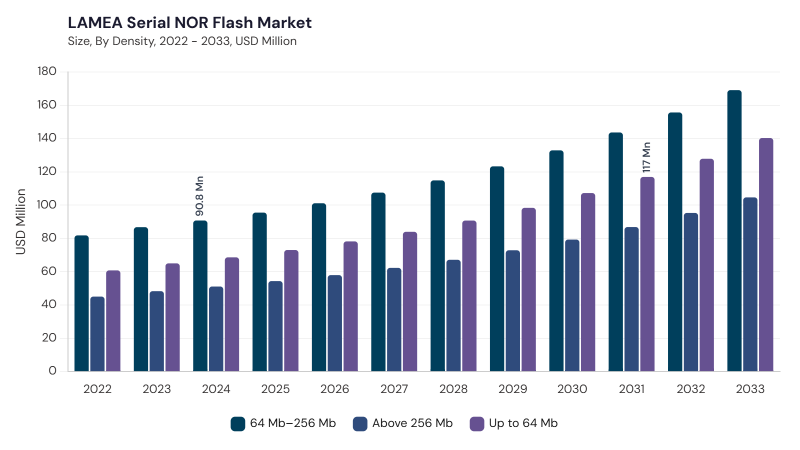
Based on Density, the market is segmented into 64 Mb–256 Mb, Up to 64 Mb, and Above 256 Mb. The 64 Mb–256 Mb market dominated the LAMEA Serial NOR Flash Market by Density in 2025, and would continue to be a dominant market till 2033; thereby, achieving a market value of USD 123.3 million by 2029, growing at a CAGR of 7.6 % during the forecast period. The Up to 64 Mb market is expected to witness a CAGR of 8.7% during (2026 - 2033).
64 Mb–256 Mb remains the leading density segment as it supports complex embedded systems, advanced diagnostics, connectivity stacks, bootloader code storage, automotive infotainment, industrial controllers, mid-tier consumer products, communication infrastructure upgrades, secure firmware updates, and reliable code execution. Up to 64 Mb holds a significant position through smart cards, IoT edge nodes, basic automotive components, utility meters, monitoring devices, security equipment, compact IoT endpoints, basic firmware, and cost-sensitive embedded automation systems. Above 256 Mb represents a promising presence through high-performance networking equipment, ADAS, industrial IoT gateways, edge computing, 5G infrastructure, digital vehicle platforms, intelligent industrial equipment, large bootloaders, complex embedded software, and secure firmware management.
Based on Interface, the market is segmented into Quad SPI (QSPI), SPI, Octal SPI (OSPI), Dual SPI, and Other Interface. Quad SPI (QSPI) remains the leading interface as it supports four-line data communication, fast boot times, reliable firmware storage, smart TVs, set-top boxes, automotive infotainment, advanced microcontroller applications, IoT devices, secure firmware updates, and bandwidth efficiency. SPI holds a substantial position through simple integration, low pin count, cost-effectiveness, consumer appliances, low-end industrial instrumentation, basic communication devices, home appliances, entry-level IoT devices, and legacy systems requiring stable operation.
Octal SPI (OSPI) maintains a considerable presence through eight-line data transfer, rapid booting, large firmware images, high bandwidth, 5G networking equipment, edge computing devices, advanced consumer electronics, telecommunications, defense, and smart city applications. Dual SPI registers a noteworthy presence through improved transfer speed, simpler hardware configuration, automotive controls, telecommunications, industrial automation, legacy upgrades, real-time firmware performance, and cost-controlled interface transitions. Other Interface represents a promising presence through HyperBus, proprietary serial interfaces, customized electronics, infrastructure equipment, aerospace, defense, specialized industrial automation, and emerging digital platforms requiring unique speed, power, security, or compatibility profiles.
Based on Application, the market is segmented into Consumer Electronics, Automotive, Industrial Automation, Telecommunications, Internet of Things (IoT), Medical Devices, Aerospace & Defense, and Other Application. Consumer Electronics remains the leading application as Serial NOR Flash supports smartphones, tablets, wearables, smart home gadgets, smart TVs, set-top boxes, firmware execution, boot code, fast read operations, low power consumption, compact design, and secure firmware storage. Automotive holds a substantial position through ECUs, infotainment systems, ADAS, vehicle networking, telematics, digital instrumentation, safety controls, power-management systems, OTA firmware upgrades, and automotive-grade reliability. Industrial Automation maintains a considerable presence through machine control, sensor interfacing, industrial IoT gateways, PLCs, automated machinery, controllers, monitoring systems, mining, utilities, oil and gas, processing industries, and resilient firmware storage in harsh environments.
Telecommunications registers a noteworthy role through base stations, network routers, communication infrastructure, broadband expansion, mobile network investment, gateways, radio equipment, boot code, firmware images, and network configuration data. Internet of Things (IoT) establishes a steady presence through smart metering, asset tracking, environmental monitoring, connected agriculture, smart cities, logistics, urban infrastructure, edge devices, low-power memory, and firmware update support. Medical Devices retains an emerging presence through implantable devices, diagnostic equipment, patient monitoring systems, portable diagnostics, connected clinical devices, secure firmware storage, calibration data, and device accuracy. Aerospace & Defense represents a promising presence through avionics, navigation systems, mission-critical communications, tactical computing platforms, surveillance equipment, secure communications, navigation platforms, and mission-oriented electronics. Other Application includes smart meters, gaming consoles, point-of-sale terminals, payment terminals, energy electronics, security systems, and specialized embedded products serving regional requirements.
Free Valuable Insights: Serial NOR Flash Market Size Worth USD 5650.7 Million billion by 2033
Based on Country, the market is segmented into Brazil, Argentina, UAE, Saudi Arabia, South Africa, Nigeria, and Rest of LAMEA. The Brazil market dominated the LAMEA Serial NOR Flash Market by Country in 2025, and would continue to be a dominant market till 2033; thereby, achieving a market value of USD 87.2 million by 2029, growing at a CAGR of 7.1 % during the forecast period. The Argentina market is expected to witness a CAGR of 8.9% during (2026 - 2033). Additionally, The UAE market is expected to witness a CAGR of 7.1% during (2026 - 2033).
Brazil is shaped by IoT adoption, smart agriculture, industrial automation, smart city frameworks, automotive control units, supply-chain localization, and demand for low-power, reliable memory, while Argentina reflects automotive electronics, ADAS, infotainment, IoT applications, smart cities, industrial automation, supply-chain diversification, and localized distribution support. The UAE is supported by smart infrastructure, IoT ecosystems, aerospace and defense applications, regional supply-chain hubs, secure boot, firmware updates, and high-density low-power Serial NOR Flash variants, whereas Saudi Arabia is driven by Vision 2030, smart infrastructure, Industry 4.0, energy, transportation, healthcare digitalization, cybersecurity standards, and localized technical support. South Africa is advancing through IoT devices, edge computing, cloud adoption, digital transformation, telecom needs, embedded security, and local support or logistics networks. Nigeria is influenced by consumer electronics demand, low-power Serial NOR Flash, local assembly priorities, higher-density memory, telecom partnerships, smart metering, and cost-sensitive procurement. Rest of LAMEA is shaped by IoT and connected devices, automotive electronics, telecommunications infrastructure, industrial automation, smart city deployments, supply-chain localization, embedded security, and region-specific customization.

By Density
By Interface
By Application
By Country
Set to reach $294.6 Million by 2029, growing at 8.3% CAGR during 2026-2033.
Brazil leads with $87.2 million by 2029, growing at 7.1% CAGR during the forecast period.
The 64 Mb–256 Mb segment will reach $123.3 million by 2029, growing at 7.6% CAGR.
Expected to witness a CAGR of 8.7% during 2026-2033.
The Argentina market is expected to witness a CAGR of 8.9% during 2026-2033.
Our team of dedicated experts can provide you with attractive expansion opportunities for your business.




 Unique Offerings
