The sample copy of this report is available for access.
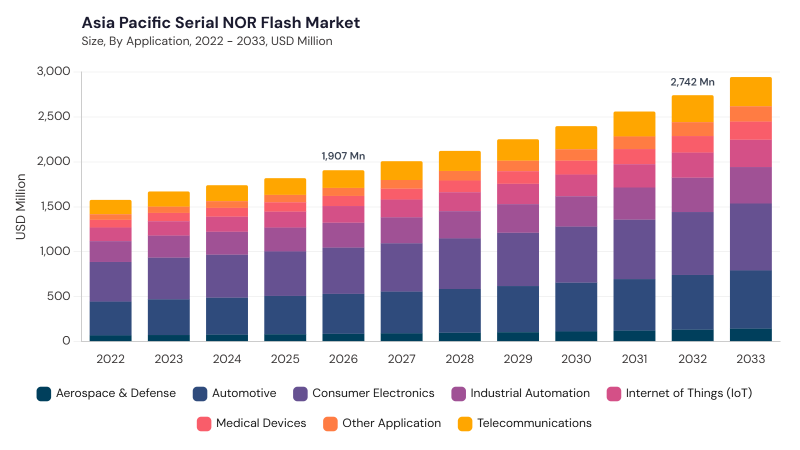
The Asia Pacific Serial NOR Flash Market is expected to reach USD 2397.6 million by 2030, growing at a CAGR of 6.4% during (2026 - 2033).
The Asia Pacific Serial NOR Flash Market originated as a specialized segment of the broader semiconductor memory industry, evolving from early parallel NOR flash technologies used for non-volatile storage in embedded systems such as consumer electronics, automotive control units, and industrial devices. The shift from parallel to serial NOR flash was driven by demand for higher density, reduced package size, improved interface speeds, low pin count, and reliable boot-code execution in compact form factors. Over time, enhanced process nodes, integrated security features, mobile computing penetration, connected-device expansion, and semiconductor manufacturing investments in Taiwan, South Korea, and China moved the market toward a mature ecosystem with diversified products, advanced microcontroller integration, low power consumption, fast read speeds, and high reliability.
Current market growth is shaped by IoT deployment, automotive electronics proliferation, energy efficiency, miniaturization, and regional localization strategies. Manufacturers are increasingly optimizing Serial NOR Flash for secure firmware storage, execute-in-place functionality, endurance, automotive-grade qualification, wider temperature tolerance, ultra-low-power operation, and smaller package footprints. Demand is also rising for application-specific memory solutions across smart cities, industrial automation, consumer electronics, ADAS, infotainment, wearable devices, portable electronics, and wireless communication modules, where reliability, power efficiency, security, and compact integration remain key purchasing considerations.
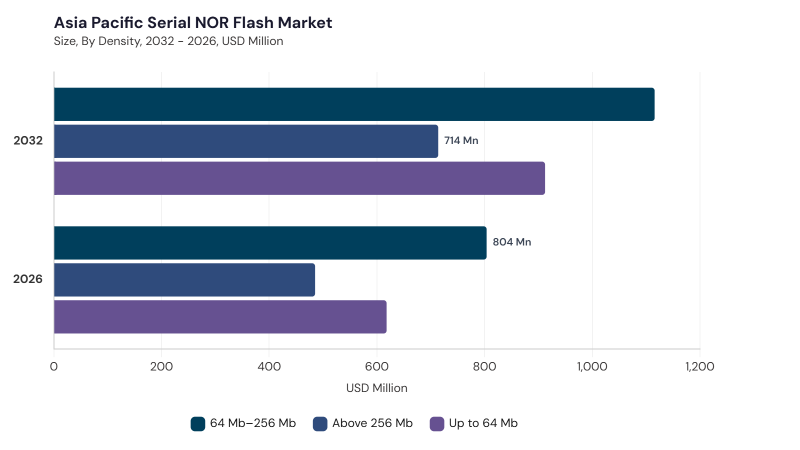
Based on Density, the market is segmented into 64 Mb–256 Mb, Up to 64 Mb, and Above 256 Mb. The 64 Mb–256 Mb market dominated the Asia Pacific Serial NOR Flash Market by Density in 2025, and would continue to be a dominant market till 2033; thereby, achieving a market value of USD 987.2 million by 2030, growing at a CAGR of 5.8 % during the forecast period. The Up to 64 Mb market is expected to witness a CAGR of 6.9% during (2026 - 2033).
64 Mb–256 Mb remains the leading density segment as it supports advanced consumer electronics, automotive infotainment systems, industrial IoT gateways, portable medical devices, firmware updates, configuration data, smart manufacturing, connected-car technologies, and reliable code execution without major cost or power escalation. Up to 64 Mb holds a significant position through embedded systems, basic IoT devices, simple industrial sensors, smart accessories, compact consumer devices, boot code, small-scale program execution, legacy upgrades, and cost-sensitive electronics requiring moderate storage capacity. Above 256 Mb represents a promising presence through multimedia-rich infotainment, networking infrastructure, complex industrial controllers, AI-enabled edge devices, secure boot mechanisms, encryption-key storage, smart city systems, and higher-capacity embedded software environments.
Based on Interface, the market is segmented into Quad SPI (QSPI), SPI, Octal SPI (OSPI), Dual SPI, and Other Interface. Quad SPI (QSPI) remains the leading interface as it supports higher throughput, reduced read latency, fast boot times, execute-in-place functionality, smartphones, tablets, wearables, automotive infotainment, ADAS, IoT devices, edge computing modules, and backward-compatible integration. SPI holds a substantial position through simplicity, low pin count, cost-effectiveness, broad microcontroller support, embedded control, household electronics, legacy industrial systems, low-cost IoT sensors, consumer appliances, and basic firmware storage.
Octal SPI (OSPI) maintains a considerable presence through eight-line data transfer, ultra-fast booting, large memory footprints, high-speed embedded platforms, automotive infotainment, industrial robotics, high-end consumer electronics, AI-driven applications, and next-generation communication systems. Dual SPI registers a noteworthy presence through moderate speed improvement, mid-range consumer devices, basic automotive modules, entry-level industrial equipment, smart home appliances, connected healthcare devices, and legacy-compatible upgrades. Other Interface represents a promising presence through HyperBus, proprietary serial interfaces, specialized industrial automation, telecommunications infrastructure, defense-related projects, customized electronic systems, and application-specific connectivity requirements.
Based on Application, the market is segmented into Consumer Electronics, Automotive, Industrial Automation, Telecommunications, Internet of Things (IoT), Medical Devices, Aerospace & Defense, and Other Application. Consumer Electronics remains the leading application as Serial NOR Flash supports smartphones, tablets, digital cameras, wearable devices, smart home gadgets, boot code storage, firmware, configuration data, fast startup, secure boot, over-the-air updates, and low-power operation. Automotive holds a substantial position through EVs, ADAS, infotainment systems, ECUs, digital instrument clusters, battery management systems, connected car technologies, extended temperature operation, automotive-grade qualification, and fail-safe memory functions. Industrial Automation maintains a considerable presence through PLCs, HMIs, robotics, control systems, factory automation controllers, machine-vision systems, predictive maintenance, remote firmware upgrades, and robust operation under thermal stress and electromagnetic interference.
Telecommunications registers a noteworthy role through base stations, routers, optical network terminals, 5G infrastructure, edge computing deployments, configuration storage, secure boot, and dependable firmware memory. Internet of Things (IoT) establishes a steady presence through smart meters, environmental sensors, asset trackers, connected appliances, smart cities, industrial IoT, low-power devices, remote updates, and secure firmware storage. Medical Devices retains an emerging presence through diagnostic equipment, patient monitoring systems, implantable devices, mobile health instruments, portable monitoring, digitally connected healthcare devices, and reliable low-power memory. Aerospace & Defense represents a promising presence through avionics, radar systems, communication equipment, mission-critical control systems, UAVs, radiation-hardened memory, error correction, and firmware reliability under harsh conditions. Other Application includes smart cards, point-of-sale terminals, custom embedded systems, surveillance systems, energy systems, commercial electronics, and application-specific embedded platforms.
Free Valuable Insights: Serial NOR Flash Market is Predicted to reach USD 5650.7 Million billion by 2033, at a CAGR of 6.1%
Based on Country, the market is segmented into China, Japan, India, South Korea, Singapore, Malaysia, and Rest of Asia Pacific. The China market dominated the Asia Pacific Serial NOR Flash Market by Country in 2025, and would continue to be a dominant market till 2033; thereby, achieving a market value of USD 849.1 million by 2030, growing at a CAGR of 4.9 % during the forecast period. The Japan market is expected to witness a CAGR of 5.5% during (2026 - 2033). Additionally, The India market is expected to witness a CAGR of 7.4% during (2026 - 2033).
China is shaped by semiconductor self-reliance, automotive electronics, IoT miniaturization, low-power memory, domestic R&D, localized production, and automotive-grade reliability, while Japan reflects higher-density memory, energy-efficient products, heterogeneous integration, multi-chip modules, embedded security, secure boot, and quality-focused semiconductor innovation. India is supported by IoT and smart devices, encrypted storage, secure boot, localized manufacturing, domestic semiconductor initiatives, advanced packaging, and cost-efficient embedded memory adoption. South Korea is advancing through automotive ADAS, in-vehicle infotainment, smart city IoT, domestic production investment, next-generation lithography, and small-footprint memory solutions, whereas Singapore is influenced by its semiconductor hub role, IoT platforms, edge-connected equipment, AI, 5G, automotive electrification, advanced manufacturing, and regional supply-chain integration. Malaysia is driven by IoT and edge computing, enhanced security, on-chip encryption, secure boot, regional supply-chain localization, advanced packaging, and telecommunications infrastructure, while Rest of Asia Pacific is shaped by IoT connectivity, automotive electronics, ADAS, industrial sensors, wearable technology, low-power designs, regional foundries, and customized Serial NOR Flash solutions.

By Density
By Interface
By Application
By Country
Set to reach $2397.6 Million by 2030, growing at 6.4% CAGR during 2026-2033.
China leads with $849.1 million by 2030, growing at a CAGR of 4.9% during 2026-2033.
The 64 Mb–256 Mb segment will achieve $987.2 million by 2030, growing at 5.8% CAGR during 2026-2033.
Japan is expected to witness a CAGR of 5.5% during 2026-2033.
India is expected to witness a CAGR of 7.4% during 2026-2033.
Our team of dedicated experts can provide you with attractive expansion opportunities for your business.




 Unique Offerings
