The sample copy of this report is available for access.
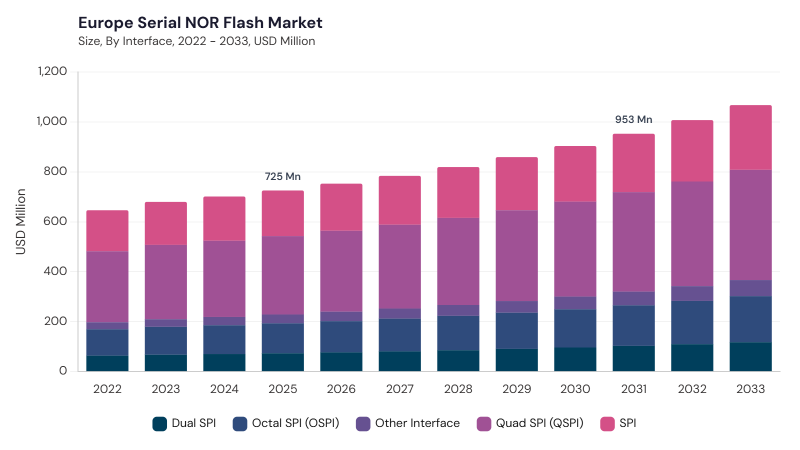
The Europe Serial NOR Flash Market is expected to reach USD 952.6 million by 2031, growing at a CAGR of 5.1% during (2026 - 2033).
The Europe Serial NOR Flash Market has its roots in early non-volatile memory development, where NOR flash emerged as a programmable and reusable alternative to ROM-based storage for embedded systems requiring reliable high-speed data retention and low power consumption. As automotive, industrial, and consumer electronics applications expanded, serial NOR flash gained momentum due to efficient interfaces, lower pin count, and suitability for compact European electronic designs. Over time, SPI protocol integration, lithography improvements, higher storage densities, stronger endurance, secure data retention, and robustness against environmental factors shifted the market from niche embedded use toward mainstream memory solutions across Europe.
Current market growth is shaped by automotive electrification, embedded security, IoT integration, miniaturization, and demand for lower power consumption. Manufacturers are increasingly developing Serial NOR Flash products with improved durability, data retention, encryption, tamper resistance, ultra-low-power operation, reduced footprint, and higher performance for ADAS, infotainment, portable electronics, and connected industrial devices. Demand is also rising for memory solutions that align with European cybersecurity expectations, automotive-grade qualification standards, wearable-device requirements, and safety-critical embedded applications.
Based on Density, the market is segmented into 64 Mb–256 Mb, Up to 64 Mb, and Above 256 Mb. The 64 Mb–256 Mb market dominated the Europe Serial NOR Flash Market by Density in 2025, and would continue to be a dominant market till 2033; thereby, achieving a market value of USD 390.3 million by 2031, growing at a CAGR of 4.5 % during the forecast period. The Up to 64 Mb market is expected to witness a CAGR of 5.6% during (2026 - 2033).
64 Mb–256 Mb remains the leading density segment as it supports automotive infotainment systems, mid-level industrial controllers, sophisticated consumer electronics, complex firmware, system boot code, in-field updates, secure boot mechanisms, and moderate non-volatile storage needs. Up to 64 Mb holds a significant position through simple embedded systems, microcontrollers, industrial controls, basic consumer electronics, legacy automotive modules, low-power devices, wearable products, and cost-sensitive applications requiring stable code storage. Above 256 Mb represents a promising presence through advanced infotainment, navigation systems, high-level ADAS modules, connected vehicles, Industry 4.0 systems, encrypted data storage, rollback functionality, frequent firmware updates, and high-capacity embedded software environments.
Based on Interface, the market is segmented into Quad SPI (QSPI), SPI, Octal SPI (OSPI), Dual SPI, and Other Interface. Quad SPI (QSPI) remains the leading interface as it supports higher throughput, lower latency, automotive infotainment, industrial control units, networking devices, IoT devices, sensor hubs, edge modules, fast boot times, and reliable firmware storage. SPI holds a substantial position through straightforward implementation, cost-effectiveness, microcontroller compatibility, consumer electronics, small embedded controllers, basic industrial devices, legacy infrastructure, mature toolchains, and stable supply chains.
Octal SPI (OSPI) maintains a considerable presence through high-throughput embedded systems, high-end automotive electronics, advanced industrial equipment, communication infrastructure, smart mobility, Industry 4.0 applications, secure boot, and low-latency code access. Dual SPI registers a noteworthy presence through moderate performance improvement, handheld devices, portable medical instruments, entry-level IoT nodes, low-power signaling, EMI-conscious designs, and migration from legacy SPI architectures. Other Interface represents a promising presence through specialized protocols, proprietary memory connectivity, hardware-level encryption, dedicated command sets, aerospace, defense, and high-reliability industrial requirements.
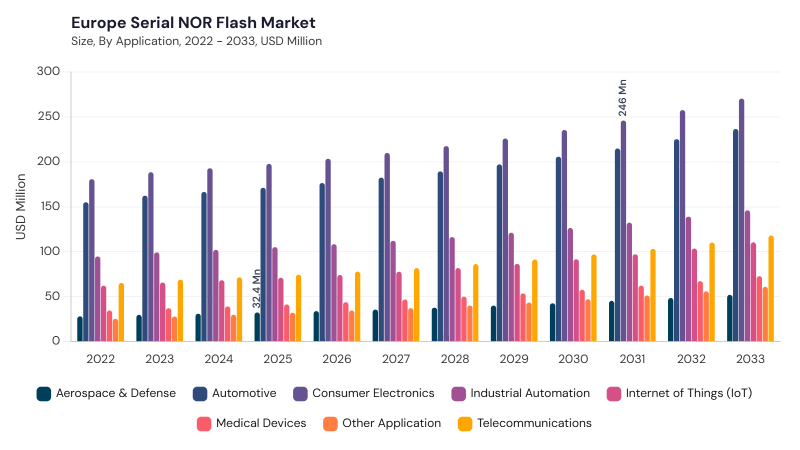
Based on Application, the market is segmented into Consumer Electronics, Automotive, Industrial Automation, Telecommunications, Internet of Things (IoT), Medical Devices, Aerospace & Defense, and Other Application. Consumer Electronics remains the leading application as Serial NOR Flash supports smartphones, smart TVs, wearable gadgets, digital cameras, fast boot-up, firmware execution, compact form factors, low power consumption, and IoT-enabled consumer products. Automotive holds a substantial position through ADAS, ECUs, infotainment systems, vehicle firmware storage, electrification, autonomous driving, ISO 26262 alignment, error correction, temperature durability, OTA updates, and secure firmware rollback. Industrial Automation maintains a considerable presence through PLCs, robotics, smart sensors, factory control systems, Industry 4.0, predictive maintenance, remote monitoring, high endurance, and secure firmware storage.
Telecommunications registers a noteworthy role through base stations, routers, modems, boot code, configuration parameters, 5G rollout, network virtualization, secure firmware management, and network resilience. Internet of Things (IoT) establishes a steady presence through smart meters, environmental sensors, asset trackers, connected industrial devices, smart cities, low-power operation, secure boot, and long device lifecycles. Medical Devices retains an emerging presence through portable diagnostic equipment, patient monitoring systems, implantable devices, MDR-related validation needs, rapid startup, secure firmware, and compact memory design. Aerospace & Defense represents a promising presence through avionics systems, communication equipment, UAVs, mission-critical firmware, harsh-environment reliability, secure data storage, and tamper resistance. Other Application includes smart cards, gaming consoles, security devices, digital signage, firmware storage, low-latency operation, and specialized embedded electronics.
Free Valuable Insights: The Worldwide Serial NOR Flash Market is projected to reach USD 5650.7 Million billion by 2033, at a CAGR of 6.1%
Based on Country, the market is segmented into Germany, UK, France, Russia, Spain, Italy, and Rest of Europe. The Germany market dominated the Europe Serial NOR Flash Market by Country in 2025, and would continue to be a dominant market till 2033; thereby, achieving a market value of USD 316.3 million by 2031, growing at a CAGR of 4.4 % during the forecast period. The UK market is expected to witness a CAGR of 3.5% during (2026 - 2033). Additionally, The France market is expected to witness a CAGR of 6% during (2026 - 2033).
Germany is shaped by automotive electronics, industrial automation, Industry 4.0, low-power designs, embedded security, multi-chip packaging, local design centers, and advanced process technologies, while the UK reflects secure boot demand, firmware protection, multi-I/O interfaces, automotive-grade memory, localized support, and enhanced packaging. France is supported by low-power IoT devices, automotive ECUs, secure boot, encryption, tamper resistance, higher memory densities, and smart industrial applications. Russia is influenced by secure memory, encryption, defense-related requirements, automotive electronics, localization, vertical integration, and domestic R&D, whereas Spain is advancing through IoT integration, smart city infrastructure, automotive-grade memory, ADAS, 3D Serial NOR Flash structures, and local technical support. Italy is driven by data security, faster SPI interfaces, optimized power profiles, embedded intelligence, automotive electronics, telecommunications infrastructure, and industrial automation systems, while Rest of Europe is shaped by automotive-grade memory, EVs, ADAS, industrial IoT, embedded security, lower power consumption, sustainability requirements, and localized supply-chain responsiveness.

By Density
By Interface
By Application
By Country
Set to reach $952.6 Million by 2031, growing at 5.1% CAGR during 2026-2033.
Germany leads with $316.3 million by 2031, growing at 4.4% CAGR during the forecast period.
The 64 Mb–256 Mb segment will achieve $390.3 million by 2031, growing at 4.5% CAGR during 2026-2033.
The UK market is expected to witness a CAGR of 3.5% during 2026-2033.
The France market is expected to witness a CAGR of 6% during 2026-2033.
Our team of dedicated experts can provide you with attractive expansion opportunities for your business.




 Unique Offerings
