The sample copy of this report is available for access.
The LAMEA Real Estate Software Market is expected to reach USD 1.8 billion by 2029, growing at a CAGR of 13.3% during (2026 – 2033).
The LAMEA Real Estate Software Market developed as real estate firms across Latin America, the Middle East, and Africa began shifting from manual property records, informal transaction processes, and fragmented databases toward digital platforms. Early adoption was concentrated in major urban centers where developers, brokers, and property managers needed basic tools for listings, lease tracking, tenant records, and property administration. Over time, cloud computing, mobile access, digital documentation, and compliance-led workflows expanded the role of software in real estate operations. The market gradually moved from desktop-based and single-user systems to collaborative platforms supporting transaction transparency, asset visibility, and remote property management.
The LAMEA Real Estate Software Market is being shaped by digital land registration, online property marketplaces, cloud-based platforms, AI-driven analytics, and demand for verified property data. Governments and real estate authorities are promoting digitized property records, e-contracts, ownership verification, and transparent transaction systems to reduce fraud and improve investor confidence. Developers, brokers, agents, and public agencies are also using software for CRM, document handling, lead management, lease tracking, digital payments, and transaction monitoring. Rising urban development, smart city projects, mixed-use communities, and large real estate investments across the Gulf, Latin America, and Africa are further increasing software demand.
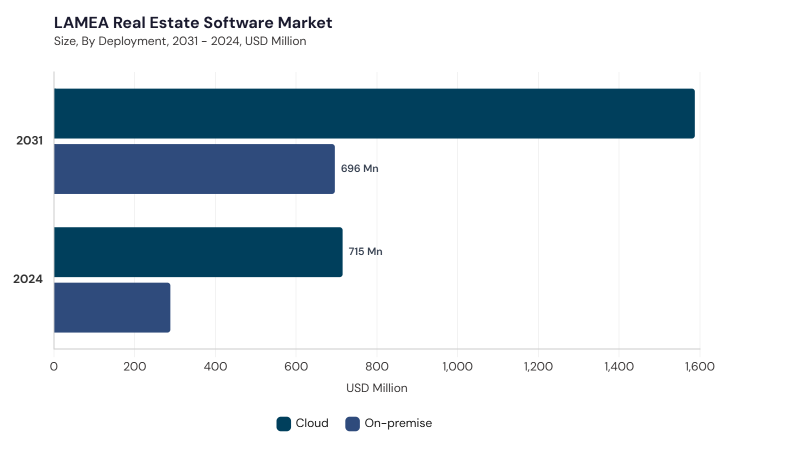
Based on Deployment, the market is segmented into Cloud and On-Premise. The Cloud market dominated the LAMEA Real Estate Software Market by Deployment in 2025, and would continue to be a dominant market till 2033; thereby, achieving a market value of USD 1.2 billion by 2029, growing at a CAGR of 12.9 % during the forecast period. The On-premise market is expected to witness a CAGR of 14.2% during (2026 - 2033).
Cloud deployment leads as real estate firms seek scalable, subscription-based, and remotely accessible platforms without heavy upfront IT investment. Cloud solutions support CRM integration, property listings, lease administration, virtual tours, automated documentation, predictive analytics, and mobile property management across distributed teams. Adoption is supported by rising smartphone use, improving internet access, remote work practices, and growing preference for SaaS-based real estate tools. On-Premise remains relevant among larger property firms, institutional owners, government-linked entities, and users requiring stronger data control, customized reporting, internal hosting, offline access, and compliance with sensitive transaction or residency requirements.
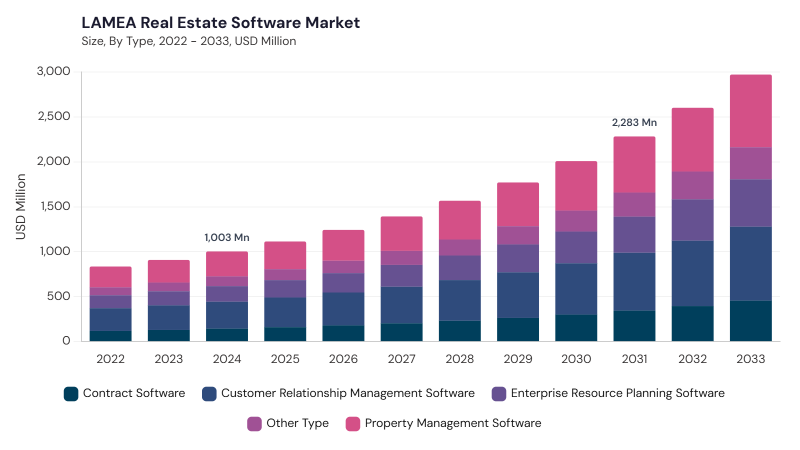
Based on Type, the market is segmented into Customer Relationship Management Software, Property Management Software, Enterprise Resource Planning Software, Contract Software, and Other Type. The Customer Relationship Management Software market dominated the LAMEA Real Estate Software Market by Type in 2025, and would continue to be a dominant market till 2033; thereby, achieving a market value of USD 508.1 million by 2029, growing at a CAGR of 12.3 % during the forecast period. The Property Management Software market is expected to witness a CAGR of 13% during (2026 - 2033). Additionally, The Enterprise Resource Planning Software market is expected to witness highest CAGR of 13.6% during (2026 - 2033).
Customer Relationship Management Software leads because developers, brokers, and real estate agencies depend on lead generation, client communication, property interest tracking, site visit scheduling, marketing automation, and sales pipeline management. CRM platforms are gaining importance as digital property marketplaces expand and buyers expect faster responses, verified listings, and personalized engagement. Property Management Software remains strong through lease administration, tenant communication, rent collection, maintenance scheduling, payment tracking, and reporting tools. Enterprise Resource Planning Software, Contract Software, and Other Type are expanding through project finance management, legal documentation, e-signatures, AI analytics, virtual tours, maintenance systems, and smart building management.
Based on Application, the market is segmented into Residential and Commercial. Residential leads due to rising urbanization, housing demand, apartment communities, gated developments, rental activity, and growing use of digital platforms by landlords, agents, tenants, and homeowners. Software supports property listing management, tenant screening, rent automation, lease administration, maintenance requests, digital payments, and tenant-landlord communication.
Mobile apps, cloud portals, AI-based recommendations, and automated workflows are improving residential property operations across emerging and mature urban markets. Commercial applications remain significant for offices, retail centers, industrial parks, hospitality assets, mixed-use projects, and investment portfolios requiring lease management, space optimization, facility operations, valuation, and financial reporting.
Based on End Use, the market is segmented into Architects & Engineers, Real Estate Agents, Project Managers, and Other End Use. Architects & Engineers lead as large urban projects, smart city developments, tourism infrastructure, mixed-use communities, and housing projects require CAD tools, BIM, structural analysis, zoning assessment, sustainability modeling, and digital documentation. These users need software that improves design accuracy, project approval workflows, consultant coordination, and regulatory readiness.
Real Estate Agents use CRM, listing portals, virtual tours, automated follow-ups, digital contracts, client verification, and mobile engagement tools to improve brokerage efficiency. Project Managers adopt scheduling, budgeting, document control, contractor coordination, BIM integration, and dashboards, while Other End Use includes facility managers, investors, asset managers, legal teams, landlords, housing associations, and property owners.
Free Valuable Insights: Real Estate Software Market Size Worth USD 25.3 Billion billion by 2033
Based on Country, the market is segmented into Brazil, Argentina, UAE, Saudi Arabia, South Africa, Nigeria, and Rest of LAMEA. The Brazil market dominated the LAMEA Real Estate Software Market by Country in 2025, and would continue to be a dominant market till 2033; thereby, achieving a market value of USD 453.7 million by 2029, growing at a CAGR of 11.9 % during the forecast period. The Argentina market is expected to witness a CAGR of 13.8% during (2026 - 2033). Additionally, The UAE market is expected to witness a CAGR of 12.4% during (2026 - 2033).
Brazil leads due to growing cloud adoption, remote property workflows, AI-powered CRM, virtual tours, contract automation, and software demand across brokerage and property management. Argentina supports growth through mobile-centric platforms, AI analytics, cloud upgrades, cybersecurity features, and localized property management tools. The UAE contributes through digital land services, AI-driven property platforms, AML-focused compliance tools, smart city development, and advanced real estate transaction systems. Saudi Arabia, South Africa, and Nigeria add demand through Vision 2030-linked digitization, online property portals, land record modernization, mobile-first adoption, and cloud-based property management, while Rest of LAMEA benefits from rising internet penetration, localized platforms, and demand for transparent real estate processes.

By Deployment
By Type
By Application
By End Use
By Country
Set to reach $1.8 Billion by 2029, growing at 13.3% CAGR during 2026-2033.
Brazil leads with a market value of USD 453.7 million by 2029, growing at 11.9% CAGR during the forecast period.
Rising adoption of cloud solutions, with the cloud segment reaching USD 1.2 billion by 2029.
Customer Relationship Management Software hits USD 508.1 million by 2029, growing at 12.3% CAGR during the forecast period.
The UAE market is expected to witness a CAGR of 12.4% during 2026-2033.
Our team of dedicated experts can provide you with attractive expansion opportunities for your business.




 Unique Offerings