The sample copy of this report is available for access.
The Asia Pacific Real Estate Software Market is expected to reach USD 4.8 billion by 2030, growing at a CAGR of 12.5% during (2026 – 2033).
The Asia Pacific Real Estate Software Market emerged as property developers, brokers, landlords, and asset managers began replacing manual documentation with digital tools for leasing, listings, rent collection, and tenant communication. Early solutions mainly addressed basic administrative needs, but rising urbanization, larger property portfolios, and growing transaction volumes created demand for more advanced platforms. Cloud deployment, mobile applications, PropTech adoption, and improved data connectivity helped software move from isolated tools toward integrated property management ecosystems. The addition of AI, big data analytics, and automated compliance features further improved valuation, portfolio analysis, and workflow accuracy.
The Asia Pacific Real Estate Software Market is advancing through AI-led automation, mobile-first platforms, localized compliance modules, cloud-native architecture, and smart building integration. Vendors are focusing on predictive maintenance, property valuation models, tenant behavior analytics, automated underwriting, digital contracts, and portfolio optimization tools. Open APIs and ecosystem partnerships are becoming important as users seek smoother data exchange across ERP, CRM, leasing, finance, and facility management systems. Sustainability tracking, ESG reporting, cybersecurity, and data localization are also shaping product development across countries with different regulatory maturity.
Based on Deployment, the market is segmented into Cloud and On-Premise. The Cloud market dominated the Asia Pacific Real Estate Software Market by Deployment in 2025, and would continue to be a dominant market till 2033; thereby, achieving a market value of USD 3.3 billion by 2030, growing at a CAGR of 12.1 % during the forecast period. The On-premise market is expected to witness a CAGR of 13.4% during (2026 - 2033).
Cloud deployment leads due to rising demand for scalable access, mobile workflows, lower IT infrastructure costs, faster updates, and real-time collaboration among brokers, developers, asset managers, tenants, and property owners. Cloud platforms support listing management, tenant communication, rent collection, portfolio analytics, lease administration, and AI-enabled decision tools across multiple sites. Their adoption is strengthened by SaaS models, expanding internet access, smart city programs, and increasing acceptance of remote real estate operations. On-Premise remains relevant among large developers, institutional investors, government-linked entities, and companies requiring stronger data control, custom integration, offline access, or compliance with strict data residency rules.
Based on Type, the market is segmented into Customer Relationship Management Software, Property Management Software, Enterprise Resource Planning Software, Contract Software, and Other Type. The Customer Relationship Management Software market dominated the Asia Pacific Real Estate Software Market by Type in 2025, and would continue to be a dominant market till 2033; thereby, achieving a market value of USD 1.3 billion by 2030, growing at a CAGR of 11.5 % during the forecast period. The Property Management Software market is expected to witness a CAGR of 12.3% during (2026 - 2033). Additionally, The Enterprise Resource Planning Software market is expected to witness highest CAGR of 12.8% during (2026 - 2033).
Customer Relationship Management Software leads as real estate agents, brokers, developers, and sales teams require lead management, client communication, marketing automation, property matching, and sales pipeline tracking. AI-enabled CRM tools are improving customer segmentation, lead scoring, chatbot support, buyer behavior analysis, and personalized property recommendations. Property Management Software remains strong through rent collection, tenant portals, maintenance scheduling, lease tracking, financial reporting, and IoT-enabled building monitoring. Enterprise Resource Planning Software, Contract Software, and Other Type are gaining adoption through project finance control, e-signatures, legal documentation, valuation analytics, virtual tours, energy management, and compliance auditing tools.
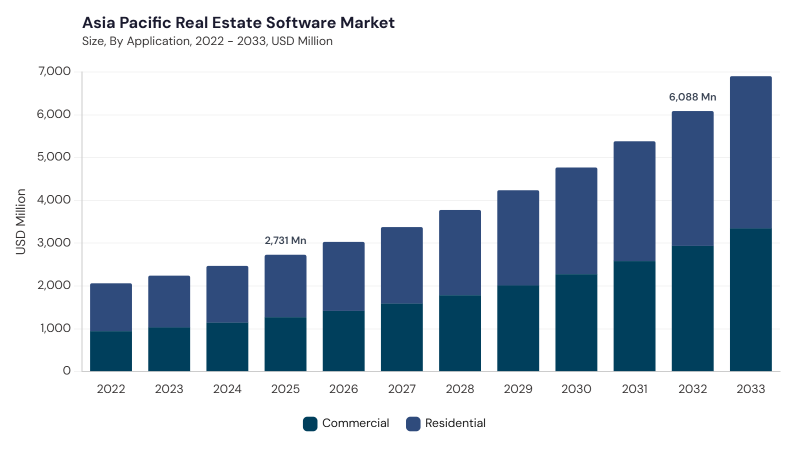
Based on Application, the market is segmented into Residential and Commercial. Residential leads due to rapid urbanization, rising housing demand, growing apartment communities, expanding middle-class buyers, and increasing use of digital platforms for home search, leasing, tenant screening, and rent management. Software adoption is supported by mobile property search, virtual tours, digital payments, automated mortgage tools, AI-based price prediction, and tenant communication platforms.
Commercial applications remain important for office buildings, retail centers, industrial parks, mixed-use projects, and institutional portfolios requiring lease administration, facility management, investment analysis, asset optimization, and space utilization tracking. The segment is further supported by ESG monitoring, cloud collaboration, AI underwriting, and data-driven portfolio risk management.
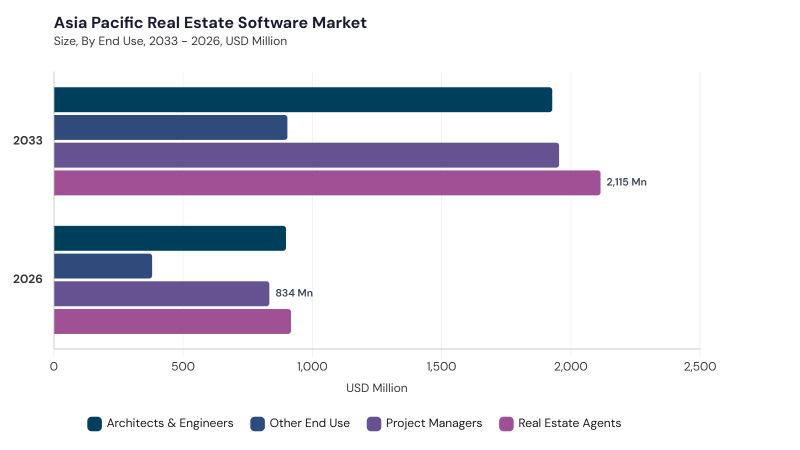
Based on End Use, the market is segmented into Architects & Engineers, Real Estate Agents, Project Managers, and Other End Use. Architects & Engineers lead as infrastructure expansion, urban development, smart city projects, and green building programs increase the use of CAD, BIM, structural analysis, simulation, zoning review, and design collaboration tools. These users rely on software to improve project feasibility, sustainability planning, regulatory documentation, and coordination between design and construction teams.
Real Estate Agents use CRM, listing portals, mobile apps, virtual tours, transaction tracking, and AI-based pricing tools to improve lead conversion and client engagement. Project Managers adopt scheduling, budgeting, document control, risk tracking, digital twins, and cloud-based collaboration tools, while Other End Use includes facility managers, investors, legal teams, financial analysts, landlords, and asset managers.
Free Valuable Insights: Real Estate Software Market is Predicted to reach USD 25.3 Billion billion by 2033, at a CAGR of 11.9%
Based on Country, the market is segmented into China, Japan, India, South Korea, Singapore, Malaysia, and Rest of Asia Pacific. The China market dominated the Asia Pacific Real Estate Software Market by Country in 2025, and would continue to be a dominant market till 2033; thereby, achieving a market value of USD 1.4 billion by 2030, growing at a CAGR of 10.6 % during the forecast period. The Japan market is expected to witness a CAGR of 11.6% during (2026 - 2033). Additionally, The India market is expected to witness a CAGR of 13.1% during (2026 - 2033).
China leads due to its large urban real estate ecosystem, strong PropTech adoption, AI-enabled property platforms, smart building integration, and expanding use of cloud and mobile real estate tools. Japan supports demand through mature property operations, labor-saving automation, AI valuation, cybersecurity-focused platforms, and integrated property lifecycle software. India is growing through RERA-linked compliance needs, mobile-first adoption, cloud platforms, property digitization, and rising demand from developers, brokers, and tier-2 and tier-3 city markets. South Korea, Singapore, and Malaysia add momentum through smart city initiatives, advanced connectivity, cloud adoption, localized PropTech platforms, and IoT-enabled building management, while Rest of Asia Pacific benefits from rising internet penetration and digital real estate transformation.

By Deployment
By Type
By Application
By End Use
By Country
Set to reach $4.8 Billion by 2030, growing at 12.5% CAGR during 2026-2033.
China leads with a market value of USD 1.4 billion by 2030, growing at a CAGR of 10.6% during the forecast period.
Rising demand for cloud deployment, expected to reach USD 3.3 billion by 2030 at 12.1% CAGR during the forecast period.
The on-premise segment is expected to witness a CAGR of 13.4% during 2026-2033.
The Japan market is expected to witness a CAGR of 11.6% during 2026-2033.
Enterprise Resource Planning Software is expected to witness the highest CAGR of 12.8% during 2026-2033.
Our team of dedicated experts can provide you with attractive expansion opportunities for your business.




 Unique Offerings