The sample copy of this report is available for access.
The LAMEA Fruit Beer Market is expected to reach USD 33.7 million by 2029, growing at a CAGR of 6.1% during (2026 – 2033).
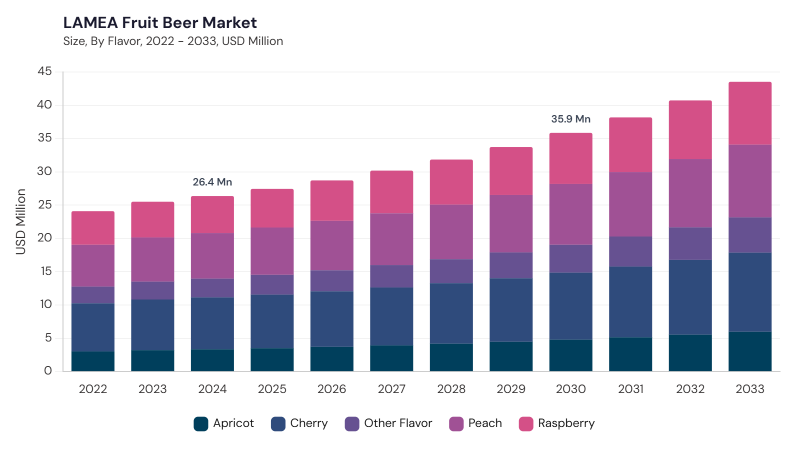
Fruit beer across LAMEA evolved from small-scale artisanal brewing using locally available fruits into a more structured specialty beverage category supported by improved fermentation and quality-control technologies. Early products were mainly experimental alternatives to conventional lagers and ales, while advances in yeast strains, natural fruit extraction, preservation, and brewing consistency enabled wider commercialization. Growing demand for natural, health-oriented, and differentiated beverages encouraged producers to expand flavor diversity and refine product quality. The market now combines regional fruit traditions, craft innovation, modern brewing technology, sustainable sourcing, and increasingly localized product development.
Low-alcohol formulations, indigenous fruit integration, sustainability, and digital engagement are shaping current market development. Brewers are increasingly using natural and organic fruit ingredients, clean-label formulations, reduced additives, and lighter alcohol profiles to appeal to health-conscious consumers. Local fruits such as guava, passion fruit, pomegranate, dates, citrus, and other tropical varieties support regional differentiation, while partnerships with growers improve authenticity and sourcing resilience. Eco-friendly packaging, e-commerce, social media marketing, advanced fermentation, and localized product strategies are further expanding consumer reach across diverse LAMEA markets.
Based on Distribution Channel, the market is segmented into Off-Trade and On-Trade. The Off-Trade market dominated the LAMEA Fruit Beer Market by Distribution Channel in 2025, and would continue to be a dominant market till 2033; thereby, achieving a market value of USD 17.8 million by 2029, growing at a CAGR of 5.7 % during the forecast period. The On-Trade market is expected to witness a CAGR of 6.6% during (2026 - 2033).
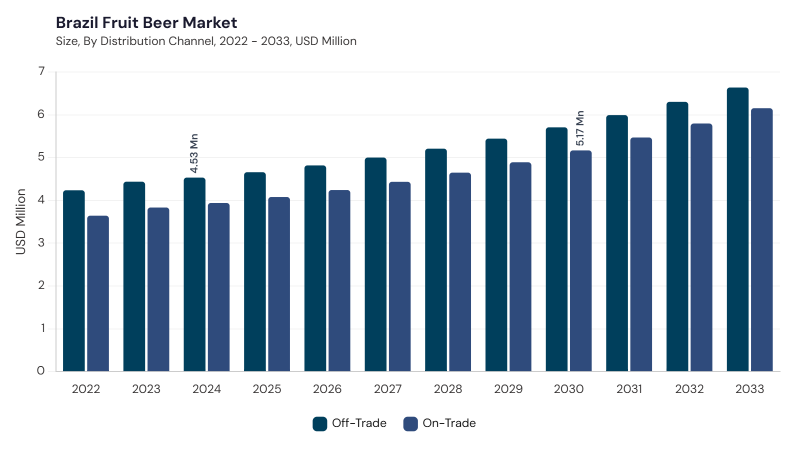
Off-Trade includes supermarkets, grocery chains, liquor stores, specialty retailers, and increasingly digital marketplaces that support home consumption, promotions, and broader geographic accessibility. This channel benefits from expanding e-commerce, mobile ordering, packaged formats, and improving cold-chain logistics. On-Trade comprises bars, restaurants, hotels, nightclubs, craft breweries, entertainment venues, and tourism-oriented hospitality where tastings, food pairings, premium offerings, and social drinking occasions encourage experimentation. The channel is particularly important for brand discovery and experiential engagement with differentiated fruit beer styles.
Based on Flavor, the market is segmented into Cherry, Peach, Raspberry, Apricot, and Other Flavor. Cherry supports distinctive fruit-forward and specialty beer formulations through its recognizable sweet-tart profile. Peach maintains a sizeable presence through its smooth aroma and approachable taste, making it suitable for refreshing and lighter beer styles.
Raspberry contributes stronger tartness, aromatic intensity, and compatibility with sour and craft formulations, while Apricot provides softer stone-fruit characteristics suited to seasonal and premium offerings. Other Flavor includes guava, passion fruit, citrus, pomegranate, date, pineapple, and other regional or tropical fruits that allow producers to create locally relevant and differentiated products.
Free Valuable Insights: Fruit Beer Market Size Worth USD 509.1 Million billion by 2033
Based on Country, the market is segmented into Brazil, Argentina, UAE, Saudi Arabia, South Africa, Nigeria, and Rest of LAMEA. The Brazil market dominated the LAMEA Fruit Beer Market by Country in 2025, and would continue to be a dominant market till 2033; thereby, achieving a market value of USD 10.3 million by 2029, growing at a CAGR of 5.1 % during the forecast period. The Argentina market is expected to witness a CAGR of 6.6% during (2026 - 2033). Additionally, The UAE market is expected to witness a CAGR of 4.6% during (2026 - 2033).
Across LAMEA, fruit beer development is being influenced by local fruit sourcing, craft brewing, health-conscious consumption, sustainability, and digital distribution. Brazil is advancing low-alcohol, tropical fruit, locally sourced, and digitally marketed formulations, while Argentina emphasizes natural ingredients, indigenous fruit combinations, hybrid styles, and sensory innovation. The UAE focuses on premium, lower-alcohol, natural, sustainable, and digitally engaged products, whereas Saudi Arabia emphasizes reduced-alcohol formulations, date and pomegranate-based profiles, local sourcing, and compliant product development. South Africa combines indigenous fruits such as marula and baobab with artisanal brewing and modern quality controls, while Nigeria is expanding natural fruit formulations, sustainable sourcing, digital marketing, and technology-enabled production. Rest of LAMEA continues to develop low-alcohol, clean-label, locally sourced, sustainable, and experimentally fermented fruit beer varieties.

By Distribution Channel
By Flavor
By Country
Set to reach $33.7 Million by 2029, growing at 6.1% CAGR during 2026-2033.
Brazil leads with $10.3 million by 2029, growing at a CAGR of 5.1% during the forecast period.
Off-Trade distribution channel dominates, reaching $17.8 million by 2029, with a CAGR of 5.7% during the forecast period.
The On-Trade market is expected to witness a CAGR of 6.6% during 2026-2033.
The UAE market is expected to witness a CAGR of 4.6% during 2026-2033.
Our team of dedicated experts can provide you with attractive expansion opportunities for your business.




 Unique Offerings