The sample copy of this report is available for access.
The Asia Pacific Fruit Beer Market is expected to reach USD 113.1 million by 2030, growing at a CAGR of 4.9% during (2026 – 2033).
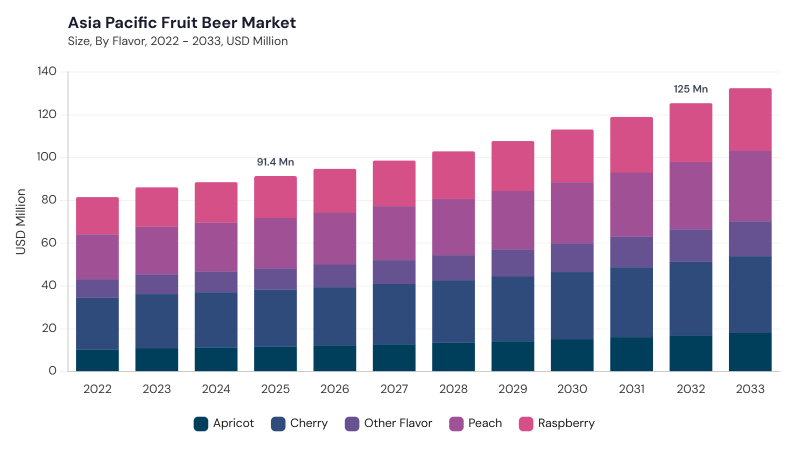
Fruit beer across Asia Pacific evolved from small-scale artisanal brewing using locally available fruits into a broader specialty beverage category supported by modern fermentation and processing technologies. Early producers relied on traditional fruit additions, while improvements in fermentation control, fruit preservation, cold-chain logistics, and brewing efficiency enabled greater consistency and scalability. Rising urbanization, expanding middle-class populations, and growing interest in natural and artisanal beverages accelerated mainstream acceptance. The market now combines regional fruit heritage with advanced brewing methods, flavor experimentation, sustainable sourcing, and increasingly diversified consumer preferences.
Natural ingredients, experimental flavors, frozen fruit utilization, sustainability, and advanced fermentation are shaping current market development. Brewers are emphasizing organic fruits, clean-label formulations, reduced additives, and natural fermentation to align with health-conscious consumption. Frozen fruit is supporting year-round ingredient availability and flavor consistency, while hybrid yeast strains and modern fermentation techniques enable more complex sensory profiles. Indigenous fruits such as yuzu, lychee, mango, passion fruit, and other tropical varieties are strengthening localization, while automation, e-commerce, cold-chain improvements, and sustainable sourcing support wider market penetration.
Based on Distribution Channel, the market is segmented into Off-Trade and On-Trade. The Off-Trade market dominated the Asia Pacific Fruit Beer Market by Distribution Channel in 2025, and would continue to be a dominant market till 2033; thereby, achieving a market value of USD 59.1 million by 2030, growing at a CAGR of 4.5 % during the forecast period. The On-Trade market is expected to witness a CAGR of 5.3% during (2026 - 2033).
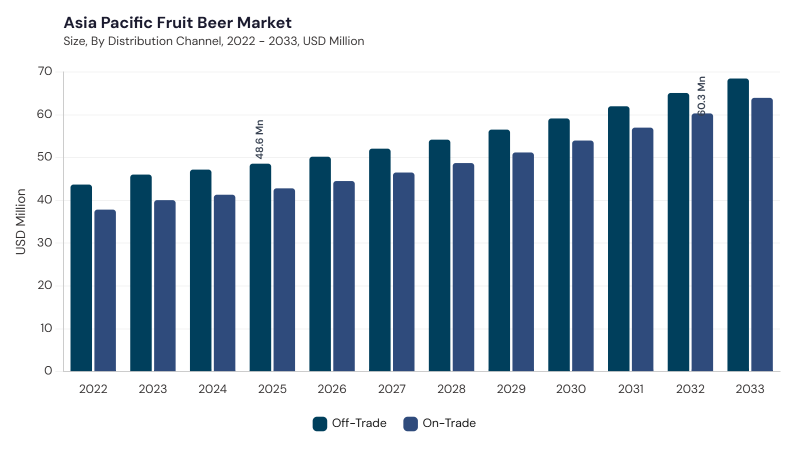
Off-Trade includes supermarkets, hypermarkets, grocery stores, convenience stores, and online platforms that provide broad accessibility and support packaged fruit beer purchases. E-commerce, smaller-format cans, promotional pricing, and improving digital infrastructure are further strengthening this channel across urban and semi-urban markets. On-Trade comprises bars, pubs, restaurants, hotels, nightclubs, craft breweries, and other hospitality venues where experiential consumption, food pairing, limited editions, and premium fruit beer offerings encourage trial. This channel is particularly important for brand discovery and flavor experimentation among younger urban consumers.
Based on Flavor, the market is segmented into Cherry, Peach, Raspberry, Apricot, and Other Flavor. Cherry provides balanced sweetness and tartness that complements craft, sour, and specialty beer formulations. Peach maintains a substantial presence through its mellow aroma, approachable sweetness, and suitability for refreshing and lighter beer styles.
Raspberry supports premium positioning through pronounced berry notes, vibrant color, and compatibility with sour and specialty beers, while Apricot offers a delicate and refined fruit profile for limited releases and artisanal formulations. Other Flavor includes yuzu, lychee, mango, passion fruit, guava, citrus, and other indigenous or tropical fruits that allow producers to differentiate portfolios according to regional palates.
Free Valuable Insights: Fruit Beer Market is Predicted to reach USD 509.1 Million billion by 2033, at a CAGR of 4.3%
Based on Country, the market is segmented into China, Japan, India, South Korea, Singapore, Malaysia, and Rest of Asia Pacific. The China market dominated the Asia Pacific Fruit Beer Market by Country in 2025, and would continue to be a dominant market till 2033; thereby, achieving a market value of USD 35.5 million by 2030, growing at a CAGR of 3.3 % during the forecast period. The Japan market is expected to witness a CAGR of 4.2% during (2026 - 2033). Additionally, The India market is expected to witness a CAGR of 5.7% during (2026 - 2033).
Across Asia Pacific, fruit beer development is being influenced by localization, health-conscious consumption, craft brewing, sustainable sourcing, and digital distribution. China is advancing lower-alcohol, locally inspired, fruit-forward products supported by craft brewing and e-commerce, while Japan emphasizes yuzu, ume and other indigenous fruits, seasonal releases, natural ingredients, and sustainable sourcing. India is developing low-alcohol options, indigenous fruit combinations, digital engagement, and localized production, whereas South Korea focuses on premium fruit beers, natural formulations, local sourcing, and advanced fermentation. Singapore combines tropical fruits, sustainability, e-commerce, and innovative brewing technologies, while Malaysia emphasizes clean-label formulations, indigenous fruits, artisanal batches, and regulatory transparency. Rest of Asia Pacific continues to expand natural, regionally sourced, sustainably produced, digitally distributed, and experimentally fermented fruit beer offerings.

By Distribution Channel
By Flavor
By Country
Set to reach $113.1 Million by 2030, growing at 4.9% CAGR during (2026–2033).
China leads with $35.5 million by 2030, growing at a CAGR of 3.3% during the forecast period.
Rising demand in the Off-Trade segment, reaching $59.1 million by 2030 at a CAGR of 4.5% during the forecast period.
The On-Trade segment is expected to witness a CAGR of 5.3% during (2026–2033).
The India market is expected to witness a CAGR of 5.7% during (2026–2033).
Our team of dedicated experts can provide you with attractive expansion opportunities for your business.




 Unique Offerings