The sample copy of this report is available for access.
The Europe Fruit Beer Market is expected to reach USD 171.1 million by 2031, growing at a CAGR of 3.8% during (2026 – 2033).
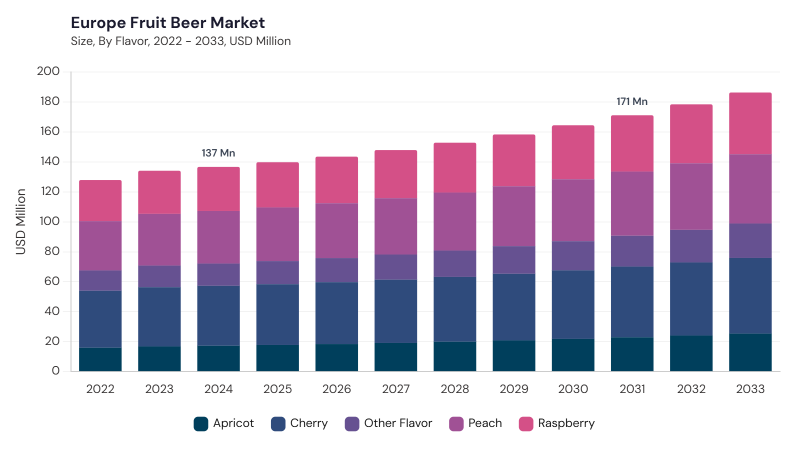
Fruit beer in Europe evolved from centuries-old regional brewing traditions into a broader craft and specialty beverage category combining heritage techniques with modern fermentation science. Early offerings were largely seasonal and artisanal, particularly in fruit-producing regions, while improvements in yeast control, fruit processing, hygiene, and flavor stabilization enabled greater consistency and year-round availability. Growing interest in craft beer and diverse sensory experiences encouraged brewers to move fruit beer beyond niche experimentation. The market now blends traditional brewing identities with contemporary innovation in fruit sourcing, fermentation, quality control, and premium product development.
Natural ingredients, low-alcohol consumption, sustainability, and experimental brewing are shaping current market development. Brewers are increasingly using locally sourced and organic fruits, clean-label formulations, advanced sensory analysis, and improved fermentation techniques to enhance authenticity and quality. Low- and no-alcohol fruit beers are expanding as consumers seek moderation without sacrificing flavor, while hybrid and regionally inspired styles broaden product diversity. Sustainable packaging, local agricultural partnerships, digital marketing, e-commerce, and experiential events are also strengthening consumer engagement and competitive differentiation.
Based on Distribution Channel, the market is segmented into Off-Trade and On-Trade. The Off-Trade market dominated the Europe Fruit Beer Market by Distribution Channel in 2025, and would continue to be a dominant market till 2033; thereby, achieving a market value of USD 89.0 million by 2031, growing at a CAGR of 3.4 % during the forecast period. The On-Trade market is expected to witness a CAGR of 4.2% during (2026 - 2033).
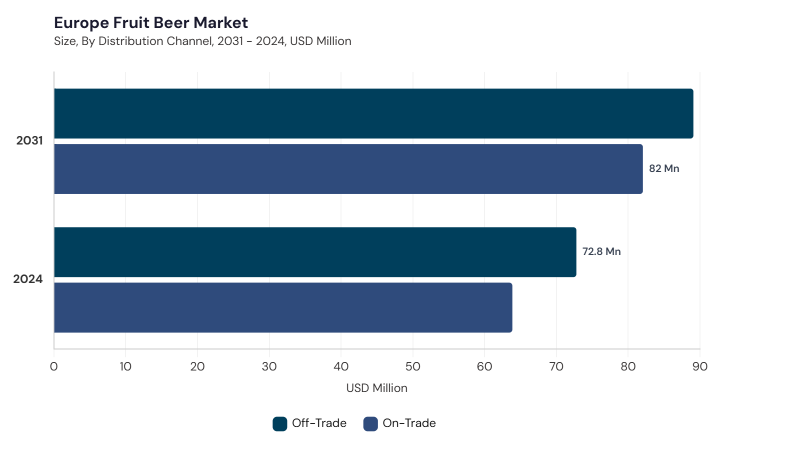
Off-Trade includes supermarkets, convenience stores, specialty retailers, bottle shops, and online platforms that support at-home consumption, wider geographic reach, and larger-volume purchasing. The channel benefits from broader craft beer assortments, seasonal promotions, premium packaging, and increasing digital availability. On-Trade comprises pubs, bars, cafés, restaurants, hotels, brewery taprooms, festivals, and other hospitality venues where tastings, food pairings, limited editions, and traditional fruit beer styles encourage experimentation. The channel plays an important role in brand discovery, storytelling, and premium consumer experiences.
Based on Flavor, the market is segmented into Cherry, Peach, Raspberry, Apricot, and Other Flavor. Cherry remains closely associated with traditional lambic, sour, and specialty beer styles, offering a recognizable balance of tartness, sweetness, and fermentation complexity. Peach provides a softer stone-fruit profile suited to wheat beers, sour styles, and seasonal offerings, while Raspberry contributes pronounced aroma, color, and tartness that complements lambic and mixed-fermentation products.
Apricot supports more delicate farmhouse, saison, and specialty formulations through its fragrant and mellow character. Other Flavor includes plum, blackcurrant, blackberry, citrus, elderberry, apple, and other locally sourced or experimental fruits used to support regional differentiation and portfolio innovation.
Free Valuable Insights: The Worldwide Fruit Beer Market is projected to reach USD 509.1 Million billion by 2033, at a CAGR of 4.3%
Based on Country, the market is segmented into Germany, UK, France, Russia, Spain, Italy, and Rest of Europe. The UK market dominated the Europe Fruit Beer Market by Country in 2025, and would continue to be a dominant market till 2033; thereby, achieving a market value of USD 28.1 million by 2031, growing at a CAGR of 2.1 % during the forecast period. The Germany market is expected to witness a CAGR of 2.7% during (2026 - 2033). Additionally, The France market is expected to witness a CAGR of 4.7% during (2026 - 2033).
Across Europe, fruit beer development is being influenced by moderation, natural ingredients, local sourcing, craft innovation, and digital engagement. Germany emphasizes lower-alcohol formulations, organic and regional fruits, sustainability, and precision brewing, while the UK focuses on natural fruit infusions, eco-friendly sourcing, digital sales, and experimental limited editions. France is advancing lower-alcohol, fruit-forward, clean-label, and terroir-based products, whereas Russia combines natural fruit ingredients, international craft influences, localized flavors, and technology-assisted production. Spain is strengthening low-alcohol offerings, local fruit sourcing, sustainability, and improved fermentation, while Italy blends indigenous fruits, functional positioning, traceability, and artisanal brewing. Rest of Europe continues to expand clean-label, sessionable, locally sourced, and technically differentiated fruit beer varieties.

By Distribution Channel
By Flavor
By Country
Set to reach $171.1 Million by 2031, growing at 3.8% CAGR during 2026-2033.
The UK leads with a market value of $28.1 million by 2031, growing at a 2.1% CAGR during the forecast period.
Rising demand in the Off-Trade channel, reaching $89.0 million by 2031 at 3.4% CAGR during the forecast period.
The On-Trade market is expected to witness a CAGR of 4.2% during 2026-2033.
The France market is expected to witness a CAGR of 4.7% during 2026-2033.
The Germany market is expected to witness a CAGR of 2.7% during 2026-2033.
Our team of dedicated experts can provide you with attractive expansion opportunities for your business.




 Unique Offerings