The sample copy of this report is available for access.
The LAMEA ESG Investing Market is expected to reach USD 9.3 trillion by 2029, growing at a CAGR of 23.2% during (2026 - 2033).
The LAMEA ESG Investing Market originated within the broader movement toward sustainable and responsible investment, where environmental, social, and governance considerations began intersecting with regional socio-economic challenges across Latin America, the Middle East, and Africa. Early adoption was fragmented, as countries and institutional investors operated without unified ESG frameworks due to varied regulatory maturity and market development. Over time, digital platforms, advanced reporting tools, ESG analytics, regulatory disclosure requirements, and improved investor engagement shifted the market from isolated early efforts toward a more cohesive regional ecosystem where ESG integration increasingly supports portfolio management and asset allocation.
Current market growth is shaped by impact-driven investment demand, technological advancement, AI-enabled ESG analytics, regulatory consolidation, and growing use of standardized ESG reporting requirements. Investors are increasingly focusing on tangible social and environmental outcomes, real-time monitoring, region-specific ESG scoring, improved benchmarking, and customized ESG products aligned with local sustainability priorities. Demand is also rising for investment approaches that balance financial returns with climate resilience, social development, governance quality, sustainable infrastructure, and transparent ESG disclosure across LAMEA economies.
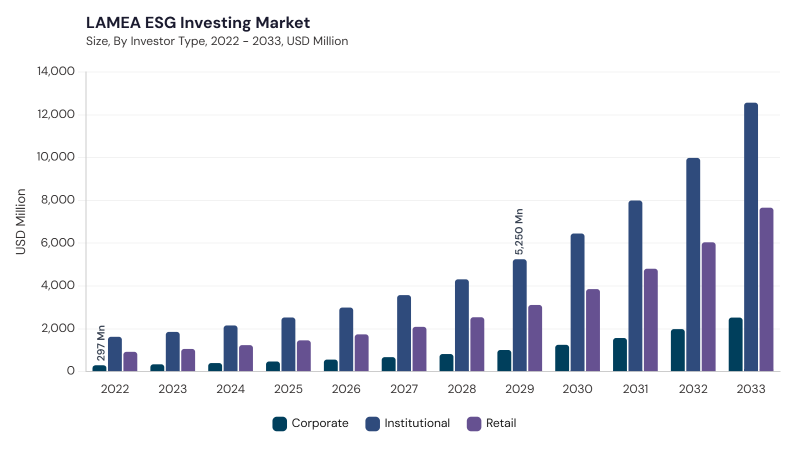
Based on Investor Type, the market is segmented into Institutional, Retail, and Corporate. The Institutional market dominated the LAMEA ESG Investing Market by Investor Type in 2025, and would continue to be a dominant market till 2033; thereby, achieving a market value of USD 5.2 trillion by 2029, growing at a CAGR of 22.8 % during the forecast period. The Retail market is expected to witness a CAGR of 23.6% during (2026 - 2033). The Corporate market is expected to witness a CAGR of 24% during (2026 - 2033).
Institutional investors remain the leading segment as they deploy ESG criteria across equities, fixed income, alternatives, impact investing, active ownership, fiduciary responsibility, green bonds, sustainability-linked loans, and standardized ESG metrics. Retail holds a significant position through mutual funds, ESG ETFs, robo-advisors, digital financial services, responsible investment products, climate-related investments, social impact funds, and rising awareness among urban individual investors. Corporate maintains a promising presence through treasury and investment divisions, sustainable infrastructure projects, green bonds, innovation funds, renewable energy procurement, resource efficiency, transition initiatives, and sustainability-linked financing aligned with stakeholder expectations.
Based on Application, the market is segmented into Integrated ESG, Environmental, Governance, and Social. Integrated ESG remains the leading application as investors incorporate environmental, social, and governance factors into financial analysis, investment selection, portfolio construction, credit assessment, infrastructure financing, equity analysis, and portfolio monitoring. Environmental holds a substantial position through renewable energy, carbon emissions, water scarcity, waste management, biodiversity, pollution prevention, sustainable agriculture, green buildings, climate-resilient infrastructure, and energy-transition projects.
Governance maintains a considerable presence through corporate transparency, board effectiveness, shareholder rights, executive accountability, anti-corruption measures, ownership structures, audit controls, and regulatory compliance. Social represents a promising presence through employment practices, worker safety, human rights, financial inclusion, community development, diversity, healthcare access, education, affordable housing, and inclusive-finance initiatives.
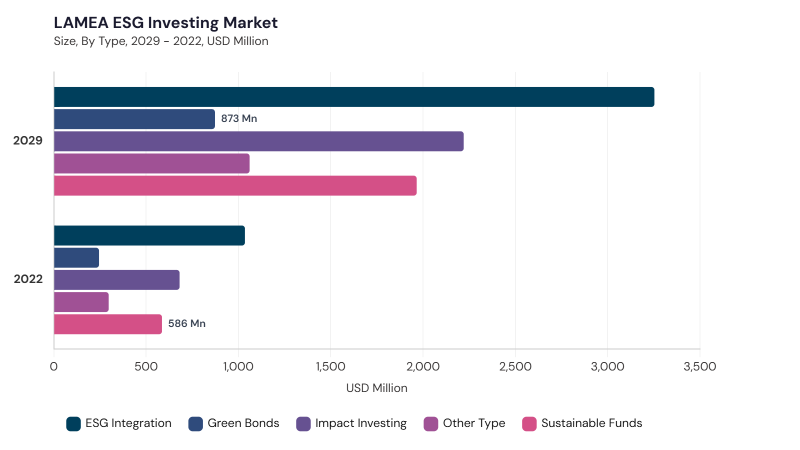
Based on Type, the market is segmented into ESG Integration, Impact Investing, Sustainable Funds, Green Bonds, and Other Type. ESG Integration remains the leading type as investors systematically incorporate ESG factors into traditional investment analysis across equities, fixed income, multi-asset portfolios, risk management, disclosure assessment, corporate governance review, and sustainability reporting. Impact Investing holds a significant position through investments targeting measurable social and environmental outcomes across renewable energy, social enterprises, affordable housing, community development, healthcare access, education, clean energy, sustainable food systems, and essential infrastructure.
Sustainable Funds maintain a considerable presence through mutual funds, ETFs, index funds, ESG-themed vehicles, clean technology, agriculture, financial services, ESG indices, and digital distribution platforms. Green Bonds hold a noteworthy role through debt financing for renewable energy infrastructure, pollution control, sustainable urban development, low-carbon projects, water systems, cleaner transportation, efficient buildings, and climate-resilient infrastructure. Other Type includes transition finance, sustainability-linked instruments, blended-finance structures, thematic investing, exclusionary screening, social bonds, water security, gender equality, and specialized investment approaches suited to varied LAMEA development needs.
Free Valuable Insights: ESG Investing Market Size Worth USD 149.1 Trillion billion by 2033
Based on Country, the market is segmented into Brazil, Chile, UAE, Saudi Arabia, South Africa, Nigeria, and Rest of LAMEA. The Brazil market dominated the LAMEA ESG Investing Market by Country in 2025, and would continue to be a dominant market till 2033; thereby, achieving a market value of USD 2.9 trillion by 2029, growing at a CAGR of 21.9 % during the forecast period. The Chile market is expected to witness a CAGR of 24.7% during (2026 - 2033). Additionally, The UAE market is expected to witness a CAGR of 21.4% during (2026 - 2033).
Brazil is shaped by sustainable finance guidelines, ESG disclosure requirements, climate-related strategies, social and governance factors, Amazon conservation, renewable energy transition, and localized ESG analytics, while Chile reflects mandatory ESG disclosures, pension fund ESG mandates, green bond expansion, AI-powered ESG analytics, indigenous rights, and corporate governance reform. The UAE is supported by international ESG alignment, mandatory disclosure emphasis, AI-powered risk assessment, renewable energy, sustainable infrastructure, community development, and its regional sustainable finance ambitions, whereas Saudi Arabia is driven by Vision 2030, Islamic finance alignment, green finance instruments, AI-enabled risk detection, governance standards, social-linked securities, and ESG product diversification. South Africa is advancing through JSE-linked ESG reporting, responsible investment demand, green financial instruments, AI-enabled ESG data management, blockchain traceability, energy transition, and inclusive economic development; Nigeria is influenced by AI-driven green finance analytics, enhanced disclosure regulation, sustainable entrepreneurship, SME impact financing, governance improvement, and localized ESG solutions; and Rest of LAMEA is shaped by regulatory disclosure momentum, region-specific ESG products, AI and blockchain verification, water scarcity, labor standards, governance reform, and localized sustainability priorities.

By Investor Type
By Application
By Type
By Country
Set to reach $9.3 Trillion by 2029, growing at 23.2% CAGR during 2026-2033.
Brazil leads with $2.9 trillion by 2029, growing at 21.9% CAGR during 2026-2033.
Institutional investments dominate, reaching $5.2 trillion by 2029, with a 22.8% CAGR during 2026-2033.
Retail segment expected to grow at 23.6% CAGR during 2026-2033.
The UAE market is expected to witness a CAGR of 21.4% during 2026-2033.
Corporate segment expected to grow at 24% CAGR during 2026-2033.
Our team of dedicated experts can provide you with attractive expansion opportunities for your business.




 Unique Offerings
