The sample copy of this report is available for access.
“Global ESG Investing Market to reach a market value of USD 149192.40 Million by 2033 growing at a CAGR of %”
The Global ESG Investing Market is expected to reach USD 149.1 trillion by 2033, growing at a CAGR of 22.4% during (2026 - 2033).
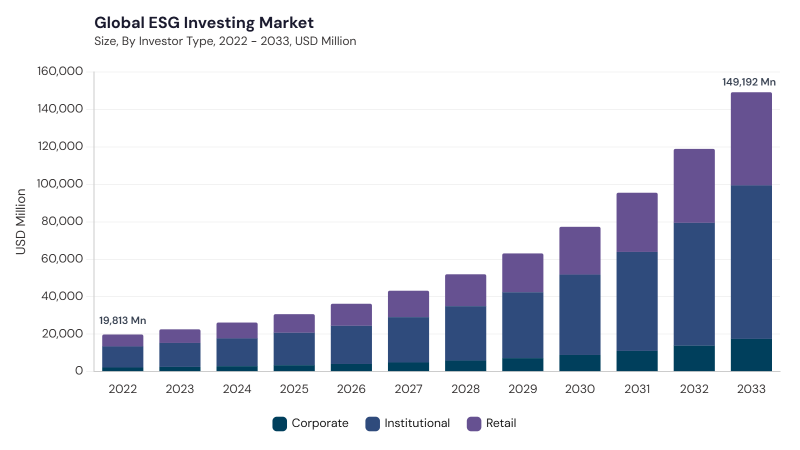
ESG investing is gaining stronger acceptance as environmental, social, and governance factors become central to investment strategy, portfolio construction, and institutional decision-making. Asset managers, banks, corporations, pension funds, insurers, and individual investors are increasingly assessing climate risk, governance standards, sustainability performance, responsible business practices, and long-term portfolio resilience before allocating capital. Market growth is further supported by disclosure requirements, demand for transparent ESG data, and rising preference for responsible investment products.
Increasing regulatory focus on ESG disclosure, rising corporate accountability, and growing investor demand for long-term risk mitigation are strengthening the ESG Investing Market. Governments and financial regulators are pushing companies and investors toward more transparent sustainability reporting, improving confidence in ESG-related decisions. Technology is also accelerating market growth as artificial intelligence, big data analytics, and blockchain improve ESG data collection, verification, scoring, and reporting. Institutional investors are increasingly treating ESG factors as financially material inputs for portfolio resilience rather than purely ethical considerations. Retail investors are also gaining access to ESG products through digital platforms and ETFs, expanding the addressable investor base. As impact measurement improves, capital allocation is shifting toward strategies that combine financial returns with measurable environmental and social outcomes.
Competition in the ESG Investing Market is shaped by data quality, investment performance, regulatory alignment, impact measurement, and product differentiation. Large global asset managers compete through broad ESG platforms, proprietary analytics, stewardship programs, sustainable funds, green bonds, and transition-focused investment strategies. Regional specialists differentiate through local regulatory expertise, thematic knowledge, and targeted sustainability products. Strategic partnerships with data providers, technology companies, and regulatory advisors are becoming important as ESG requirements become more complex. Competitive intensity is also increasing as firms invest in AI-enabled analytics, customized reporting, and private-market ESG solutions. Overall, the market is evolving toward deeper product sophistication, stronger transparency, and greater integration of ESG factors across mainstream investment workflows.


The ESG Investing Market is moderately competitive, with large asset managers, investment technology providers, ESG-focused fund managers, and responsible-investment specialists competing across institutional, retail, and corporate investor groups. Amundi, BlackRock, State Street Investment Management, BNP Paribas Asset Management, UBS Asset Management, Robeco, Allianz Global Investors, Nordea Asset Management, DWS Group, and J.P. Morgan Asset Management maintain strong positions through sustainable funds, ESG integration, stewardship, climate strategies, impact products, and responsible-investment research. Competition is increasingly shaped by proprietary ESG methodologies, regulatory reporting capability, thematic sustainability expertise, and multi-asset implementation. Firms with stronger data infrastructure, transparent impact reporting, and global distribution networks are better positioned to capture institutional and retail ESG demand.
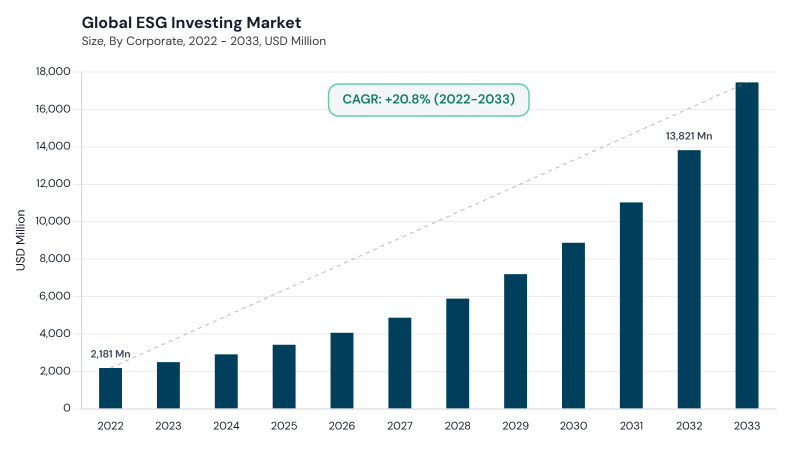
Based on investor type, the market is segmented into Institutional, Retail, and Corporate. The Institutional market dominated the Global ESG Investing Market by Investor Type in 2025, and would continue to be a dominant market till 2033; thereby, achieving a market value of USD 81.9 trillion by 2033, growing at a CAGR of 22 % during the forecast period. The Retail market is expected to witness a CAGR of 22.8% during (2026 - 2033). The Corporate market is expected to witness a CAGR of 23.1% during (2026 - 2033).
Institutional investors include pension funds, insurers, sovereign funds, asset managers, and other large investors integrating ESG factors into portfolio construction, fiduciary oversight, and long-term risk management. Retail investors are adopting ESG investing through mutual funds, ETFs, digital investment platforms, sustainability ratings, and advisor-led portfolio solutions. Corporate participation is linked to responsible treasury strategies, sustainability-linked investments, decarbonization commitments, and broader corporate governance objectives. Institutional investors generally require advanced ESG analytics, reporting frameworks, and stewardship capabilities, while retail investors prioritize accessible products and transparent sustainability claims. Corporate users focus on alignment with internal sustainability goals and investor-relations requirements. Across all investor types, demand is shaped by trust in ESG data, regulatory clarity, investment performance, and credible measurement of sustainability outcomes.
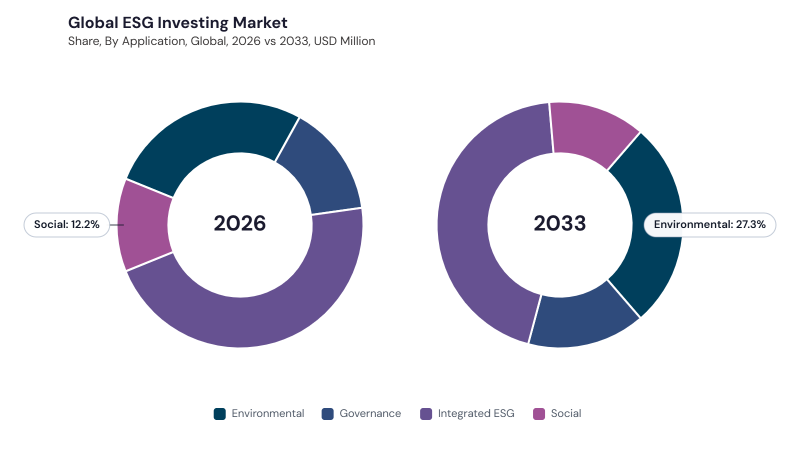
Based on application, the market is segmented into Integrated ESG, Environmental, Governance, and Social. The Integrated ESG market dominated the Global ESG Investing Market by Application in 2025, and would continue to be a dominant market till 2033; thereby, achieving a market value of USD 66.2 trillion by 2033, growing at a CAGR of 21.8 % during the forecast period. The Environmental market is expected to witness a CAGR of 22.6% during (2026 - 2033). Additionally, The Governance market is expected to witness highest CAGR of 23.3% during (2026 - 2033).
Integrated ESG reflects the combined use of environmental, social, and governance factors within financial analysis, valuation, portfolio screening, and risk assessment. Environmental applications focus on climate transition, renewable energy, resource efficiency, pollution reduction, clean technologies, and decarbonization strategies. Governance applications emphasize board independence, shareholder rights, executive accountability, business ethics, transparency, and reporting quality. Social applications cover workforce practices, diversity, human rights, community impact, health and safety, and supply-chain responsibility. The application mix shows that ESG investing is no longer limited to environmental themes, as investors increasingly evaluate governance quality and social exposure alongside climate-related risks. Stronger disclosure standards and analytics tools are helping investors compare these application areas more systematically. As ESG strategies mature, application-level differentiation is expected to depend on materiality, data reliability, and measurable investment outcomes.
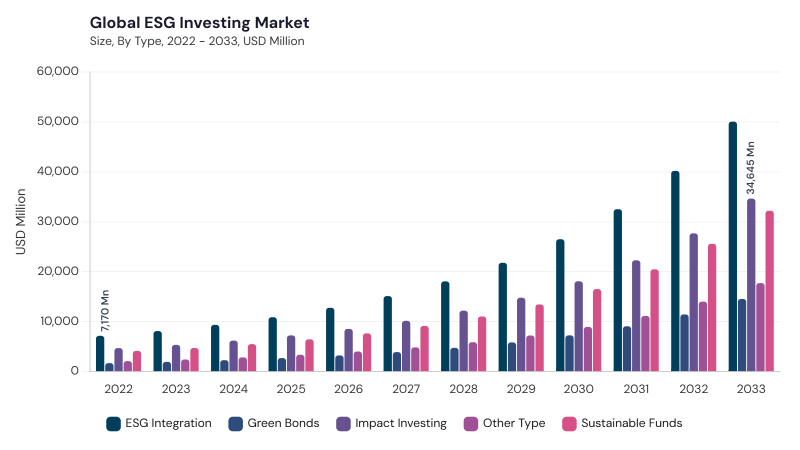
Based on type, the market is segmented into ESG Integration, Impact Investing, Sustainable Funds, Green Bonds, and Other Type. The ESG Integration market dominated the Global ESG Investing Market by Type in 2025, and would continue to be a dominant market till 2033; thereby, achieving a market value of USD 50.0 trillion by 2033, growing at a CAGR of 21.5 % during the forecast period. The Impact Investing market is expected to witness a CAGR of 22.1% during (2026 - 2033). Additionally, The Sustainable Funds market is expected to witness highest CAGR of 22.8% during (2026 - 2033).
ESG Integration involves embedding ESG indicators into investment research, valuation models, risk frameworks, and portfolio decision-making. Impact Investing focuses on measurable environmental and social outcomes alongside financial returns, requiring stronger reporting and outcome-tracking frameworks. Sustainable Funds include ESG-focused mutual funds, ETFs, and other pooled investment products designed for investors seeking responsible exposure across asset classes. Green Bonds support financing for renewable energy, clean infrastructure, energy efficiency, climate adaptation, and other environmentally focused projects. Other Type includes specialized sustainability-oriented products and strategies addressing evolving investor mandates, thematic opportunities, and regulatory requirements. These types reflect the broadening of ESG investing from screening-based approaches toward multi-asset, outcome-oriented, and transition-focused capital allocation. Product development is increasingly shaped by transparency, classification rules, stewardship expectations, and investor demand for credible ESG claims.
Free Valuable Insights: ESG Investing Market Size to reach $149.1 Trillion by 2033
Region-wise, the ESG Investing Market is analyzed across North America, Europe, Asia Pacific, and LAMEA. The North America market dominated the Global ESG Investing Market by Region in 2025, and would continue to be a dominant market till 2033; thereby, achieving a market value of USD 52.3 trillion by 2033, growing at a CAGR of 21.8 % during the forecast period. The Europe market is expected to witness a CAGR of 22.2% during (2026 - 2033). Additionally, The Asia Pacific market is expected to witness a CAGR of 23.1% during (2026 - 2033).
North America is supported by strong institutional investor participation, ESG product expansion, stewardship activity, and increasing focus on climate and governance risk. Europe remains highly influential due to sustainability disclosure rules, taxonomy-linked investment practices, and mature responsible-investment frameworks. Asia Pacific is gaining momentum through regulatory development, rising sustainable finance initiatives, green bond issuance, and growing demand from institutional and retail investors. LAMEA is developing through climate finance, social-impact priorities, governance reforms, and increasing policy support for sustainable capital flows. Across regions, market growth is shaped by ESG data quality, local disclosure rules, investor education, greenwashing concerns, and the ability of firms to adapt global ESG frameworks to regional priorities.
| Report Attribute | Details |
|---|---|
| Market size value in 2026 | USD 36.2 trillion |
| Market size forecast in 2033 | USD 149.1 trillion |
| Base Year | 2025 |
| Historical Period | 2022 to 2024 |
| Forecast Period | 2026 to 2033 |
| Revenue Growth Rate | CAGR of 22.4% from 2026 to 2033 |
| Number of Pages | XX |
| Tables | XX |
| Report Coverage | Market Trends, Revenue Estimation and Forecast, Segmentation Analysis, Regional and Country Breakdown, Competitive Landscape, Market Share Analysis, Company Profiling, Companies Strategic Developments, SWOT Analysis, Product Life Cycle Analysis, Value Chain Analysis, Market Consolidation Analysis, Key Customer Criteria, Pandemic Impact Analysis, and Winning Imperatives |
| Segments Covered | Investor Type, Application, Type, and Geography |
| Country Scope |
|
| Companies Included | Amundi; BlackRock; State Street Investment Management; BNP Paribas Asset Management; UBS Asset Management; Robeco; Allianz Global Investors; Nordea Asset Management; DWS Group; J.P. Morgan Asset Management |
By Investor Type
By Application
By Type
By Geography
Expected to reach USD 149.1 trillion by 2033, growing at 22.4% CAGR during 2026-2033.
The ESG investing market grows at 22.4% CAGR during the forecast period (2026-2033).
Amundi, BlackRock, State Street Investment Management, BNP Paribas, UBS, Robeco, Allianz, Nordea, DWS, J.P. Morgan.
Sustainable regulatory frameworks and increasing corporate accountability boost investor confidence.
Technological advancements in ESG data analytics enhance market growth.
The ESG investing market is projected to reach USD 149.1 trillion by 2033.
Our team of dedicated experts can provide you with attractive expansion opportunities for your business.






 Unique Offerings
