The sample copy of this report is available for access.
The Europe ESG Investing Market is expected to reach USD 24.2 trillion by 2031, growing at a CAGR of 22.2% during (2026 - 2033).
The Europe ESG Investing Market originated in the early 2000s as environmental, social, and governance issues began influencing investor priorities alongside traditional financial metrics. Initial development centered on socially responsible investing, which expanded as European regulatory frameworks advanced around sustainability and corporate accountability. Over time, advanced analytics, big data, artificial intelligence, SFDR, taxonomy frameworks, and mandatory ESG disclosure initiatives shifted ESG investing from a niche strategy into a mainstream component of asset allocation, portfolio construction, and risk management.
Current market growth is shaped by technology-driven ESG data analytics, regulatory standardization, impact investing, sustainable finance frameworks, and demand for measurable societal outcomes. Investors are increasingly using AI-enabled data platforms, proprietary ESG scoring models, alternative data sources, blockchain-enabled transparency tools, and machine learning to assess ESG performance with greater precision. Demand is also rising for ESG products that improve disclosure quality, reduce greenwashing risk, support regulatory alignment, and direct capital toward environmental and social impact across Europe.
Based on Investor Type, the market is segmented into Institutional, Retail, and Corporate. The Institutional market dominated the Europe ESG Investing Market by Investor Type in 2025, and would continue to be a dominant market till 2033; thereby, achieving a market value of USD 13.4 trillion by 2031, growing at a CAGR of 21.8 % during the forecast period. The Retail market is expected to witness a CAGR of 22.6% during (2026 - 2033). The Corporate market is expected to witness a CAGR of 22.9% during (2026 - 2033).
Institutional investors remain the leading segment as they use ESG equities, fixed income, green bonds, alternative assets, proxy voting, stewardship programs, ESG analytics, risk platforms, climate scenario analysis, and transition-risk evaluation across large portfolios. Retail holds a significant position through ESG-themed mutual funds, ETFs, digital investment platforms, robo-advisors, sustainability-oriented savings products, ESG-focused apps, and growing demand from values-driven individual investors. Corporate maintains a promising presence through treasury departments, corporate pension schemes, green bonds, sustainability-linked loans, corporate asset allocation, non-financial reporting, carbon neutrality pledges, and ESG-aligned capital deployment.
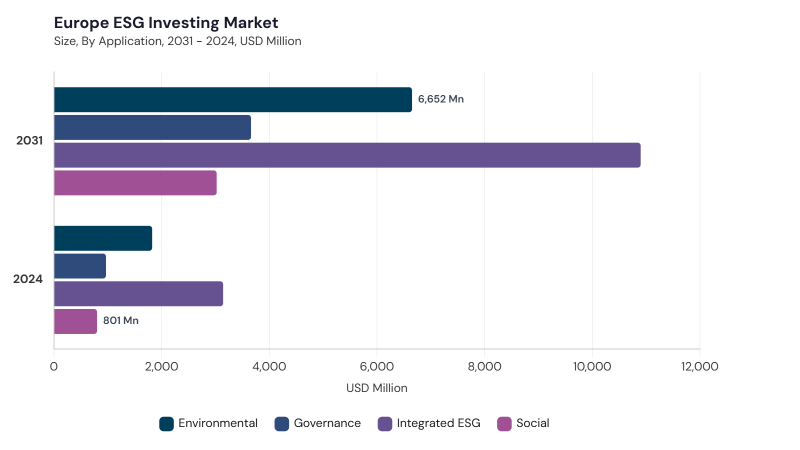
Based on Application, the market is segmented into Integrated ESG, Environmental, Governance, and Social. Integrated ESG remains the leading application as investors embed environmental, social, and governance factors into portfolio construction, security selection, risk assessment, investment monitoring, stewardship, and engagement with portfolio companies. Environmental holds a substantial position through climate change, greenhouse gas emissions, renewable energy, biodiversity, pollution reduction, circular economy practices, water management, green bonds, renewable infrastructure funds, and climate transition strategies.
Governance maintains a considerable presence through board independence, shareholder rights, executive compensation, corporate ethics, audit practices, risk oversight, stewardship policies, proxy voting, and sustainability oversight. Social represents a promising presence through labor conditions, human rights, workplace safety, diversity and inclusion, supply-chain standards, community relationships, data privacy, affordable housing, healthcare, education, and social-impact investment approaches.
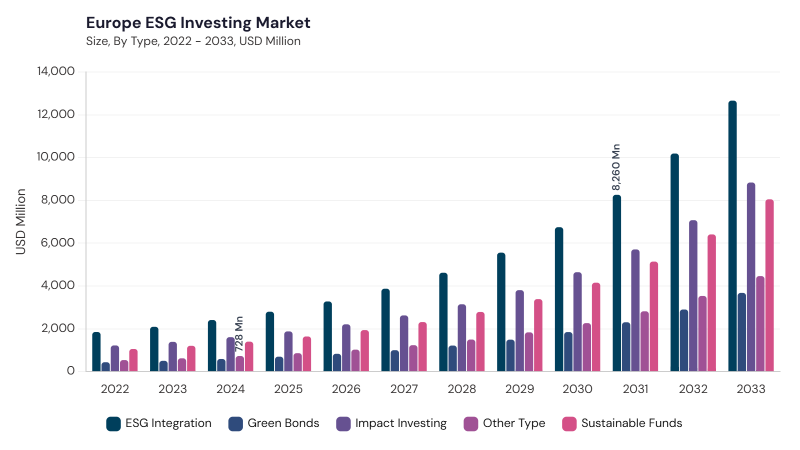
Based on Type, the market is segmented into ESG Integration, Impact Investing, Sustainable Funds, Green Bonds, and Other Type. ESG Integration remains the leading type as investors systematically apply environmental, social, and governance factors across equities, fixed income, alternatives, financial analysis, portfolio construction, risk mitigation, SFDR-aligned disclosure, and AI-enabled ESG data aggregation. Impact Investing holds a significant position through investments targeting measurable social or environmental benefits across renewable energy, affordable housing, social enterprises, specialized bonds, private equity, venture capital, and SDG-aligned outcomes.
Sustainable Funds maintain a considerable presence through collective investment vehicles, thematic funds, best-in-class approaches, ESG screening, clean technology, resource efficiency, social inclusion, digital advisory platforms, and net-zero aligned strategies. Green Bonds hold a noteworthy role through financing for renewable energy, energy efficiency, clean transportation, water management, climate adaptation, sovereign issuances, municipal issuances, and corporate issuances. Other Type includes transition-oriented instruments, sustainability-linked strategies, social bonds, norms-based screening, exclusionary strategies, thematic investments, circular economy strategies, and other specialized responsible-investment approaches.
Free Valuable Insights: The Worldwide ESG Investing Market is projected to reach USD 149.1 Trillion billion by 2033, at a CAGR of 22.4%
Based on Country, the market is segmented into Germany, UK, France, Netherlands, Spain, Italy, and Rest of Europe. The UK market dominated the Europe ESG Investing Market by Country in 2025, and would continue to be a dominant market till 2033; thereby, achieving a market value of USD 6.7 trillion by 2031, growing at a CAGR of 21 % during the forecast period. The Germany market is expected to witness a CAGR of 21.2% during (2026 - 2033). Additionally, The France market is expected to witness a CAGR of 23% during (2026 - 2033).
Germany is shaped by SFDR-driven transparency, energy transition, low-carbon investment flows, renewable infrastructure, AI-powered ESG analytics, and blockchain-enabled sustainability tracking, while the UK reflects exclusionary-screening roots, non-financial disclosure mandates, AI and machine learning, stewardship, shareholder activism, and proprietary ESG scoring models. France is supported by regulatory alignment, climate-risk mitigation, low-carbon allocation, renewable-sector investment, AI-enabled ESG reporting, and active shareholder engagement. The Netherlands is influenced by regulatory complexity, internal ESG audits, supply-chain ESG assessment tools, impact-driven strategies, advanced analytics, and real-time monitoring, whereas Spain is advancing through AI-enabled ESG data analysis, stricter EU and Spanish disclosure frameworks, localized sustainable investments, renewable energy, circular economy initiatives, and social inclusion programs. Italy is driven by EU taxonomy alignment, ESG disclosure mandates, predictive ESG analytics, investor activism, climate-change thematic funds, social inclusion, and transparent reporting, while Rest of Europe is shaped by EU-wide sustainability reporting, impact investing, green bonds, AI-driven ESG scoring, big data integration, active ownership, and localized ESG strategies.

By Investor Type
By Application
By Type
By Country
Set to reach $24.2 Trillion by 2031, growing at 22.2% CAGR during 2026-2033.
The UK leads with $6.7 trillion by 2031, growing at 21% CAGR during the forecast period.
Institutional investments dominate, reaching $13.4 trillion by 2031, with a 21.8% CAGR during 2026-2033.
The Retail segment will grow at a 22.6% CAGR during 2026-2033.
Germany is expected to grow at a 21.2% CAGR during 2026-2033.
The Corporate segment will grow at a 22.9% CAGR during 2026-2033.
Our team of dedicated experts can provide you with attractive expansion opportunities for your business.




 Unique Offerings
