The sample copy of this report is available for access.
The Asia Pacific ESG Investing Market is expected to reach USD 18.5 trillion by 2030, growing at a CAGR of 23.1% during (2026 - 2033).
The Asia Pacific ESG Investing Market originated as a response to growing global awareness of environmental, social, and governance issues, with early development driven by international frameworks and investor demand for sustainable investment options. Initial adoption was gradual due to varying regulatory maturity and market readiness across regional economies, with early emphasis placed mainly on environmental concerns. Over time, big data analytics, AI-enabled ESG scoring, stricter disclosure requirements, regional sustainability frameworks, green bonds, and ESG-themed funds shifted the market from disparate compliance-driven efforts toward a more sophisticated ecosystem based on data-driven analysis, regulatory alignment, and investor activism.
Current market growth is shaped by regulatory harmonization, advanced data analytics, artificial intelligence, thematic investing, impact investing, and growing demand for measurable environmental and social outcomes. Asset managers and investors are increasingly using ESG quant models, customized portfolio construction, real-time data feeds, proprietary scoring methods, blockchain-enabled transparency, and machine learning to improve risk profiling and investment decision-making. Demand is also rising for localized ESG solutions that align with country-specific regulations, investor preferences, sustainable development goals, and regional priorities such as renewable energy, clean technology, social infrastructure, and resilient development.
Based on Investor Type, the market is segmented into Institutional, Retail, and Corporate. The Institutional market dominated the Asia Pacific ESG Investing Market by Investor Type in 2025, and would continue to be a dominant market till 2033; thereby, achieving a market value of USD 10.3 trillion by 2030, growing at a CAGR of 22.7 % during the forecast period. The Retail market is expected to witness a CAGR of 23.6% during (2026 - 2033). The Corporate market is expected to witness a CAGR of 23.9% during (2026 - 2033).
Institutional investors remain the leading segment as they deploy ESG strategies across equities, fixed income, alternative assets, environmental risk assessment, social impact review, governance standards, engagement with portfolio companies, regulatory compliance, and dynamic portfolio adjustment using advanced ESG analytics. Retail holds a significant position through mutual funds, ETFs, robo-advisory platforms, digital wealth channels, responsible investing awareness, ESG-themed products, mobile apps, AI-based advisory tools, and younger demographics seeking transparent and low-cost sustainable investment options. Corporate maintains a promising presence through treasury management, strategic sustainability investments, ESG-aligned securities, green bonds, sustainability-linked loans, energy efficiency, sustainable supply chains, social responsibility projects, and capital allocation aligned with emerging sustainability regulations.
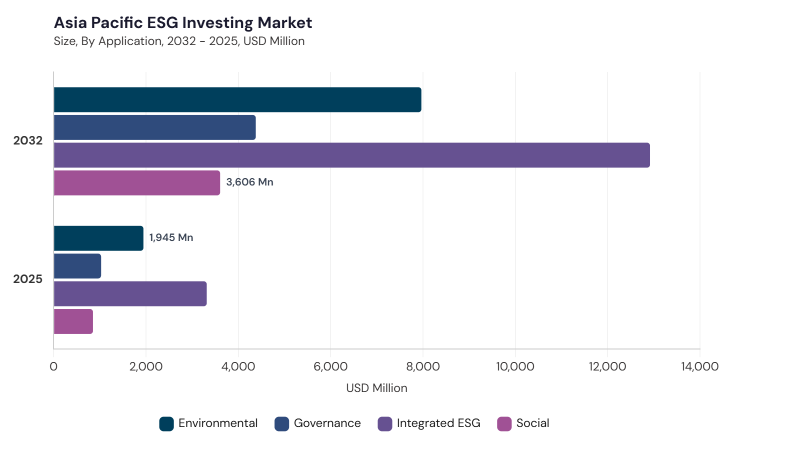
Based on Application, the market is segmented into Integrated ESG, Environmental, Governance, and Social. Integrated ESG remains the leading application as investors incorporate sustainability considerations into nonfinancial analysis, ESG risk scoring, due diligence, portfolio construction, credit assessment, equity research, and long-term risk evaluation. Environmental holds a substantial position through renewable power expansion, electric mobility, cleaner industrial processes, climate adaptation, energy-system modernization, sustainable infrastructure, green buildings, clean technology, water infrastructure, and low-carbon projects.
Governance maintains a considerable presence through ownership transparency, board effectiveness, minority shareholder protection, corporate accountability, stronger risk controls, governance metrics, stewardship practices, and regulatory-risk mitigation. Social represents a promising presence through labor conditions, workforce development, financial inclusion, community impact, responsible sourcing, social infrastructure, accessible healthcare, sustainable agriculture, education access, and supply-chain responsibility.
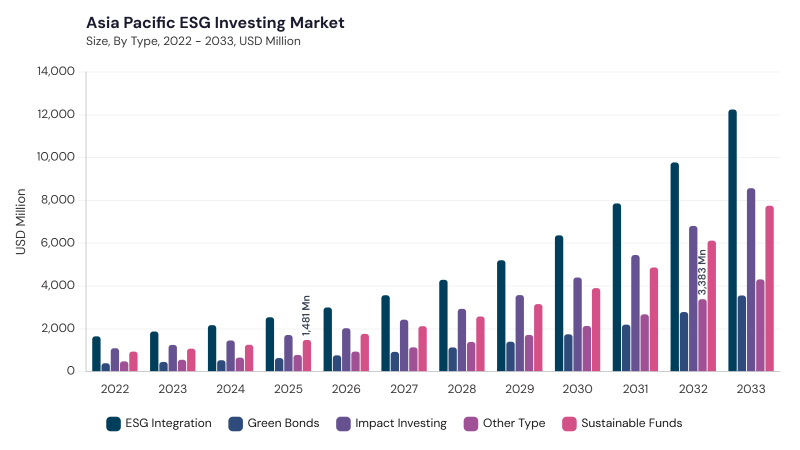
Based on Type, the market is segmented into ESG Integration, Impact Investing, Sustainable Funds, Green Bonds, and Other Type. ESG Integration remains the leading type as investors systematically incorporate environmental, social, and governance factors into traditional financial analysis across equities, fixed income, portfolio construction, ESG scoring, third-party research, and multi-factor risk models. Impact Investing holds a significant position through measurable positive outcomes across renewable energy, social housing, community development, financial inclusion, accessible healthcare, sustainable agriculture, clean technology, and resilient infrastructure.
Sustainable Funds maintain a considerable presence through mutual funds, ETFs, ESG-screened portfolios, thematic funds, clean energy strategies, water-resource funds, ESG benchmarks, sustainable product labeling, and digital reporting platforms. Green Bonds hold a noteworthy role through fixed-income financing for renewable energy, energy efficiency, water management, pollution control, sustainable transport, green buildings, sovereign green bonds, corporate green bonds, and climate-action projects. Other Type includes transition finance, sustainability-linked instruments, social bonds, sustainability-linked loans, climate-focused strategies, engagement-based investing, ESG derivatives, and locally tailored responsible-investment structures.
Free Valuable Insights: ESG Investing Market is Predicted to reach USD 149.1 Trillion billion by 2033, at a CAGR of 22.4%
Based on Country, the market is segmented into China, Japan, India, South Korea, Singapore, Australia, and Rest of Asia Pacific. The China market dominated the Asia Pacific ESG Investing Market by Country in 2025, and would continue to be a dominant market till 2033; thereby, achieving a market value of USD 5.5 trillion by 2030, growing at a CAGR of 21.2 % during the forecast period. The Japan market is expected to witness a CAGR of 22.3% during (2026 - 2033). Additionally, The India market is expected to witness a CAGR of 24.1% during (2026 - 2033).
China is shaped by green finance, carbon-neutrality alignment, AI-driven ESG scoring, blockchain-enabled verification, localized ESG integration, and regulatory disclosure tightening, while Japan reflects ESG disclosure mandates, fixed-income ESG instruments, green and sustainability bonds, active stewardship, pension fund participation, and data-driven ESG evaluation. India is supported by disclosure guidelines, localized ESG assessment models, AI-driven scoring, thematic funds, renewable energy, social inclusion, governance enhancement, and blockchain-enabled transparency. South Korea is advancing through sustainability reporting, stewardship codes, AI-based ESG scoring, diversity and labor-practice scrutiny, social governance themes, and institutional participation, whereas Singapore is influenced by mandatory ESG disclosure emphasis, green finance instruments, impact investing, AI-enabled analytics, private wealth participation, and its role as a regional ESG hub. Australia is progressing through climate-focused products, green bonds, sustainable index funds, biodiversity and water-resource considerations, AI-enabled analytics, and blockchain-backed ESG verification, while Rest of Asia Pacific is shaped by regulatory standardization, local ESG rating agencies, green bonds, impact-focused equity funds, AI-driven ESG scoring, big data integration, and region-specific social and environmental priorities.

By Investor Type
By Application
By Type
By Country
Set to reach $18.5 Trillion by 2030, growing at 23.1% CAGR during 2026-2033.
China leads with a market value of USD 5.5 trillion by 2030, growing at a 21.2% CAGR during 2026-2033.
The Institutional segment will achieve USD 10.3 trillion by 2030, growing at a 22.7% CAGR during 2026-2033.
The Retail market is expected to witness a CAGR of 23.6% during 2026-2033.
The India market is expected to witness a CAGR of 24.1% during 2026-2033.
Our team of dedicated experts can provide you with attractive expansion opportunities for your business.




 Unique Offerings
